Translation of the instructions can be
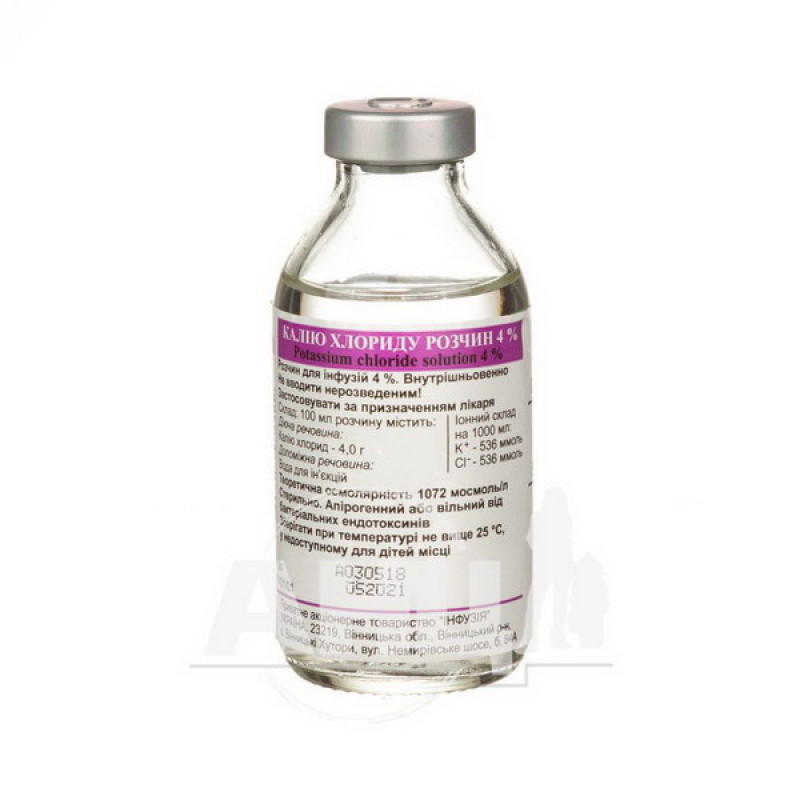
POTASSIUM CHLORIDE SOLUTION 4% solution for infusions 4%
Instruction
For medical use of the medicinal product
Potassium chloride solution 4%
(Potassium chloride solution 4%)
Composition:
Active ingredient: potassium chloride;
100 ml of solution contain 4.0 g of potassium chloride;
ionic composition per 1000 ml of the drug: K + - 536 mmol, Cl ¯ - 536 mmol;
excipient: water for injections.
Dosage form.
Solution for infusion.
Main physicochemical properties: clear colorless liquid, pH 4.0-7.0.
Theoretical osmolarity - +1072 mosmol/l.
Pharmacotherapeutic group.
Electrolyte solutions. ATS code B05X A01.
Pharmacological properties.
Pharmacodynamics. potassium - the active substance of the drug, is the main intracellular cation of most body tissues. potassium ions are necessary for many vital physiological processes. they participate in the regulation of the function of excitability, contractility, conductivity and automatism of the myocardium; necessary for maintaining intracellular pressure, conduction and synaptic transmission of the nerve impulse, maintaining the concentration of potassium in the myocardium, skeletal muscles and smooth muscle cells, as well as for maintaining normal kidney function. in small doses, potassium ions dilate the coronary vessels, in large doses they narrow them. potassium contributes to an increase in the content of acetylcholine and disruption of the sympathetic division of the central nervous system (CNS). has a moderate diuretic effect. increasing potassium levels reduces the risk of developing toxic effects of cardiac glycosides on the heart. potassium also plays an important role in the development and correction of acid-base balance disorders.
Pharmacokinetics. Potassium is excreted mainly by the kidneys by secretion in the distal tubules, where sodium-potassium exchange also occurs. The ability of the kidneys to store potassium is insignificant, and its excretion in the urine continues even with a significant decrease in the level of potassium in the body. Tubular secretion of potassium depends on several factors, including the concentration of chloride ions, hydrogen ion exchange, acid-base balance and adrenal hormones. Some potassium is excreted in the feces, a small amount of it can be excreted in saliva, sweat, bile or pancreatic juice.
Clinical characteristics.
Indication.
Hypokalemia caused by the use of saluretics, uncontrollable vomiting, profuse diarrhea, surgical intervention; intoxication with cardiac glycosides; arrhythmias of various origins, including paroxysmal tachycardia (associated mainly with electrolyte disorders and absolute or relative hypokalemia); hypokalemic form of paroxysmal myoplegia; muscular dystrophy, myasthenia gravis; decreased potassium levels in the body when using corticosteroids.
Contraindication.
Impaired renal excretory function (potassium accumulates in the blood plasma, which can lead to intoxication), impaired atrioventricular conduction, hyperkalemia of various genesis, hyperchloremia, acute renal failure (with oligo- or anuria, azotemia), retention uremic stage in chronic renal failure, systemic acidosis, diabetic acidosis, acute dehydration, significant burns, intestinal obstruction, Addison's disease, cerebral edema.
The drug should not be administered simultaneously with blood products.
Special safety measures.
Abrupt withdrawal of "potassium chloride solution 4%" while using it with cardiac glycosides requires special caution, since the hypokalemia that develops in this case increases the toxicity of digitalis.
Do not administer undiluted!
Interaction with other drugs and other types of interactions.
With the simultaneous use of potassium chloride with potassium-sparing diuretics, angiotensin-converting enzyme (ACE) inhibitors, trimethoprim and non-steroidal anti-inflammatory drugs (NSAIDs), the risk of developing hyperkalemia increases (it is necessary to monitor the level of potassium in the blood serum). Under the influence of potassium preparations, the side effects of cardiac glycosides decrease, the effect of quinidine on the heart increases, as well as the undesirable effect of disopyramide on the cardiovascular system.
Application features.
During treatment, it is recommended to regularly monitor the level of potassium in the blood serum, as well as the acid-base balance of the blood, and to monitor cardiac activity using an ECG, especially in patients with diseases of the cardiovascular system and kidneys.
Magnesium deficiency, which may accompany potassium deficiency, also needs to be treated.
In patients with chronic kidney disease or any disease accompanied by impaired excretion of potassium from the body, or with too rapid intravenous administration of "Potassium Chloride Solution 4%", hyperkalemia may develop, which can potentially be fatal.
Use with caution in diseases of the cardiovascular system, when used simultaneously with potassium-sparing diuretics.
Concomitant parenteral administration of calcium ions may cause arrhythmia.
Use during pregnancy or breastfeeding.
The drug can be used for vital indications, when the benefit outweighs the risk. It should be taken into account that potassium preparations reduce uterine tone.
The drug should be used exclusively in a hospital setting. There are no data on the effect of the drug on the reaction rate when driving vehicles or working with other mechanisms.
Method of administration and doses.
Administer intravenously by drip. The required dose should be determined by serum potassium levels. Potassium deficiency should be calculated using the formula:
Potassium = body weight × 0.2 × 2 × (4.5 - K + plasma);
where: potassium - calculation in mmol, body weight - calculation in kg, 4.5 - normal potassium level in mmol / l in blood serum, K + plasma - actual potassium content (mmol / l) in the patient's blood serum.
The result obtained is the required amount of potassium for the body (deficiency) in mmol. To determine the amount of the drug to be used, it should be noted that "Potassium chloride solution 4%" contains K + ions - 0.536 mmol / ml. The required amount of solution should be diluted with water for injection 10 times (up to 500 ml) and administered dropwise (20-30 drops per minute). Also, 0.9% sodium chloride solution or 5% glucose solution can be used as a solvent.
In severe intoxications requiring rapid elimination of pathological phenomena, "Potassium chloride solution 4%" diluted in 40% glucose solution should be used.
The usual recommended dose should not exceed 20 mmol of potassium per hour or 2-3 mmol of potassium per kilogram of body weight per day.
In emergency cases, when the serum potassium level is less than 2 mmol/l or there is a threat of hypokalemia (serum potassium level is less than 2 mmol/l, or ECG changes and/or muscle paralysis are observed), the dose should be selected individually (the dose can be up to 40 mg/h or 400 mg/day), while medical supervision, monitoring of cardiac activity using an ECG, and frequent checking of serum potassium levels are necessary to prevent hyperkalemia and cardiac arrest.
Children.
There are no data on the use of the drug in children.
Overdose.
It remains asymptomatic for a long time until the concentration of potassium in the blood serum reaches a high level (6.5-8 mmol / l). Hyperkalemia and hyperhydration may develop. In this case, patients experience muscle weakness, abdominal pain, paresthesia, frequent shallow breathing, arrhythmia, possible loss of consciousness, increased body temperature, apathy, decreased blood pressure and body weight, mental disorders. The electrocardiogram records a sharpening of the T wave, depression of the ST segment, expansion of the QRS complex, a decrease in the amplitude of the P wave, and a prolongation of the PQ interval. In this case, the drug must be canceled.
Treatment is symptomatic, aimed at supporting vital functions. Administer parenterally regular insulin and calcium preparations. In severe cases, hemodialysis is indicated.
Adverse reactions.
Electrolyte imbalance: hypophosphatemia; hypomagnesemia; hyperkalemia; hyponatremia.
Gastrointestinal tract: dyspeptic disorders (nausea, abdominal pain).
From the cardiovascular system: bradycardia; cardiac conduction disorders, arrhythmia, extrasystole; arterial hypotension.
On the part of the immune system: allergic reactions (hyperthermia, skin rash, angioedema, shock).
On the part of the nervous system: in rare cases, when using high doses, weakness, paresthesia, and confusion may occur.
General reactions of the body: hypervolemia; suffocation; sore throat.
Changes at the injection site: pain, redness, phlebitis.
In case of adverse reactions, the solution should be discontinued.
Therapy is symptomatic.
Expiration date.
3 years.
Storage conditions.
Store at a temperature not exceeding 25 °C out of the reach of children.
Incompatibility.
Do not mix with other medicines. Do not use other medicines as a solvent, except those specified in the "Method of administration" section.
Packaging.
In 50 ml or 100 ml bottles.
Vacation category.
According to the recipe.
Producer.
Private Joint Stock Company "Infusion".
Location of the manufacturer and address of its place of business.
Ukraine, 23219, Vinnytsia region, Vinnytsia district, village of Vinnytsia Khutora, Nemyrivske Shosse str., 84a.