Content:
Sterile swab/applicator. Disposable gloves. Tube with buffer.
For self-testing.
IMPORTANTLY:
To obtain a correct result, follow the instructions in the Instructions for Use. There are many reasons for false test results.
After the test, you should consult a doctor. The final diagnosis should be made by a doctor after clinical and additional laboratory tests.
PRINCIPLE OF THE METHOD
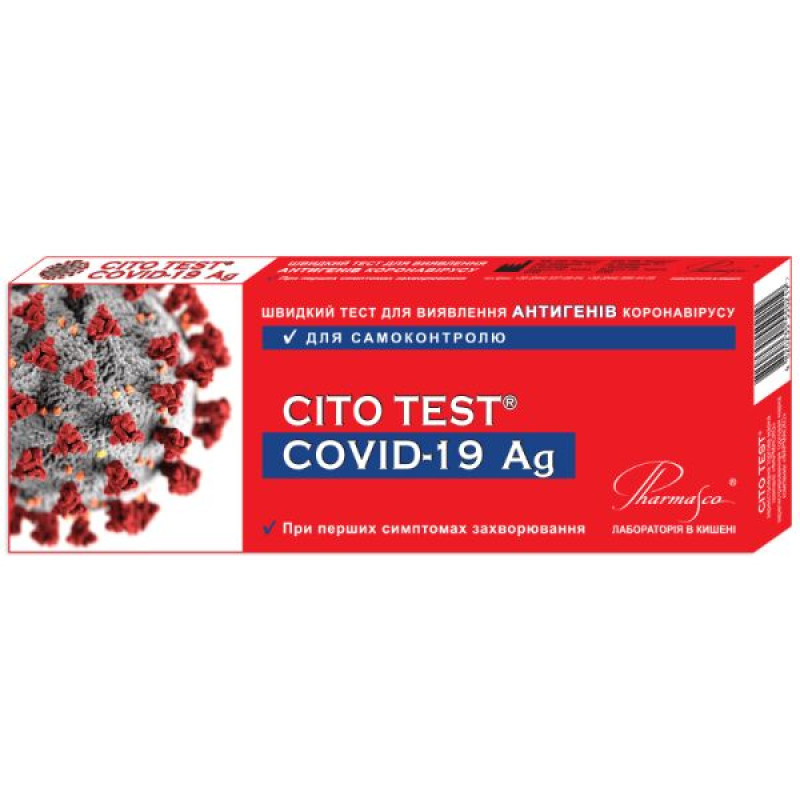
The CITO TEST COVID-19 Ag rapid antigen test is a high-quality rapid test with visual control of the result. During the test, the sample reacts with reagents that have been previously applied and dried on the test membrane. In case of a positive result, if the sample contains the SARS-CoV-2 antigen, a colored test line is formed. The presence of a test line is confirmation of a sufficient amount of sample used, filling of the membrane capillaries and internal quality control of the reagents.
General properties
COVID-19 (Coronavirus Disease 2019) is an infectious disease of droplet transmission caused by the latest recently discovered coronavirus (SARS-CoV-2), with predominantly upper respiratory tract infection and general intoxication (patients with fever, cough, cough, (shortness of breath), sore throat, nasal congestion, malaise, headache, muscle pain, fatigue, weakness, loss of taste and smell) and can lead to atypical pneumonia, severe acute respiratory syndrome, septic shock and even death.
COVID-19 can be spread from someone who is infected with the virus, mainly by breathing in small droplets from the nose or mouth of an infected person when they cough, sneeze or talk. It is therefore important to stay at least 1.5 metres (m) away from an infected person. These droplets can land on objects and surfaces around you, such as tables, doorknobs and stair railings. As a result, other people can become infected with COVID-19 by touching these objects or surfaces and then touching their eyes, mouth or nose. It is therefore important to wash your hands regularly with soap and water or use an alcohol-based hand rub.
In our country, the incidence of COVID-19 remains very high. According to scientists, the real number of cases is higher than official statistics. People of all ages are susceptible to infection, especially those with weakened immune systems. People over 60 years of age, pregnant women and people with chronic diseases are at risk, because they have a very high incidence of adverse consequences of the disease. Complications of the disease pose a serious threat to health and life. To avoid complications, it is necessary to diagnose and treat COVID-19 in a timely manner.
Rapid tests are used as a preliminary screening test for coronavirus infection. These tests can detect IgM or IgG antibodies or specific SARS-CoV-2 antigens. Each test has a different diagnostic value at different stages of the disease. Rapid tests for the detection of SARS-CoV-2 antigens are used for preliminary preliminary diagnosis in individuals with suspected COVID-19. As a rule, coronavirus antigens are detected in upper respiratory tract samples in the acute phase of infection within 5-7 days* after the onset of the first symptoms of acute respiratory disease. In the future, the viral load decreases and the immune response increases, therefore, antibody tests should be performed from the 2nd week of illness. It should be noted that the joint use of antigen and antibody tests improves the diagnosis of coronavirus infection. The feasibility of using rapid tests for screening diagnostics of coronavirus infection is described in the recommendations of the FDA, WHO and the Standards of Medical Care "CORONAVIRUS DAVID (COVID-19)". Ministry of Health of Ukraine.
Technical specifications
The sensitivity and specificity of CITO TEST® COVID-19 Ag have been determined in clinical studies and are: 90.4% sensitivity and 99.5% specificity.
Indications for use
CITO TEST® COVID-19 Ag is a rapid test for the qualitative detection of SARS-CoV-2 coronavirus antigens in nasopharyngeal swabs from people with suspected coronavirus infection.
Contraindication
LIMITATION
The CITO TEST COVID-19 Ag rapid test should only be used to detect SARS-CoV-2 antigens in nasopharyngeal swabs from individuals suspected of having coronavirus infection. The test cannot quantify or increase the concentration of SARS-CoV-2 antigens in the sample. A positive test result only indicates the presence of SARS-CoV-2 antigens in the sample and should not be the sole criterion for diagnosing coronavirus infection. After testing with the result obtained, a doctor should be consulted. The final diagnosis should be made by a doctor after conducting clinical and additional laboratory tests. If the test result is negative and symptoms of COVID-19 are present, it is recommended to repeat the test in a few days or perform a PCR test. A negative test result does not exclude coronavirus infection, especially in contact persons. The possibility of further PCR testing should be considered. A negative test result is possible if coronavirus antigens are present in the sample at a concentration below the detection limit of the test. Excess blood or mucus in the sample may give false results.
Dosage and use
Sampling
Tilt your head back approximately 45-70°. Gently insert the tip of a sterile swab into the nostril and slide it along the outer nasal wall parallel to the palate to a depth of approximately 5 cm for adults, 3 cm for children, until resistance is felt at the back of the pharynx. Rotate the swab inward for a few seconds (s)** to allow it to absorb the secretion. Slowly withdraw the swab from the nasal cavity.
NOTE: Testing should be performed as soon as possible after specimen collection. If testing cannot be performed immediately, the swab containing the specimen should be placed in a dry, sterile, tightly closed storage tube. This specimen can be stored for 8 hours at room temperature and 24 hours at 2-8°C.
Sample preparation
5. Unscrew the cap of the buffer tube.
6. Insert the sterile swab into the buffer tube. Rotate the swab for approximately 10 seconds (sec), pressing the swab against the inside wall of the tube.
7. Remove the swab by squeezing the walls of the tube to extract the maximum amount of fluid from the swab.
8. Close the lid with a test tube.
Testing procedure
Prepare all the materials needed for the test: watch, test cassette, sterile swab, buffer tube and specimen. Bring them to room temperature. Open the sealed pouch, remove the test cassette from the packaging and use it within 1 hour (one hour). The best result will be obtained if the test is performed immediately after opening the sealed pouch. Place the test cassette on a clean and flat surface. Unscrew the cap of the specimen cassette, turn it upside down and place 3 drops of the resulting mixture in the test cassette marked with the letter (S). Start the countdown. Record the result in 15 minutes (min). Do not read the result after 20 minutes (min).
RECORDING THE RESULT
POSITIVE: *** two colored lines appear.
One colored line should appear in the control region (C) and another in the test region (T).
A positive result indicates the presence of coronavirus antigens in the sample.
*** NOTE:
The color intensity of the lines in the test region may vary depending on the concentration of coronavirus antigens in the specimen. Therefore, a colored line of any intensity in the test region should be considered positive.
Negative: One colored line appears in the control region.
There is no line in the test area.
INVALID: The test line does not appear. The reason may be insufficient amount of test sample, non-compliance with testing procedures, expiration dates and storage conditions of rapid tests. In case of an invalid test result, the test should be repeated with another test cassette.
QUALITY CONTROL
The test is equipped with an internal quality control (formation of a colored control line). The appearance of a control line indicates sufficient sample use and compliance with the testing procedure.
Storage conditions
The test can be stored and transported at 2-30 °C. The test is stable until the expiration date indicated on the package. The test should be stored in a sealed package until use. Do not freeze. Do not use after the expiration date.
The test has a shelf life of 24 months.
Packaging
Carton.
Producer
LLC NVK "Farmasko", Ukraine