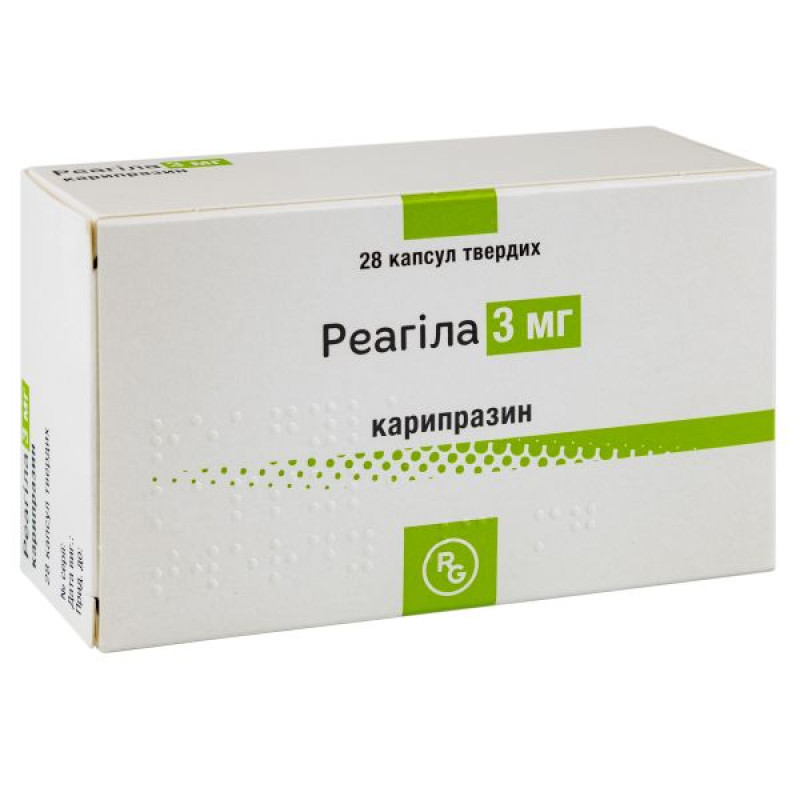
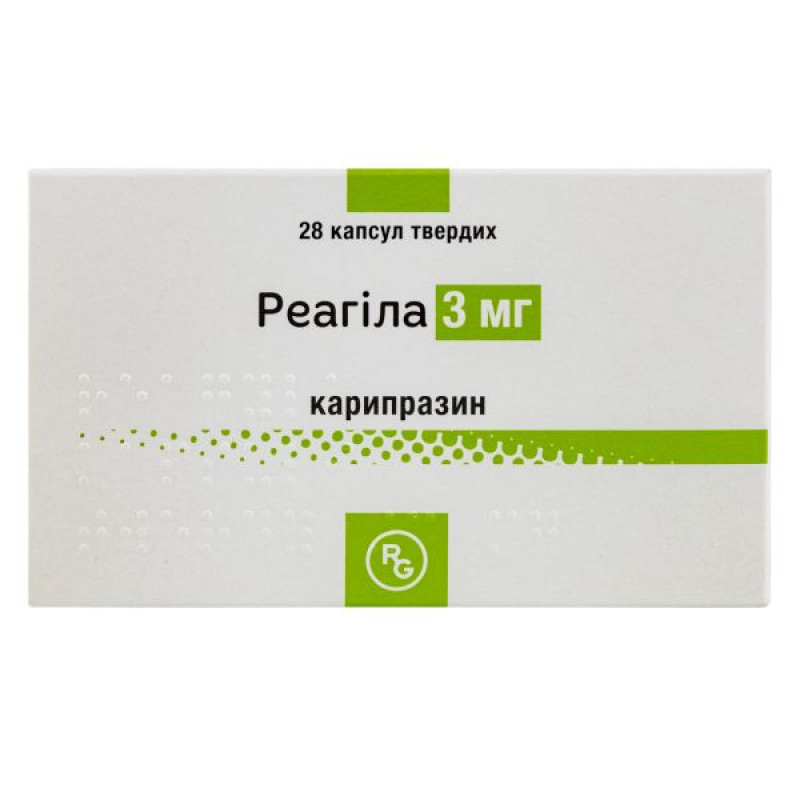
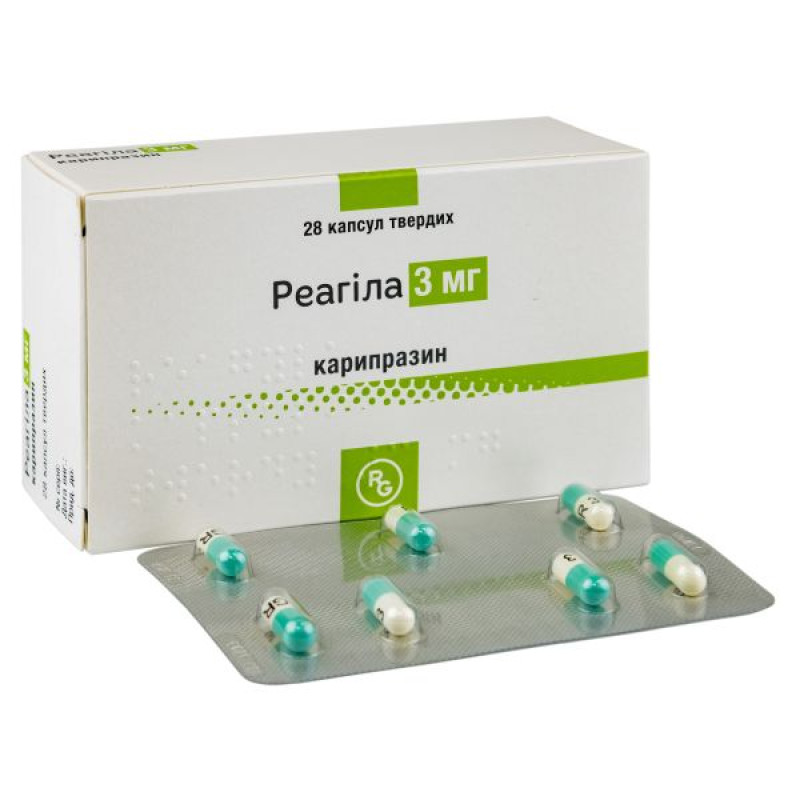
Instructions for Reagyl capsules 3 mg No. 28
Composition
active ingredient: cariprazine;
1 capsule contains 3 mg cariprazine (as cariprazine hydrochloride 3.270 mg).
Excipients: pregelatinized corn starch, magnesium stearate.
Hard capsules: titanium dioxide, E 171; gelatin; special red AC, E 129; diamond blue FCF, E 133; iron oxide yellow, E 172; black printing ink: iron oxide black, E 172; shellac; ethanol; water; propylene glycol; isopropanol; butanol; aqueous ammonia; potassium hydroxide.
Dosage form
The capsules are hard.
Main physical and chemical properties: hard gelatin capsules, size No. 4. Capsule cap — green opaque, capsule body — white opaque. The capsule body is marked with the inscription "GR 3" in black. Capsule contents — white or yellowish-white powder.
Pharmacotherapeutic group
Psycholeptics, other antipsychotics. ATX code N05A X15.
Pharmacological properties
Pharmacodynamics
Mechanism of action
The mechanism of action of cariprazine is not yet fully understood. However, the therapeutic effect of cariprazine may be mediated by a combination of partial agonist action at D3, D2 dopamine (Ki values in the range of 0.085–0.3 nM vs. 0.49–0.71 nM, respectively) and 5-HT1A serotonin receptors (Ki values in the range of 1.4–2.6 nM) and antagonist action at 5-HT2B, 5-HT2A serotonin and H1 histamine receptors (Ki values in the range of 0.58–1.1 nM, 18.8 nM and 23.3 nM, respectively). Cariprazine has low affinity for 5-HT2C serotonin and α1 adrenoceptors (Ki values of 134 nM and 155 nM, respectively). Cariprazine has no significant affinity for cholinergic muscarinic receptors (IC50 > 1000 nM). The two major active metabolites, desmethyl-cariprazine and didesmethyl-cariprazine, bind to receptors and have an in vitro functional activity profile similar to the parent drug.
Pharmacodynamic effects
Preclinical in vivo studies indicate that cariprazine binds to D3 receptors to the same extent as D2 receptors at pharmacologically effective doses. Dose-dependent binding to brain D3 and D2 dopamine receptors (with preferential binding in areas with increased D3 synthesis) was observed in patients with schizophrenia receiving therapeutic doses of cariprazine for 15 days.
The effect of cariprazine on the QT interval was evaluated in patients with schizophrenia or schizoaffective disorder. Holter ECG monitoring was collected in 129 patients over a 12-hour period at baseline and steady state. No QT prolongation was observed at subtherapeutic doses (9 mg/day or 18 mg/day). No cariprazine-treated patients had a QT prolongation ≥ 60 ms from baseline, and no patients had a QT prolongation > 500 ms during the study.
Clinical efficacy
Effectiveness in short-term use
The efficacy of cariprazine in the treatment of acute schizophrenia was studied in three multicenter, international, randomized, double-blind, placebo-controlled, 6-week studies in 1,754 patients aged 18 to 60 years. In all acute schizophrenia studies, the primary endpoint was the change from baseline to week 6 in the Positive and Negative Symptom Scale (PANSS) total score, and the secondary endpoint was the change from baseline to week 6 in the Clinical Global Impression of Severity Scale (CGI-S). In an international placebo-controlled trial using fixed doses of 1.5 mg, 3.0 mg, and 4.5 mg of cariprazine and 4.0 mg of risperidone for assay sensitivity, all doses of cariprazine and the active control showed statistically significant improvements in both the primary and secondary endpoints compared to placebo. In an international placebo-controlled trial using fixed doses of 3.0 mg and 6.0 mg of cariprazine and 10 mg of aripiprazole for assay sensitivity, both doses of cariprazine and the active control showed statistically significant improvements in both the primary and secondary endpoints compared to placebo. In a third international placebo-controlled trial, which used fixed/adapted doses of 3.0–6.0 mg and 6.0–9.0 mg of cariprazine for assay sensitivity, both cariprazine groups showed statistically significant improvements in both the primary and secondary endpoints compared to placebo.
The results of the primary efficacy endpoint are presented in Table 1 below. The results of the secondary efficacy endpoint (CGI) and additional endpoints supported the primary endpoint.
Table 1. Changes from baseline to week 6 in PANSS total score in schizophrenia exacerbation studies—ITT group.
Initial level
Mean value ± SD | Change
LS mean (SP) | Treatment difference compared to placebo (95% CI) | P-value | |
| PANSS Total Score (MMRM) | | | | |
| Study RGH-MD-16 (n = 711) | | | | |
| Placebo | 97.3 ± 9.22 | –13.29 (1.82) | — | — |
| Cariprazine 1.5 mg/day | 97.1 ± 9.13 | –21.27 (1.77) | –7.97 (–12.94, –3.01) | 0.0017 |
| Cariprazine 3 mg/day | 97.2 ± 8.66 | –8.16 (–13.09, –3.22) | 0.0013 |
| Cariprazine 4.5 mg/day | 96.7 ± 9.01 | –23.77 (1.74) | –10.48 (–15.41, –5.55) | < 0.0001 |
| Risperidone 4 mg/day | 98.1 ± 9.50 | –29.27 (1.74) | –15.98 (–20.91, –11.04) | < 0.0001* |
| Study RGH-MD-04 (n = 604) | | | | |
| Placebo | 96.5 ± 9.1 | –14.3 (1.5) | — | — |
| Cariprazine 3 mg/day | 96.1 ± 8.7 | –20.2 (1.5) | –6.0 (–10.1, –1.9) | 0.0044 |
| Cariprazine 6 mg/day | 95.7 ± 9.4 | –23.0 (1.5) | –8.8 (–12.9, –4.7) | < 0.0001 |
| Aripiprazole 10 mg/day | 95.6 ± 9.0 | –21.2 (1.4) | –7.0 (–11.0, –2.9) | 0.0008* |
| Study RGH-MD-05 (n = 439) | | | | |
| Placebo | 96.6 ± 9.0 | –16.0 (1.6) | — | — |
| Cariprazine 3-6 mg/day | 96.3 ± 9.3 | –22.8 (1.6) | –6.8 (–11.3, –2.4) | 0.0029 |
| Cariprazine 6-9 mg/day | 96.3 ± 9.0 | –25.9 (1.7) | –9.9 (–14.5, –5.3) | < 0.0001 |
CI = confidence interval; ITT = intention-to-treat analysis; LS = least squares mean; PANSS = Positive and Negative Syndrome Scale; SE = standard error; SD = standard deviation; MMRM = mixed-effects model for multiple measurements.
*Compared to placebo.
Effectiveness with long-term use
The efficacy of cariprazine for maintenance of antipsychotic effect was investigated in a long-term, randomized, withdrawal-controlled clinical trial. A total of 751 patients with acute schizophrenia symptoms received cariprazine at a dose of 3–9 mg/day for 20 weeks, of whom 337 received cariprazine at a dose range of 3 to 6 mg/day. Subsequently, stabilized patients were randomized in a double-blind manner to receive fixed doses of cariprazine of 3 to 6 mg (n = 51) or placebo (n = 51) for 72 weeks. The primary outcome of the study was time to relapse. At the end of the study, 49.0% of patients receiving placebo versus 21.6% of patients receiving cariprazine had relapsed schizophrenic symptoms. Therefore, the time to relapse (92 vs. 326 days based on the 25th percentile) was significantly longer in the cariprazine group than in the placebo group (p = 0.009).
Efficacy for predominantly negative symptoms of schizophrenia
The efficacy of cariprazine in the treatment of predominantly negative symptoms of schizophrenia was investigated in a 26-week, multicenter, double-blind, active-controlled clinical trial. Cariprazine (dose range 3–4 mg, target dose 4.5 mg) was studied compared with risperidone (dose range 3–6 mg, target dose 4 mg) in patients with persistent predominantly negative symptoms of schizophrenia (n = 461). 86% of patients were <55 years of age, and 54% were male.
Persistent predominantly negative symptoms were defined as symptoms lasting at least 6 months and characterized by high levels of negative symptoms and low levels of positive symptoms [(PANSS negative symptom score ≥ 24, score ≥ 4 in at least 2 of 3 PANSS subscales (N1: flattening of emotions, N4: lack of motivation, and N6: poverty of language) and PANSS positive symptom score ≤ 19]. Patients with secondary negative symptoms such as moderate to severe depressive symptoms and clinically significant parkinsonism (extrapyramidal symptoms [EPS]) were excluded.
Both cariprazine- and risperidone-treated patients showed statistically significant improvements in change from baseline in the primary efficacy parameter, the PANSS negative symptom score (PANSS-FSNS) (p<0.001). However, from week 14 onwards, a statistically significant difference was observed in favor of cariprazine compared to risperidone (p=0.002) (Table 2). Both cariprazine- and risperidone-treated patients showed statistically significant improvements in change from baseline in the secondary efficacy parameter, the total score on the Personal and Social Functioning (PSP) scale (p<0.001). However, from week 10 onwards, a statistically significant difference was observed in favor of cariprazine compared to risperidone (p=0.001) (Table 2).
Both the differences in the Clinical Global Impression of Disease Severity Scale (p = 0.005) and the Improvement Scale (p < 0.001) and the PANSS-FSNS response rate (PANSS FSNS improvement ≥ 30% at week 26; p = 0.003) supported the findings for the primary and secondary efficacy parameters.
Table 2. Summary of results of study RGH-188-005
| Efficiency parameter | Cariprazine LS mean value | Risperidone LS mean value | Estimated treatment difference | 95% CI | p-value |
| PANSS-FSNS at baseline | 27.8 | 27.5 | - | - | - |
| PANSS-FSNS at 26 weeks | 18.5 | 19.6 | - | - | - |
| PANSS-FSNS changes from baseline to week 26 | -8.9 | -7.4 | 1.5 | –2.4; –0.5 | 0.002 |
| Overall PSP score at baseline | 48.8 | 48.2 | - | - | - |
| Overall PSP score at week 26 | 64.0 | 59.7 | - | - | - |
| Total PSP score from change from baseline to week 26 | 14.3 | 9.7 | 4.6 | 2.7; 6.6 | < 0.001 |
LS mean = least squares mean.
The European Medicines Agency has deferred the obligation to submit the results of studies with cariprazine in children. For information on the use of this medicine in children, see the section on Children.
Pharmacokinetics
Cariprazine has two pharmacologically active metabolites with similar activity to cariprazine, desmethyl-cariprazine (DCAR) and didesmethyl-cariprazine (DDCAR). Total cariprazine exposure (sum of cariprazine + DCAR and DDCAR) reaches 50% of steady-state exposure approximately 1 week after daily dosing, and 90% of steady-state exposure is reached by 3 weeks. At steady-state, DDCAR exposure is approximately two to three times higher than cariprazine exposure, and DCAR exposure is approximately 30% of cariprazine exposure.
Absorption
The absolute bioavailability of cariprazine is unknown. Cariprazine is well absorbed after oral administration. After multiple doses, peak plasma concentrations of cariprazine and its major active metabolites are usually achieved approximately 3–8 hours after administration.
Administration of a single 1.5 mg dose of cariprazine with a high-fat meal (900 to 1,000 calories) did not significantly affect cariprazine Cmax or AUC (AUC0–∞ increased by 12%, Cmax decreased by 5% when the drug was administered after food compared to fasting). Food also had minimal effects on the metabolites DCAR and DDCAR.
Cariprazine can be taken without regard to meals.
Distribution
Based on population pharmacokinetic analysis, the apparent volume of distribution (V/D) was 916 L for cariprazine, 475 L for DCAR, and 1,568 L for DDCAR, indicating extensive distribution of cariprazine and its major active metabolites. Cariprazine and its major active metabolites are extensively bound (cariprazine 96-97%, DCAR 94-97%, DDCAR 92-97%) to plasma proteins.
Biotransformation
The metabolism of cariprazine involves demethylation (DCAR and DDCAR), hydroxylation (cariprazine hydroxide, HCAR), and a combination of demethylation and hydroxylation (hydroxy-desmethyl-cariprazine, HDCAR, and hydroxy-didesmethyl-cariprazine, HDDCAR). The metabolites HCAR, HDCAR, and HDDCAR are further biotransformed to their respective sulfate and glucuronide conjugates. An additional metabolite, desdichlorophenyl-piperazine-cariprazine acid (DDCPPCAR), is formed by dealkylation and subsequent oxidation of cariprazine.
Cariprazine is metabolized by CYP3A4 and to a lesser extent CYP2D6 to DCAR and HCAR. DCAR is further metabolized by CYP3A4 and to a lesser extent CYP2D6 to DDCAR and HDCAR. DDCAR is then metabolized by CYP3A4 to HDDCAR.
Cariprazine and its major active metabolites are not substrates for P-glycoprotein (P-gp), organic anion transporter polypeptide 1B1 and 1B3 (OATP1B1 and OATP1B3), and breast cancer resistance protein (BCRP). Interactions of cariprazine with inhibitors of P-gp, OATP1B1, OATP1B3, and BCRP are unlikely.
Breeding
Cariprazine and its major active metabolites are primarily eliminated by hepatic metabolism. Following administration of 12.5 mg/day of cariprazine to patients with schizophrenia, 20.8% of the dose was excreted in the urine as cariprazine and its metabolites.
Unchanged cariprazine is excreted in the urine at a rate of 1.2% of the dose and in the feces at a rate of 3.7%.
The mean terminal half-life (1–3 days for cariprazine and DCAR and 13–19 days for DDCAR) is not predictive of the time to reach steady state or decline in plasma concentrations after discontinuation of treatment. For the treatment of patients taking cariprazine, the effective half-life is of greater importance than the terminal half-life. The effective (functional) half-life is 2 days for cariprazine and DCAR, 8 days for DDCAR, and 1 week for total cariprazine. Plasma concentrations of total cariprazine will gradually decline after discontinuation or interruption of treatment. Plasma concentrations of total cariprazine decrease by 50% after approximately 1 week, and a greater than 90% decline in total cariprazine occurs after approximately 3 weeks.
Linearity
After repeated administration, plasma concentrations of cariprazine and its two major active metabolites, desmethyl-cariprazine (DCAR) and didesmethyl-cariprazine (DDCAR), increase proportionally over the therapeutic dose range of 1.5 mg to 6 mg.
Certain patient groups
Kidney dysfunction
Population pharmacokinetic modeling was performed using data from patients enrolled in a clinical trial of cariprazine for the treatment of schizophrenia with a range of renal function parameters, including normal renal function (creatinine clearance (CrCl) ≥ 90 mL/min) and mild (CrCl 60–89 mL/min) and moderate (CrCl 30–59 mL/min) renal impairment. No significant relationship was found between cariprazine plasma clearance and creatinine clearance.
Cariprazine has not been evaluated in patients with severe (CrCl < 30 mL/min) renal impairment (see Dosage and Administration).
A two-part study (a single dose of 1 mg cariprazine [Part A] and a daily dose of 0.5 mg cariprazine for 14 days [Part B]) was conducted in patients with varying degrees of hepatic impairment (Child-Pugh classes A and B). Following a single dose of 1 mg cariprazine or 0.5 mg cariprazine for 14 days, patients with mild to moderate hepatic impairment had approximately 25% higher cariprazine concentrations (Cmax and AUC) and approximately 45% lower concentrations of the major active metabolites, desmethyl cariprazine and didesmethyl cariprazine, compared to healthy subjects.
After multiple dosing of cariprazine, the total active component (CAR + DCAR + DDCAR) concentrations (AUC and Cmax) were reduced by 21–22% and 13–15%, respectively, in mild to moderate hepatic impairment (HIF) when unbound + bound concentrations were considered, compared to healthy subjects, while the unbound total component was calculated to be reduced by 12–13% and increased by 20–25%, respectively, in patients with mild to moderate HIF.
Cariprazine has not been evaluated in patients with severe (Child-Pugh Class C) hepatic impairment (see Dosage and Administration).
Age, gender, and race
In a population pharmacokinetic analysis, there were no clinically relevant differences in pharmacokinetic parameters (AUC and Cmax of the sum of cariprazine and its major active metabolites) based on age, gender, and race. The analysis included data from 2,844 patients of various races, including 536 patients aged 50 to 65 years. Of the 2,844 patients, 933 were female (see Dosage and Administration). Data in elderly patients (over 65 years) are limited.
Smoking
Because cariprazine is not a substrate for CYP1A2, smoking is not expected to affect the pharmacokinetics of cariprazine.
Potential effects of cariprazine on other drugs
Cariprazine and its major active metabolites did not induce CYP1A2, CYP2B6, or CYP3A4 enzymes and were not inhibitors of CYP1A2, CYP2A6, CYP2B6, CYP2C8, CYP2C9, CYP219, CYP2D6, CYP2E1, or CYP3A4 in vitro. Cariprazine and its major active metabolites are not inhibitors of the transport proteins OATP1B1, OATP1B3, BCRP, organic cation transport protein 2 (OCT2), and organic anion transport proteins 1 and 3 (OAT1 and OAT3) in vitro. DCAR and DDCAR were not inhibitors of the transport protein P-gp, although cariprazine was an inhibitor of P-gp in the intestine (see section 4.5).
Indication
For the treatment of schizophrenia in adult patients.
Contraindication
Hypersensitivity to the active substance or to any of the excipients.
Concomitant use of a strong or moderate CYP3A4 inhibitor (see section "Interaction with other medicinal products and other types of interactions").
Concomitant use of a strong or moderate CYP3A4 inducer (see section "Interaction with other medicinal products and other types of interactions").
Interaction with other medicinal products and other types of interactions
Potential effects of other drugs on cariprazine
The metabolism of cariprazine and its major active metabolites, desmethyl-cariprazine (DCAR) and didesmethyl-cariprazine (DDCAR), is predominantly mediated by CYP3A4 with minimal involvement of CYP2D6.
CYP3A4 inhibitors
Ketoconazole, a strong CYP3A4 inhibitor, causes a 2-fold increase in total cariprazine (sum of cariprazine and its active metabolites) plasma levels during short-term (4 days) co-administration, when unbound or unbound + bound components are considered.
Due to the long half-life of the active components of cariprazine, further increases in total cariprazine plasma levels can be expected with longer combined administration. Therefore, the combination of cariprazine with strong or moderate CYP3A4 inhibitors (e.g. boceprevir, clarithromycin, cobicistat, indinavir, itraconazole, ketoconazole, nefazodone, nelfinavir, posaconazole, ritonavir, saquinavir, telaprevir, telithromycin, voriconazole, diltiazem, erythromycin, fluconazole, verapamil) is contraindicated (see section 4.3). Grapefruit juice should be avoided.
CYP3A4 inducers
The combined use of cariprazine with strong or moderate CYP3A4 inducers may result in a significant increase in total cariprazine exposure, therefore the combined use of cariprazine and strong or moderate CYP3A4 inducers (e.g. carbamazepine, phenobarbital, phenytoin, rifampicin, St. John's wort (Hypericum perforatum), bosentan, efavirenz, etravirine, modafinil, nafcillin) is contraindicated (see section "Contraindications").
CYP2D6 inhibitors
CYP2D6-mediated pathways play a minor role in the metabolism of cariprazine, with the major pathway being via CYP3A4 (see Pharmacokinetics). Therefore, CYP2D6 inhibitors are unlikely to have a clinically significant effect on the metabolism of cariprazine.
Potential effects of cariprazine on other drugs
P-glycoprotein (P-gp) substrates
Cariprazine is an in vitro P-gp inhibitor at its theoretically highest intestinal concentration. The clinical implications of this effect are not yet fully understood, but increased monitoring and dose adjustment may be required for use with P-gp substrates with narrow therapeutic indices such as dabigatran and digoxin.
It is currently unknown whether cariprazine may reduce the effectiveness of hormonal contraceptives, so women who use them systematically should additionally use a barrier method.
Pharmacodynamic interactions
Considering the primary effects on the central nervous system, Reagila should be used with caution in combination with other centrally acting drugs and alcohol.
Application features
Suicidal thoughts and behavior
The emergence of suicidality (suicidal ideation, suicide attempts and completed suicide) is a common feature of psychiatric illness and generally occurs soon after initiation or change of antipsychotic therapy. Antipsychotic therapy should be accompanied by close monitoring of patients at high risk.
Akathisia, agitation
Akathisia and agitation are common side effects of antipsychotics. Akathisia is a movement disorder characterized by a feeling of inner restlessness and a compelling need to be constantly in motion, as well as actions such as rocking while standing or sitting, lifting one leg as if marching in place, and crossing and straightening the legs while sitting. Because cariprazine causes akathisia and agitation, it should be used with caution in patients who are predisposed to or already exhibit symptoms of akathisia. Akathisia develops early in treatment. Therefore, close monitoring is important during the initial phase of treatment. Prevention involves slowly increasing the dose; therapeutic measures include gradually reducing the dose of cariprazine or of the medications used to treat extrapyramidal symptoms. The dose may be adjusted according to individual response and tolerability (see section 4.8).
Tardive dyskinesia
Tardive dyskinesia is a syndrome characterized by rhythmic involuntary movements, predominantly of the tongue and/or face, that can develop in patients treated with antipsychotics. If symptoms of tardive dyskinesia develop in a patient treated with cariprazine, discontinuation of treatment should be considered.
Parkinson's disease
When antipsychotics are prescribed to patients with Parkinson's disease, exacerbation of the underlying disease and worsening of the course of Parkinson's disease are possible. Therefore, when prescribing cariprazine to patients with Parkinson's disease, physicians should weigh the benefit/risk ratio.
Eye symptoms/cataracts
In nonclinical studies with cariprazine in dogs, lens opacities/cataracts were observed (see Adverse Reactions section). However, a causal relationship between the lens changes/cataracts observed in human studies and cariprazine has not been established. However, patients who develop symptoms potentially related to cataracts should be advised to undergo an ophthalmological examination and then re-evaluated for continued treatment.
Neuroleptic malignant syndrome (NMS)
A potentially fatal symptom complex called neuroleptic malignant syndrome (NMS) has been reported with antipsychotic treatment. Clinical manifestations of NMS include hyperpyrexia, muscle rigidity, elevated serum creatinine phosphokinase, altered mental status, and signs of autonomic dysfunction (irregular pulse or blood pressure, tachycardia, diaphoresis, and cardiac arrhythmia). Additional features may include myoglobinuria (rhabdomyolysis) and acute renal failure. If a patient develops symptoms suggestive of NMS or develops unexplained fever without additional clinical manifestations of NMS, cariprazine should be discontinued immediately.
Convulsions and seizures
Cariprazine should be administered with caution to patients with a history of seizures or pathological conditions that potentially lower the seizure threshold.
Elderly patients with dementia
The effect of cariprazine in elderly patients with dementia has not been studied, therefore the drug is not recommended for use in such patients due to an increased risk of overall mortality.
Risk of cerebrovascular accident (CVA)
In randomized, placebo-controlled clinical trials in patients with dementia treated with some atypical antipsychotics, an approximately three-fold increased risk of cerebrovascular events has been observed. The mechanism of the increased risk is unknown. An increased risk of CVD cannot be excluded with other antipsychotics or in other patient populations. Cariprazine should be used with caution in patients with risk factors for stroke.
Cardiovascular diseases
Blood pressure changes
Cariprazine can cause both orthostatic hypotension and hypertension (see section 4.8). Cariprazine should be used with caution in patients with a history of cardiovascular disease and those prone to blood pressure fluctuations. Blood pressure should be monitored.
ECG changes
In a clinical study conducted to evaluate QT prolongation, no QT prolongation was observed with cariprazine compared to placebo (see section 5.1). Only a few cases of minor QT prolongation with cariprazine have been reported in clinical studies (see section 4.8). Therefore, cariprazine should be used with caution in patients with a history of cardiovascular disease or a family history of QT prolongation, and in patients receiving medications that may prolong the QT interval (see section 5.1).
Venous thromboembolism (VTE)
Cases of venous thromboembolism have been reported with antipsychotic drugs. Since patients taking antipsychotics often have acquired risk factors for VTE, all possible risk factors for VTE should be identified before and during treatment with cariprazine, and their prophylaxis should be considered.
Hyperglycemia and diabetes mellitus
In patients with diabetes mellitus or with risk factors for diabetes mellitus (e.g. obesity, family history of diabetes) who are initiating treatment with atypical antipsychotics, serum glucose levels should be monitored. Adverse reactions related to glucose levels have been reported in clinical trials with cariprazine (see section 5.1).
Women of childbearing age
Women of childbearing potential should use highly effective contraception while taking cariprazine and for at least 10 weeks after stopping treatment (see sections 4.5 and 4.8). Women who regularly use hormonal contraceptives should additionally use a barrier method.
Body weight changes
Significant weight gain has been observed with cariprazine. Patients should have their weight monitored regularly (see section 4.8).
Excipients
Reagila, hard capsules of 3 mg, 4.5 mg and 6 mg, contain the dye special red AC (E129), which may cause allergic reactions.
Ability to influence reaction speed when driving vehicles or other mechanisms
Cariprazine has minor or moderate influence on the ability to drive and use machines. Patients should be cautioned against operating hazardous machinery, including driving, until they are certain that Reagyl does not affect them.
Use during pregnancy or breastfeeding
Women of childbearing age/women using contraception
Women of childbearing potential should avoid pregnancy while taking Reagyl. Female patients of childbearing potential should use highly effective methods of contraception during treatment and for at least 10 weeks after the last dose of Reagyl. It is currently unknown whether cariprazine may reduce the effectiveness of hormonal contraceptives, so women who use them systematically should additionally use a barrier method (see section “Interaction with other medicinal products and other types of interactions”).
Pregnancy
There are no or limited amount of data from the use of cariprazine in pregnant women.
Animal studies have shown reproductive toxicity, including malformations in rats.
The use of Reagila is not recommended during pregnancy, as well as in women of childbearing potential who are not using effective contraception. After stopping treatment with cariprazine, contraceptive methods should be used for at least 10 weeks due to the slow elimination of the active components.
Neonates exposed to antipsychotics (including cariprazine) during the third trimester of pregnancy are at risk of developing adverse reactions such as extrapyramidal symptoms and/or withdrawal symptoms, which may vary in severity and duration. Agitation, hypertension, hypotension, tremor, somnolence, respiratory distress syndrome, and feeding disorders have been reported. These complications varied in severity; in some cases the symptoms resolved spontaneously, while in others the neonates required intensive care unit treatment and prolonged hospitalization. Therefore, neonates should be closely monitored.
Breast-feeding
It is not known whether cariprazine and its major metabolites are excreted in human milk. Cariprazine and its metabolites are excreted in the milk of lactating rats. Effects on the newborn/infants cannot be excluded. Breast-feeding should be discontinued during treatment with cariprazine.
Fertility
The effect of cariprazine on human fertility has not been studied. In studies in rats, reduced fertility and fertilization rates were observed in females.
Method of administration and doses
The recommended starting dose of cariprazine is 1.5 mg once daily. The dose may be increased slowly in 1.5 mg increments as needed to a maximum dose of 6 mg/day. The lowest effective dose should be maintained according to the physician's clinical judgment. Due to the long half-life of cariprazine and its active metabolites, changes in dosage will not be fully reflected in plasma for several weeks. Patients should be monitored for adverse reactions and response to treatment for several weeks after initiation of cariprazine and after each dose change (see section 5.2).
Switching from other antipsychotics to cariprazine
When switching from other antipsychotics to cariprazine, gradual cross-titration should be considered, with the previous therapy gradually discontinued when cariprazine is initiated.
Switching from cariprazine to another antipsychotic
When switching from cariprazine to another antipsychotic, there will be no gradual cross-titration, so the new antipsychotic can be started at the lowest dose when cariprazine is discontinued. It should be noted that plasma concentrations of cariprazine and its active metabolites will decrease by 50% within approximately 1 week (see section 5.2).
Special patient groups
Kidney dysfunction
Patients with mild to moderate renal impairment (creatinine clearance (CrCl) ≥ 30 mL/min and < 89 mL/min) do not require any dose adjustment. The safety and efficacy of cariprazine in patients with severe renal impairment (CrCl < 30 mL/min) have not been evaluated. Cariprazine is not recommended for patients with severe renal impairment (see section 5.2).
Liver dysfunction
Patients with mild to moderate hepatic impairment (Child-Pugh score 5-9) do not require any dose adjustment. The safety and efficacy of cariprazine in patients with severe hepatic impairment (Child-Pugh score 10-15) have not been evaluated. Cariprazine is not recommended for patients with severe hepatic impairment (see Pharmacokinetics).
Elderly patients
There are insufficient data available on the treatment of elderly patients (≥ 65 years) with cariprazine to indicate whether their response to treatment differs from that of younger patients (see section 5.2). Dose selection for elderly patients should be more cautious.
Method of application
The drug Reagila should be taken orally once a day at the same time, regardless of food intake.
Children
The safety and efficacy of cariprazine in children (under 18 years of age) have not been established. No data available.
Overdose
Symptoms
An accidental acute overdose (48 mg/day) has been reported in one patient. This patient experienced orthostasis and sedation. The patient fully recovered the same day.
Overdose treatment
Treatment of overdose should be supportive, including maintenance of a patent airway, oxygenation, and ventilation, and symptomatic. Cardiovascular monitoring should be initiated immediately and include electrocardiographic monitoring for possible arrhythmias. Anticholinergics should be administered if severe extrapyramidal symptoms occur. Since cariprazine is highly bound to plasma proteins, hemodialysis will not be useful in the treatment of overdose. Close medical supervision and monitoring should be continued until the patient recovers.
Cariprazine has no specific antidote.
Adverse reactions
The most commonly reported adverse reactions with cariprazine across the dose range (1.5–6 mg) were akathisia (19%) and parkinsonism (17.5%).