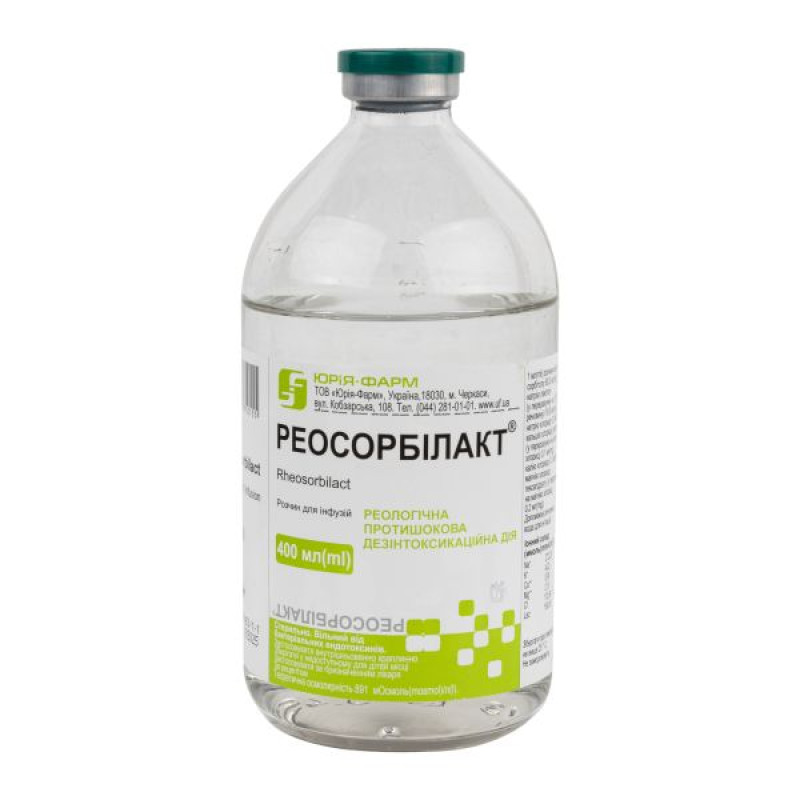
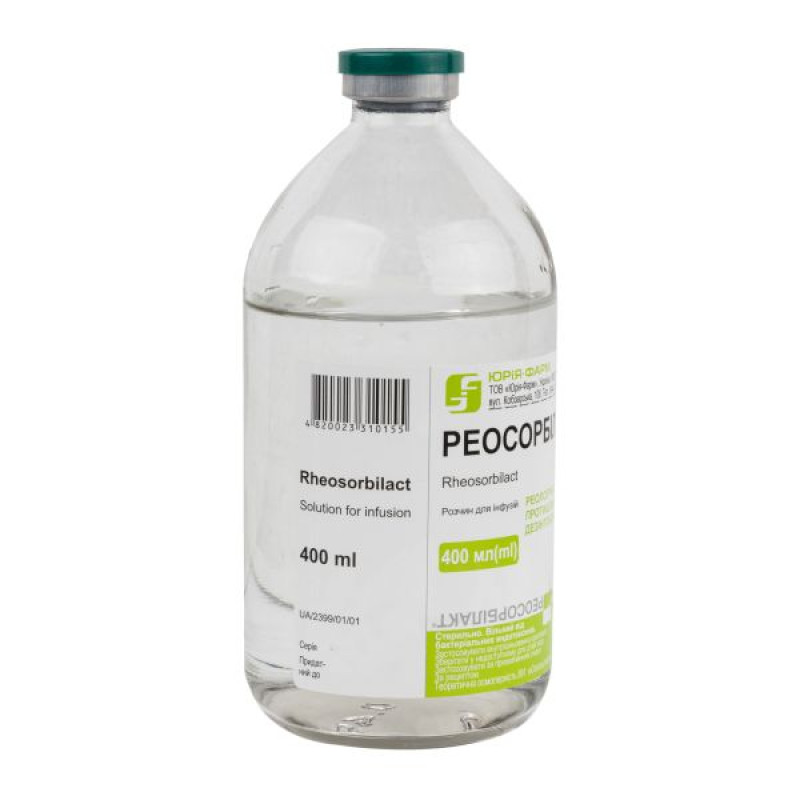
Instructions Reosorbilact solution for infusions bottle 400 ml
Composition
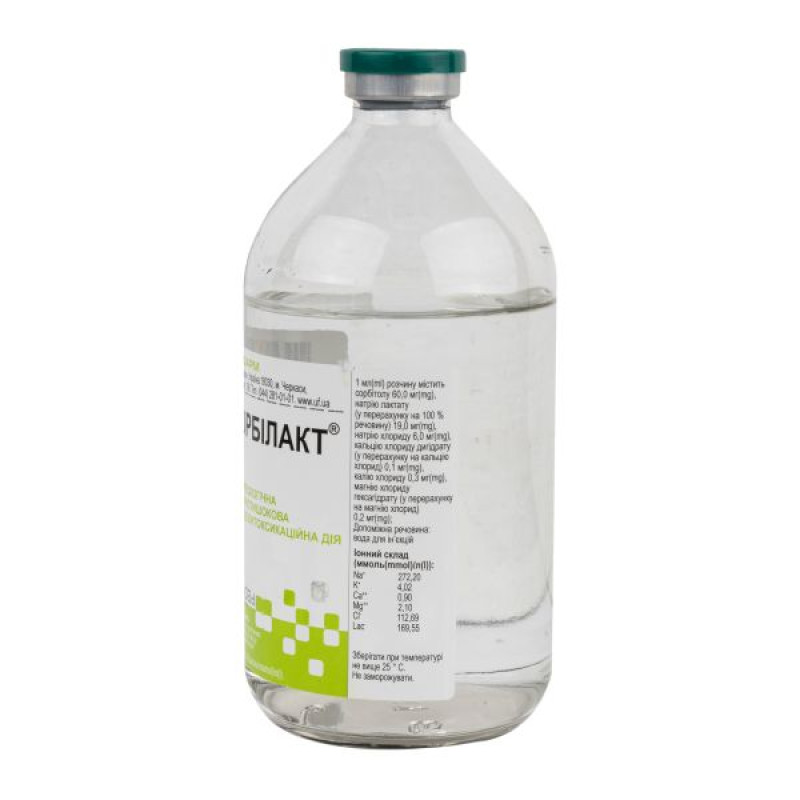
active ingredients: 1 ml of solution contains sorbitol 60.0 mg, sodium lactate (calculated as 100% substance) 19.0 mg, sodium chloride 6.0 mg, calcium chloride dihydrate (calculated as calcium chloride) 0.1 mg, potassium chloride 0.3 mg, magnesium chloride hexahydrate (calculated as magnesium chloride) 0.2 mg;
excipient: water for injections.
Dosage form
Solution for infusion.
Main physical and chemical properties: transparent colorless liquid; theoretical osmolarity – 891 mOsmol/l; pH 6.00-7.60; ionic composition: 1 l of the preparation contains Na+ – 272.20 mmol, K+ – 4.02 mmol, Ca++ – 0.90 mmol, Mg++ – 2.10 mmol, Cl- – 112.69 mmol,
Lac- – 169.55 mmol.
Pharmacotherapeutic group
Solutions that affect electrolyte balance. Electrolytes in combination with other drugs. ATX code B05B B04.
Pharmacological properties
Pharmacodynamics
Reosorbilact® has a rheological, anti-shock, detoxification effect and stimulates intestinal peristalsis. The main pharmacologically active substances of the drug are sorbitol and sodium lactate. In the liver, sorbitol is first converted into fructose, which is subsequently converted into glucose, and then into glycogen. Part of the sorbitol is used for immediate energy needs, the other part is stored as a reserve in the form of glycogen. Isotonic sorbitol solution has a disaggregant effect and thus improves microcirculation and tissue perfusion.
Unlike bicarbonate solution, correction of metabolic acidosis with sodium lactate proceeds more slowly as it is incorporated into the metabolism, and there are no sharp fluctuations in pH. The effect of sodium lactate becomes apparent 20-30 minutes after administration.
Sodium chloride has a rehydrating effect, replenishing the deficiency of sodium and chlorine ions in various pathological conditions.
Calcium chloride replenishes the deficiency of calcium ions. Calcium ions are necessary for the transmission of nerve impulses, contraction of skeletal and smooth muscles, myocardial activity, bone formation, blood clotting. Reduces the permeability of cells and vascular walls, prevents the development of inflammatory reactions, increases the body's resistance to infections.
Potassium chloride restores water and electrolyte balance. Has a negative chrono- and bathmotropic effect, in high doses - a negative ino-, dromotropic and moderate diuretic effect. Participates in the process of conducting nerve impulses. Increases the content of acetylcholine and causes excitation of the sympathetic division of the autonomic nervous system. Improves skeletal muscle contraction in muscular dystrophy, myasthenia.
Pharmacokinetics
Sorbitol is quickly included in the general metabolism, 80-90% of it is utilized in the liver and accumulates in the form of glycogen, 5% is deposited in the brain tissues, cardiac muscle and skeletal muscles, 6-12% is excreted in the urine. When injected into the vascular bed, sodium, CO2 and H2O are released from sodium lactate, which form sodium bicarbonate, which leads to an increase in the alkaline reserve of the blood. Only half of the injected sodium lactate (isomer L) is considered active, and the other half (isomer D) is not metabolized and is excreted in the urine.
Sodium chloride is rapidly excreted from the vascular bed, only temporarily increasing the volume of circulating blood. It increases diuresis.
Indication
To improve capillary blood flow for the purpose of prevention and treatment of traumatic, surgical, hemolytic, toxic and burn shock, acute blood loss, burn disease; infectious diseases accompanied by intoxication, exacerbation of chronic hepatitis; sepsis; for preoperative preparation and in the postoperative period; to improve arterial and venous blood circulation for the purpose of prevention of thrombosis, thrombophlebitis, endarteritis, Raynaud's disease.
Contraindication
Individual hypersensitivity to the components of the drug. Reosorbilact® should not be used in alkalosis, as well as in cases where the infusion of large volumes of fluid is contraindicated (cerebral hemorrhage, thromboembolism, cardiovascular decompensation, grade III arterial hypertension, decompensated heart disease, terminal renal failure), dehydration, oliguria.
Interaction with other medicinal products and other types of interactions
Do not use as a solvent carrier for other medicinal products.
Application features
The drug should be used under the control of indicators of acid-base status and blood electrolytes, liver function and blood pressure. Administer with caution to patients with calculous cholecystitis.
The drug contains sorbitol, so patients with rare hereditary fructose intolerance should not use this drug.
Use during pregnancy or breastfeeding
There is no data on contraindications during pregnancy or breastfeeding.
Ability to influence reaction speed when driving vehicles or other mechanisms
Since the drug is used in a hospital setting, there is no data on such effects.
Method of administration and doses
Reosorbilact® should be administered intravenously to adults by drip at a rate of 40-60 cr/min. If necessary, the drug can be administered intravenously after a test by drip at a rate of 30 cr/min. After 15 drops, the drug should be discontinued, and after 3 minutes, if there is no reaction, Reosorbilact® should be administered intravenously.
In case of traumatic, burn, postoperative and hemolytic shocks, adults should be administered 600-1000 ml (10-15 ml/kg of the patient's body weight) once and repeatedly.
600-1000 ml (10-15 ml/kg of the patient's body weight), first as a jet, then as a drip. In chronic hepatitis, adults should be administered 400 ml (6-7 ml/kg of the patient's body weight) as a drip. In acute blood loss, adults should be administered 1500-1800 ml (up to 25 ml/kg of the patient's body weight). In this case, it is recommended to perform Reosorbilact® infusions at the prehospital stage in a specialized ambulance. In the preoperative period and after various surgical interventions - at a dose of 400 ml (6-7 ml/kg of the patient's body weight) as a drip for 3-5 days. For thrombo-obliterating diseases of blood vessels - at the rate of 8-10 ml/kg of body weight drip, repeated every other day, up to 10 infusions per course of treatment.
Children
There is insufficient data on experience with use in children.
Overdose
There are phenomena of alkalosis, which quickly disappear on their own if the drug is immediately stopped, sometimes collapse, dehydration (due to increased diuresis). If the rate of administration is exceeded, tachycardia, increased blood pressure, shortness of breath, headache, chest pain, abdominal pain may develop. These symptoms quickly disappear on their own after stopping or significantly reducing the rate of solution administration.
Adverse reactions
On the part of the immune system: anaphylactoid reactions, angioedema, hyperthermia.
From the cardiovascular system: increase or decrease in blood pressure, tachycardia, shortness of breath, acrocyanosis.
Neurological disorders: tremor, headache, dizziness, general weakness.
Skin and subcutaneous tissue disorders: skin rash, urticaria, itching.
Gastrointestinal disorders: nausea, vomiting.
General disorders: changes at the injection site, including pain and burning.
Expiration date
2 years.
Storage conditions
Store at a temperature not exceeding 25 ° C. Do not freeze. Keep out of the reach of children.
Incompatibility
Reosorbilact® cannot be mixed with phosphate- and carbonate-containing solutions.
Packaging
200 ml or 400 ml in a bottle, 1 bottle in a pack; 200 ml or 400 ml in bottles;
250 ml or 500 ml in containers.
Vacation category
According to the recipe.
Producer
LLC "Yuria-Pharm".
Location of the manufacturer and its business address
Ukraine, 18030, Cherkasy, Verbovetskogo St., 108. Tel./fax: (044) 281-01-01.