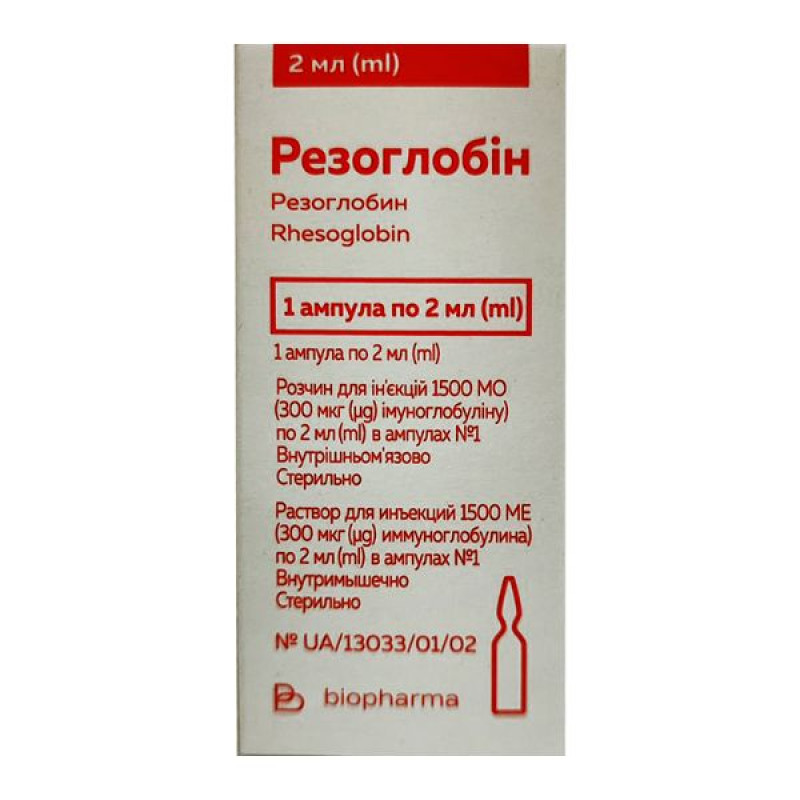
Instructions Resoglobin solution for injection 1500 IU (300 μg immunoglobulin) in a 2 ml ampoule No. 1
Composition
active ingredient: Anti-D (rh) immunoglobulin;
1 ampoule (1 ml or 2 ml) contains specific antibodies to anti-Rh (D) – 1500 IU (300 μg of immunoglobulin);
excipients: glycine (glycocol, aminoacetic acid), sodium chloride.
Dosage form
Solution for injection.
Main physicochemical properties: transparent or with slight opalescence, colorless or yellowish liquid. During storage, a slight precipitate may appear, which disappears when shaken. The drug is an immunologically active protein fraction of blood plasma of immunized donors (or reimmunized donors), tested for the absence of antibodies to HIV-1, HIV-2, hepatitis C virus and hepatitis B virus surface antigen, purified and concentrated by fractionation with ethyl alcohol, which has undergone the stage of viral inactivation by the solvent-detergent method and nanofiltration method, with a high content of anti-Rh (D) antibodies. The protein content in 1.0 ml of the drug is from 0.09 g to 0.11 g. The drug does not contain preservatives and antibiotics.
Pharmacotherapeutic group
Specific immunoglobulins. Human anti-Rh immunoglobulin (D). ATX code: J06B B01.
Immunological and biological properties
Pharmacological properties
Pharmacodynamics
The active substance of the drug is immunoglobulin specific for the Rh (D) antigen. The drug prevents Rh sensitization of Rh-negative women, which is possible as a result of Rh (D)-positive fetal blood entering the mother's bloodstream during the birth of Rh (D)-positive children, during abortion (both spontaneous and induced), during amniocentesis, and in case of abdominal trauma during pregnancy.
Pharmacokinetics
Specific antibodies to anti-Rh (D) – 1500 IU (300 mcg of immunoglobulin).
Indication
The drug is used:
- for prenatal prophylaxis in Rh-negative women who are not sensitized to the Rho (D) antigen;
- for prophylaxis in the postpartum period in Rh-negative women who are not sensitized to the Rh (D) antigen, i.e. those who have not developed Rh antibodies (provided this is the first pregnancy and the birth of an Rh-positive child whose blood is compatible with the mother's blood according to the AB blood group system);
- during artificial termination of pregnancy in Rh-negative women, also not sensitized to the Rh (D) antigen, in the case of Rh-positive blood type of the man;
- in case of miscarriage and threatened miscarriage at any stage of pregnancy;
- when performing amniocentesis;
- with injuries to the abdominal organs during pregnancy.
Contraindication
The drug is contraindicated in selective Ig A deficiency if antibodies to Ig A are present; in the presence of severe allergic reactions to the administration of human blood protein preparations in history, as well as hypersensitivity reactions to donor human immunoglobulins.
The drug is contraindicated in Rh-positive women in labor, as well as Rh-negative women in labor who are sensitized to the Rh (D) antigen and have Rh antibodies detected in their serum.
The drug should not be administered in case of severe thrombocytopenia and other hemostatic disorders.
Interaction with other medicinal products and other types of interactions
Combination with other specific medications is possible.
Immunization of women with live vaccines should be carried out no earlier than 3 months after administration of the drug.
Application features
It is forbidden to administer the drug intravenously!
Patients who have received the drug should be under medical supervision for 30 minutes.
Patients suffering from allergic diseases or having a history of them are recommended to take antihistamines on the day of immunoglobulin administration and for the next 3 days. In case of anaphylactic shock, standard anti-shock therapy is performed.
Use under the supervision of a physician. Before administration, the ampoules with the drug are kept for 2 hours at room temperature (20 ± 2) ºС. The drug cannot be stored in an open ampoule. After the expiration date, the drug should not be used.
Use during pregnancy or breastfeeding
The drug should be used during pregnancy and breastfeeding if indicated.
Ability to influence reaction speed when driving vehicles or other mechanisms
Not studied.
Method of administration and doses
The drug should be administered intramuscularly.
When applying, the following criteria must be taken into account:
- the mother must be Rh-negative and must not already be sensitized to the Rh (D) antigen;
- the baby must be Rh-positive and have a negative direct antiglobulin test result. If the drug is administered before delivery, it is very important that the mother receives another dose of the drug after the birth of the Rh-positive baby within 72 hours of delivery. If it is determined that the father is Rh-negative, then the drug is not necessary.
- for prenatal prophylaxis at approximately 28 weeks of pregnancy. After this, another dose of 1500 IU (300 mcg) should be administered, preferably within 72 hours after delivery, if the baby is Rh-positive;
- for prophylaxis in the postpartum period within 72 hours after delivery;
- in case of artificial abortion, termination of ectopic pregnancy immediately after the end of the operation. During pregnancy after 13 weeks, a single dose is recommended;
if the pregnancy is interrupted before 13 weeks, a single mini-dose of immunoglobulin of approximately 250 IU (50 mcg) may be administered;
- in case of miscarriage and threatened miscarriage at any stage of pregnancy;
- when performing amniocentesis or in case of abdominal trauma during the second and/or third trimester of pregnancy, it is recommended to administer one dose of the drug immediately after the end of the operation. If amniocentesis or abdominal trauma requires administration of the drug during the period of 13–18 weeks of pregnancy, an additional 1500 IU (300 mcg) (1 ampoule) should be administered during the period of 26–28 weeks.
Children: The safety and efficacy of the drug in children have not been studied.
It is forbidden to administer the drug to newborns!
In infants whose mothers received the drug before delivery, weakly positive direct antiglobulin tests may be obtained at birth. Passively acquired antibodies to Rh(D) may be detected in the mother's serum if an antibody screening test is performed after prenatal or postpartum administration of the drug.
Overdose
It was not studied.
Adverse reactions
Reactions to the administration of immunoglobulin are usually absent.
Possible:
injection site reactions – swelling, pain, erythema, induration, redness, rash, itching;
general disorders and reactions – fever, weakness, chills;
immune system disorders – hypersensitivity reactions, and in extremely rare cases anaphylactic shock;
nervous system disorders – headache;
cardiovascular system disorders – tachycardia, hypotension;
gastrointestinal disorders – nausea, vomiting;
Skin and subcutaneous tissue disorders – erythema, itching;
Musculoskeletal and connective tissue disorders – arthralgia.
Expiration date
2 years.
Storage conditions
Store in a dry place, protected from light, at a temperature of 2 to 8 °C.
Keep out of reach of children.
Incompatibility
It is unacceptable to mix the drug in the same syringe with other medications during administration.
Packaging
1 ml or 2 ml (specific antibodies to anti-Rh (D) – 1500 IU (300 μg immunoglobulin)) in an ampoule. 1 or 3 or 5 ampoules in a pack.
Vacation category
According to the recipe.
Producer
LLC "BIOPHARMA PLASMA", Ukraine.
Location of the manufacturer and address of its place of business
Legal address: Ukraine, 09100, Kyiv region, Bila Tserkva, Kyivska st., 37-V.
Address of place of business:
Ukraine, 09100, Kyiv region, Bila Tserkva, Kyivska st., 37-V.