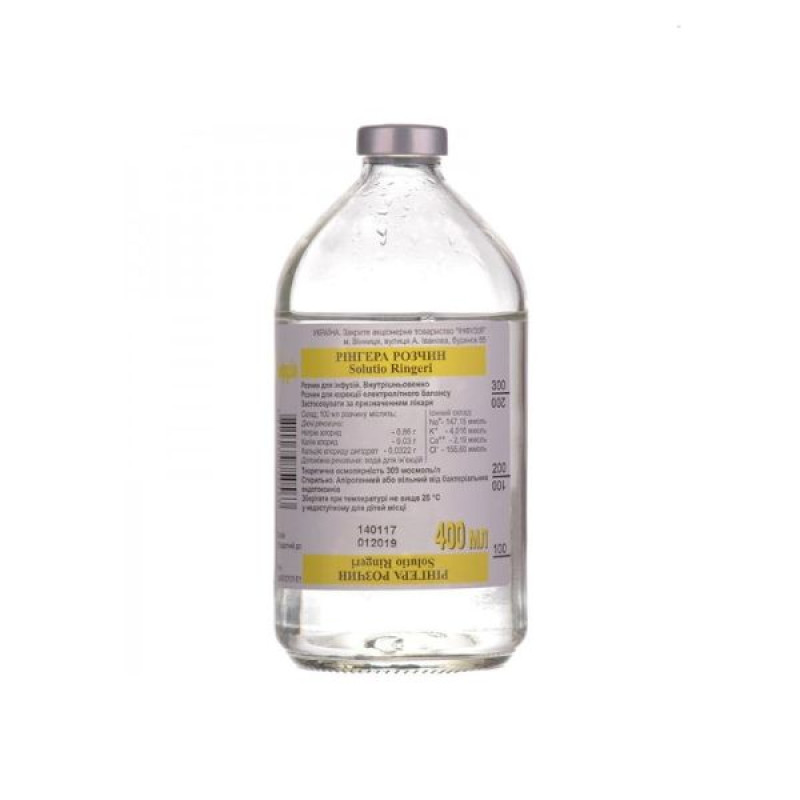
Instructions for Ringer's solution for infusion, 400 ml bottle
Composition
active ingredients: sodium chloride, potassium chloride, calcium chloride dihydrate;
100 ml of solution contain sodium chloride – 0.86 g; potassium chloride – 0.03 g; calcium chloride dihydrate – 0.0322 g;
excipient: water for injections.
Ionic composition per 1000 ml of the drug: Na+ – 147.15 mmol; K+ – 4.016 mmol; Ca++ – 2.19 mmol;
Cl- – 155.60 mmol.
Dosage form
Solution for infusion.
Main physicochemical properties: transparent colorless liquid; theoretical osmolarity – 309 mosmol/l; pH 5.0-7.5.
Pharmacotherapeutic group
Solutions for intravenous administration. Solutions used to correct electrolyte imbalances. ATX code B05B B01.
Pharmacological properties
Pharmacodynamics.
Ringer's solution is a source of water and electrolytes. It can induce diuresis depending on the patient's condition.
Sodium, the major cation of extracellular fluid, is involved primarily in the control of water distribution, water balance, and osmotic pressure of body fluids. Sodium is also associated with chlorine and bicarbonate in the regulation of acid-base balance of body fluids.
Potassium, the main cation of intracellular fluid, participates in carbohydrate utilization and protein synthesis, and is needed for the regulation of nerve conduction and muscle contraction, especially of the heart.
Chloride, the major extracellular anion, is closely related to sodium metabolism, and changes in the body's acid-base balance are reflected by changes in chloride concentration. Infusion of large amounts of chloride ions can cause loss of bicarbonate ions, leading to acidosis. For this reason, Ringer's solution is buffered with lactate or acetate.
Calcium, an important cation that ensures the formation of bones and teeth (in the form of calcium phosphate and calcium carbonate). In its ionized form, calcium is needed for the functional mechanism of blood clotting, normal heart function, and the regulation of neuromuscular excitability.
Pharmacokinetics.
Na+ and Cl- ions administered with Ringer's solution are subject to the same pharmacokinetics as those administered with food. They are freely distributed in all organs, tissues and intercellular spaces and are excreted by glomerular filtration in the kidneys. In the tubules, significant reabsorption of Na+ and Cl- ions occurs, mainly in the loop of Henle and the distal tubule, including the mechanism of blocking by loop and thiazide diuretics, respectively.
Potassium ions (K+) are freely filtered in the glomerulus, but are almost completely reabsorbed in the proximal tubules, and only 10% of filtered K+ ions are excreted. Secretion in the distal tubules and collecting ducts can greatly increase K+ elimination. The kidneys have a limited capacity to store K+. Therefore, when the Na+ concentration in the distal tubules is high, K+ loss can be significant and hypokalemia can develop. This explains the presence of K+ in Ringer's solution.
Calcium ion (Ca++) homeostasis is well controlled by hormones and rarely requires clinical intervention with intravenous infusion of a solution.
Indication
It is used for hypovolemia and extracellular dehydration due to prolonged vomiting, diarrhea, significant burns, frostbite, peritonitis, severe infectious diseases, shock, collapse; during surgery and in the postoperative period. It is used to dilute concentrated electrolyte solutions.
Contraindication
- Hypernatremia;
- hyperkalemia;
- hypercalcemia;
- hyperhydration;
- metabolic alkalosis;
- decompensated heart failure;
- oliguria and anuria;
- acute renal failure;
- pulmonary edema;
- brain swelling;
- hypercoagulation;
- thrombophlebitis.
Interaction with other medicinal products and other types of interactions
Sodium retention in the body may increase with the simultaneous use of the following drugs: nonsteroidal anti-inflammatory drugs, androgens, anabolic hormones, estrogens, corticotropin, mineralocorticoids, vasodilators or ganglioblockers.
When used with potassium-sparing diuretics, ACE inhibitors and potassium preparations, the risk of developing hyperkalemia increases.
In combination with cardiac glycosides, the likelihood of their toxic effects increases.
Application features
During prolonged parenteral therapy, it is necessary to determine laboratory parameters and give a clinical assessment of the patient's condition to monitor electrolyte concentrations and water-electrolyte balance every 6 hours (depending on the infusion rate).
The use of intravenous solutions may cause fluid and/or solute overload, hyperhydration, congestion and pulmonary edema. The risk of dilution is inversely proportional to the electrolyte concentration. The risk of solution overload, leading to congestion with peripheral edema and pulmonary edema, is directly proportional to the electrolyte concentration.
Sodium-containing solutions should be used with caution in patients receiving corticosteroids or corticotropin.
The potassium content requires caution when using the solution in patients with heart disease, hyperkalemia, severe renal failure, and clinical conditions accompanied by potassium retention in the body.
Calcium administration should be done under ECG monitoring, especially in patients receiving digitalis. Serum calcium levels do not always reflect tissue calcium levels.
In patients with reduced renal excretory function, administration of the solution may lead to sodium or potassium retention.
The presence of calcium ions requires caution when administered simultaneously with blood products due to the likelihood of coagulation.
Parenteral calcium should be administered with special care to patients receiving cardiac glycosides.
This solution is intended for intravenous administration using sterile equipment. It is recommended to change the intravenous line at least every
24 hours.
The solution should only be used when it is clear and the bottle is airtight.
The physician should also consider the possibility of adverse reactions to drugs used concurrently with Ringer's solution.
If an adverse reaction occurs, the infusion should be stopped, the patient's condition assessed, and appropriate therapeutic measures instituted.
Use during pregnancy or breastfeeding
No studies have been conducted on the use of Ringer's solution in pregnant women.
It is not known whether this drug is excreted in human milk. Because most drugs are excreted in human milk, caution should be exercised when Ringer's solution is administered to a nursing woman.
Ability to influence reaction speed when driving vehicles or other mechanisms
Data are missing due to the use of the drug exclusively in a hospital setting.
Method of administration and doses
The solution is intended for intravenous use only.
The dose is prescribed by a doctor and depends on the patient's age, body weight, clinical condition, and laboratory parameters.
The usual dose for an adult is up to 1-2 liters per day; the maximum dose depends on the state of water and electrolyte balance, cardiovascular system and kidneys.
The infusion rate for adults is 60-80 drops/minute or by jet.
The solution should be prescribed based on the calculated maintenance or replacement fluid requirements for each patient.
Parenteral products should be inspected visually for particulate matter and discoloration prior to use.
Children
No studies have been conducted on the use of Ringer's solution in children.
Overdose
Administration of too much solution may lead to fluid and electrolyte imbalance (hypervolemia, hypernatremia, hypercalcemia, hyperchloremia) and acid-base imbalance. Treatment is symptomatic.
Adverse reactions
Electrolyte metabolism disorders (potassium, calcium, sodium, chlorine), chloride acidosis, and hyperhydration may occur.
In case of adverse reactions, the solution should be stopped, the patient's condition assessed and assistance provided.
Expiration date
3 years.
Storage conditions
Store at a temperature not exceeding 25 °C in a place inaccessible to children.
Incompatibility: To reduce the risk of possible incompatibility arising from mixing this solution with other prescribed additives, the final infusion solution should be inspected for turbidity or precipitation immediately after mixing, prior to use, and periodically during use.
Packaging
200 ml and 400 ml bottles.
Vacation category
According to the recipe.
Producer
Private Joint Stock Company "Infusion".
Location of the manufacturer and its business address
Ukraine, 23219, Vinnytsia region, Vinnytsia district, village Vinnytskie Khutory, Nemyrivske highway st., bldg. 84A.
Applicant
Private Joint Stock Company "Infusion".
Location of the applicant and/or applicant's representative
Ukraine, 04073, Kyiv, Moskovsky Prospect, bldg. 21-A.