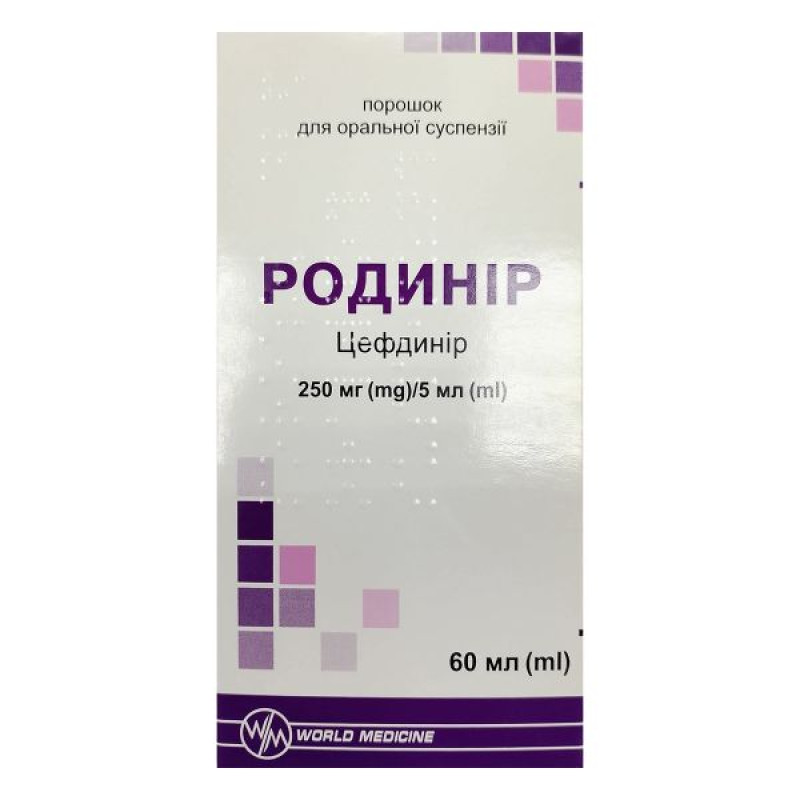
Instructions Rodinir powder for oral suspension 250 mg/5 ml bottle 60 ml
Composition
active ingredient: cefdinir;
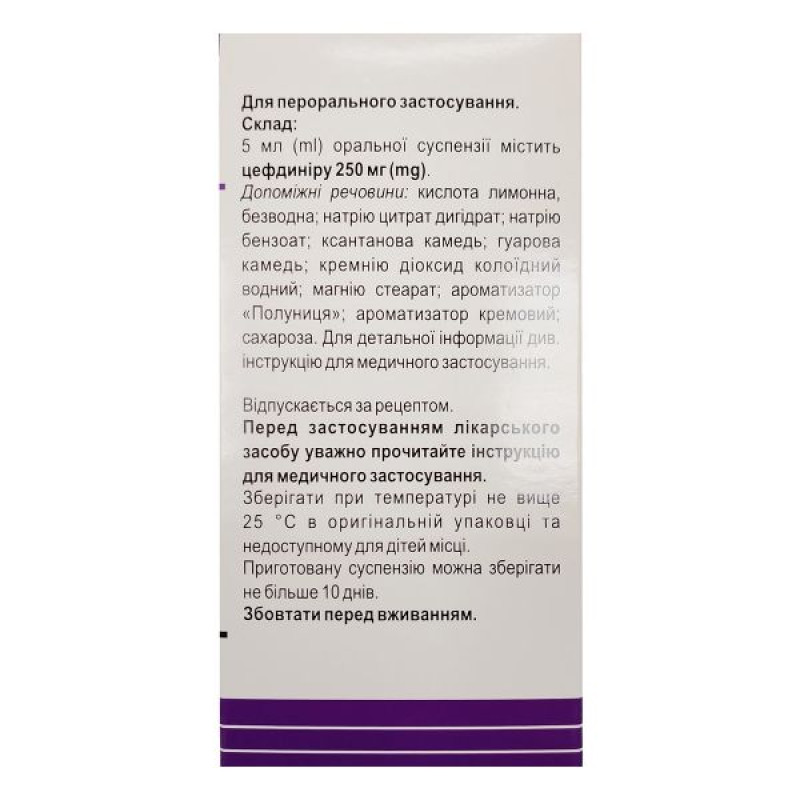
5 ml of oral suspension contains cefdinir 250 mg;
excipients: citric acid, anhydrous; sodium citrate dihydrate; sodium benzoate; xanthan gum; guar gum; colloidal silicon dioxide; magnesium stearate; strawberry flavor; cream flavor; sucrose.
Dosage form
Powder for oral suspension.
Main physicochemical properties:
powder: homogeneous granular powder of creamy yellow color with the smell of strawberries and cream;
Prepared suspension: homogeneous suspension of creamy yellow color with the smell of strawberries and cream.
Pharmacotherapeutic group
Antimicrobials for systemic use. Other beta-lactam antibiotics. Third generation cephalosporins. ATX code J01D D15.
Pharmacological properties
Pharmacodynamics.
Cefdinir is a third-generation, semi-synthetic, broad-spectrum oral cephalosporin antibiotic.
Like other cephalosporin antibiotics, cefdinir exerts its bactericidal action against susceptible microorganisms by inhibiting cell wall synthesis. It is resistant to the action of many, but not all, beta-lactamases. As a result, many microorganisms resistant to penicillins and some cephalosporins are sensitive to cefdinir.
The spectrum of antimicrobial activity of cefdinir includes:
- aerobic gram-positive microorganisms: Staphylococcus aureus (only strains sensitive to methicillin), Staphylococcus pneumoniae (only strains sensitive to penicillin), Staphylococcus pyogenes;
- aerobic gram-negative microorganisms: Haemophilus influenzae, Haemophilus parainfluenzae, Moraxella catarrhalis.
The minimum inhibitory concentration (MIC) of cefdinir in vitro is 1 μg/mL or less against (>90%) strains of the following microorganisms, however, its safety and efficacy in the treatment of diseases caused by these microorganisms have not been established in adequate and well-controlled clinical trials.
Aerobic gram-positive microorganisms: Staphylococcus epidermidis, Streptococcus agalactiae, Streptococcus viridans group.
Aerobic gram-negative microorganisms: Citrobacter koseri, Escherichia coli, Klebsiella pneumoniae, Proteus mirabilis.
Pharmacokinetics.
Absorption.
When administered orally, the time to reach maximum plasma concentrations of cefdinir is 2 to 4 hours. Plasma concentrations of cefdinir increase with increasing dose, but the increase becomes less proportional in the dose range of 300 mg (7 mg/kg) to 600 mg (14 mg/kg).
When cefdinir is taken with a fatty meal, the maximum plasma concentration (Cmax) and the area under the concentration-time curve (AUC) are reduced by 16% and 10%, respectively. This decrease is considered to be clinically insignificant. Therefore, cefdinir can be used regardless of food intake.
When administered once or twice daily in patients with normal renal function, cefdinir does not accumulate in the blood plasma.
Distribution.
The mean volume of distribution (Vdarea) of cefdinir in adult patients is 0.35 l/kg (± 0.29); in pediatric patients (age 6 months to 12 years) Vdarea is 0.67 l/kg (± 0.38). The extent of binding of cefdinir to plasma proteins is 60% to 70% in adults, in pediatric patients the extent of binding is independent of cefdinir concentration.
Metabolism and excretion.
Cefdinir is not significantly metabolized. It is eliminated primarily by the kidneys, with a mean elimination half-life (T1/2) of 1.7 (± 0.6) hours. In healthy volunteers with normal renal function, creatinine clearance (CC) is 2.0 (± 1.0) ml/min/kg, and oral clearance is 11.6 (± 6.0) and 15.5 (± 5.4) ml/min/kg after 300 mg and 600 mg of cefdinir, respectively. The mean percentage of the administered dose excreted unchanged in the urine after 300 mg and 600 mg doses is 18.4% (± 6.4) and 11.6% (± 4.6), respectively. Cefdinir clearance is reduced in patients with impaired renal function.
Since renal excretion is the major route of elimination of cefdinir, its dosage should be adjusted accordingly in patients with severe renal impairment and in patients undergoing hemodialysis.
Elderly patients.
The systemic exposure of cefdinir is significantly increased in the elderly: Cmax and AUC are 44% and 86%, respectively. This is due to a decrease in its clearance. The volume of distribution was also reduced. Thus, no significant decrease in the mean T1/2 of cefdinir was observed (elderly patients: 2.2 ± 0.6 hours compared to young patients: 1.8 ± 0.4 hours). Since the clearance of cefdinir is primarily associated with changes in renal function, and not with age, there is no need for dosage adjustment in such patients.
Patients with liver dysfunction.
Since cefdinir is primarily excreted by the kidneys and is not significantly metabolized, studies in patients with hepatic impairment have not been conducted. No dosage adjustment is recommended for such patients.
Patients with renal failure.
In patients with creatinine clearance from 30 to 60 ml/min, Cmax and T1/2 were approximately 2-fold higher and AUC approximately 3-fold higher. In patients with creatinine clearance, Cmax was approximately 2-fold higher, T1/2 approximately 5-fold higher and AUC approximately 6-fold higher. In patients with severe renal impairment (creatinine clearance
During dialysis (4 hours), 63% of cefdinir is removed from the body and T1/2 is reduced from 16 (± 3.5) to 3.2 (± 1.2) hours. It is recommended to adjust the dosage regimen for patients on hemodialysis.
Indication
Adults and children aged 13 and over
Community-acquired pneumonia caused by:
- Haemophilus influenzae (including beta-lactamase-producing strains);
- Haemophilus parainfluenzae (including beta-lactamase-producing strains);
- Streptococcus pneumonia (only strains sensitive to penicillin);
- Moraxella catarrhalis (including beta-lactamase-producing strains).
Exacerbation of chronic bronchitis caused by:
- Haemophilus influenzae (including beta-lactamase-producing strains);
- Haemophilus parainfluenzae (including beta-lactamase-producing strains);
- Streptococcus pneumonia (only strains sensitive to penicillin);
- Moraxella catarrhalis (including beta-lactamase-producing strains).
Acute sinusitis caused by:
- Haemophilus influenzae (including beta-lactamase-producing strains);
- Streptococcus pneumonia (only strains sensitive to penicillin);
- Moraxella catarrhalis (including beta-lactamase-producing strains).
Pharyngitis/tonsillitis due to:
- Streptococcus pyogenes.
Uncomplicated skin and soft tissue infections caused by:
- Staphylococcus aureus (including strains producing beta-lactamase);
- Streptococcus pyogenes.
Children weighing 18 kg or more
Acute otitis media caused by:
- Haemophilus influenzae (including beta-lactamase-producing strains);
- Streptococcus pneumonia (only strains sensitive to penicillin);
- Moraxella catarrhalis (including beta-lactamase-producing strains).
Acute sinusitis caused by:
- Haemophilus influenzae (including beta-lactamase-producing strains);
- Streptococcus pneumonia (only strains sensitive to penicillin);
- Moraxella catarrhalis (including beta-lactamase-producing strains).
Pharyngitis/tonsillitis due to:
- Streptococcus pyogenes.
Uncomplicated skin and soft tissue infections caused by:
- Staphylococcus aureus (including strains producing beta-lactamase);
- Streptococcus pyogenes.
Contraindication
Hypersensitivity to cefdinir, other cephalosporins and excipients of the drug.
Interaction with other medicinal products and other types of interactions
When cefdinir is used simultaneously with other drugs, the following interactions may develop:
With antacids (aluminum or magnesium-containing) - a decrease in Cmax and AUC of cefdinir by approximately 40%. When using these drugs simultaneously, cefdinir should be taken at least 2 hours before or 2 hours after taking the antacid.
With iron-containing drugs (containing 60 mg of elemental iron), vitamin drugs (containing 10 mg of iron) - a decrease in the absorption of cefdinir by 80% and 31%, respectively. With simultaneous use of these drugs, cefdinir should be taken at least 2 hours before or 2 hours after taking iron-containing drugs.
Cases of reddish stool discoloration have been reported in patients taking cefdinir. In many cases, patients were taking iron-fortified products at the same time. The reddish discoloration may be due to the formation of a complex of cefdinir or its degradation products with non-absorbed iron in the digestive tract.
With probenecid - impaired renal excretion of cefdinir (as with the use of other cephalosporins), which leads to a 2-fold increase in AUC, Cmax - by 54% and prolongation of T1/2 - by 50%.
Interaction with laboratory tests.
False-positive results for urinary ketones may occur with cefdinir when nitroprusside is used, but not with nitroferricyanide.
Cefdinir may also cause false-positive results in urine glucose tests using Benedict's solution or Fehling's reagent. It is recommended that only enzymatic methods be used to determine glucosuria.
The use of cephalosporins can sometimes lead to a false-positive Coombs test result.
Application features
The use of the drug in the absence of a proven or reasonably suspected bacterial infection or prophylactic use of cefdinir is of questionable benefit to the patient and increases the risk of developing antibiotic resistance.
Before starting the drug, a history of hypersensitivity reactions to cefdinir, other cephalosporins, penicillins, or other drugs should be excluded.
As with other broad-spectrum antibiotics, prolonged treatment with cefdinir may result in the overgrowth of non-susceptible organisms. The patient should be closely monitored. In the event of superinfection, appropriate alternative treatment should be instituted.
Impact on the immune system.
If hypersensitivity reactions occur, the drug should be discontinued. In the event of serious allergic reactions, the administration of adrenaline and other emergency measures may be necessary, including oxygen, intravenous fluids, antihistamines, corticosteroids, pressor amines, and airway management as clinically indicated.
Effect on the digestive tract.
Antibacterial therapy alters the normal colonic flora, leading to overgrowth of C. difficile, subsequent release of toxins A and B, and development of antibiotic-associated diarrhea (AAD). Because C. difficile can be refractory to antimicrobial therapy, this disease is associated with increased morbidity and mortality and may require colectomy.
AAD has been reported with virtually all antibacterial agents, including cefdinir, and has ranged in severity from mild diarrhea to fatal colitis. AAD should be considered in all patients presenting with diarrhea during or after antibacterial therapy. A careful history and clinical examination should be performed, as late onset of AAD has been reported, with pseudomembranous colitis occurring 2 months after completion of antimicrobial therapy.
If AAD is suspected or confirmed, the drug should be discontinued. Based on the clinical condition, the patient may be treated with fluids, electrolytes, and amino acid replacement, appropriate antibiotic therapy for C. difficile, or surgery.
Use in patients with a history of colitis.
The drug should be used with caution in such patients.
Use in patients with renal insufficiency.
Patients with transient or persistent renal insufficiency (CK
Use during pregnancy or breastfeeding
Experimental reproduction studies have shown the absence of any teratogenic effect. There are no data on the results of the use of cefdinir in pregnant women. During pregnancy, the use of the drug is possible only in case of justified clinical need.
When using cefdinir at a dose of 600 mg, it is not detected in breast milk.
Ability to influence reaction speed when driving vehicles or other mechanisms
The drug does not affect the reaction speed when driving vehicles or other mechanisms.
Method of administration and doses
The medicine is intended for oral use.
The suspension is prepared immediately before the first use. The bottle should be shaken to loosen the powder, add 38 ml or 63 ml of boiled water cooled to room temperature, in two portions (up to the mark), shaking vigorously each time. Then let the suspension stand for about 5 minutes to ensure complete dilution. The suspension should be shaken well before each dose. For accurate dosing of the drug, a 5 ml measuring spoon should be used, which should be rinsed well with water after each use. After dilution, the suspension should be stored for no more than 10 days at room temperature. For convenience of administration of the suspension for children under 2 years of age, it can be diluted with water in a ratio of 1:2. The drug can be used regardless of food intake.
The dosage regimen is set individually depending on the patient's age, body weight, kidney function, and the severity of the infection.
Adults and children aged 13 and over
The total daily dose for the treatment of all infections is 14 mg/kg body weight. The maximum dose of the drug is 600 mg per day. The use of the drug 1 time per day for 10 days is as effective as the use of 2 times per day. The use of cefdinir 1 time per day has not been studied in the treatment of skin infections, so in these cases the drug should be taken 2 times per day.
Children weighing 18 kg or more.
The recommended dosage of the drug and the duration of treatment for infections are listed in the tables below.
Table 1
| Type of infection | Dosage | Duration |
| Acute otitis media | 7 mg/kg every 12 hours or 14 mg/kg every 24 hours | 5-10 days or 10 days |
| Acute sinusitis | 7 mg/kg every 12 hours or 14 mg/kg every 24 hours | 10 days |
| Pharyngitis/tonsillitis | 7 mg/kg every 12 hours or 14 mg/kg every 24 hours | 5-10 days or 10 days |
| Uncomplicated skin and soft tissue infections | 7 mg/kg every 12 hours or 14 mg/kg every 24 hours | 10 days |
Table 2
| Body weight, kg | Dosage |
| 18 | 2.5 ml every 12 hours or 5 ml once a day |
| 27 | 3.75 ml every 12 hours or 7.5 ml once a day |
| 36 | 5 ml every 12 hours or 10 ml once a day |
| ≥ 431 | 6 ml every 12 hours or 12 ml once a day |
1 For children weighing ≥ 43 kg, the drug should be administered at a maximum daily dose of 600 mg.
Adult patients with creatinine clearance
The following formula can be used to estimate creatinine clearance in adult patients. Plasma creatinine should reflect steady-state renal function.
[140 – age (in years)] × body weight (kg) 72 × plasma creatinine (mg/dL) | (× 0.85 for women) |
CC (ml/min) =
The following formula can be used to estimate the CC of children.
K ´ height (cm)__________________ blood plasma creatinine (mg/dl) |
CC (ml/min/1.73 m2) =
K = 0.55 for children weighing 18 kg or more.
Patients on hemodialysis.
For patients on continuous hemodialysis, the recommended initial dose of the drug is 300 mg or 7 mg/kg every other day. At the end of each hemodialysis session, 300 mg (or 7 mg/kg) of cefdinir should be administered, with subsequent doses (300 mg or 7 mg/kg) administered every other day.
Patients with liver dysfunction.
No dosage adjustment is recommended for such patients.
Elderly patients.
There is no need for dosage adjustment in such patients.
Children.
The medicine should be used in children weighing 18 kg or more.
Overdose
There are no data on overdose of cefdinir in humans. In acute toxicity studies in rodents, a single oral dose of cefdinir at a dose of 5600 mg/kg did not cause any adverse reactions. The following symptoms and signs have been reported with overdose of other cephalosporins: nausea, vomiting, gastric discomfort, diarrhea, and convulsions.
Cefdinir is removed from the body by hemodialysis, which may be useful in the event of serious toxic reactions caused by overdose, especially if the patient has impaired renal function.
Adverse reactions
The following adverse reactions have been observed during treatment with cefdinir with the following frequencies: very common (≥1/10), common (≥1/100 and <1/1000), uncommon (≥1/1000 to
often – diarrhea, vaginal candidiasis, nausea, headache, abdominal pain, vaginitis;
infrequently - rash, dyspepsia, flatulence, vomiting, bowel disorders, anorexia, constipation, dizziness, dry mouth, asthenia, insomnia, leukorrhea, candidiasis, itching, drowsiness.
The following adverse reactions have been reported with the use of cephalosporin antibiotics:
allergic reactions, anaphylaxis, Stevens-Johnson syndrome, erythema multiforme, toxic epidermal necrolysis, renal dysfunction, toxic nephropathy, hepatic dysfunction (including cholestasis), aplastic anemia, hemolytic anemia, hemorrhagic disorders, false-positive urine glucose test, neutropenia, pancytopenia, and agranulocytosis. Pseudomembranous colitis may develop both during and after antibiotic treatment.
The use of some cephalosporins has been associated with the development of seizures, especially in patients with impaired renal function who have not undergone dosage adjustment. If seizures develop, the drug should be discontinued. Anticonvulsant therapy may be prescribed if clinically necessary.
The following adverse reactions have also been reported in post-marketing experience with cefdinir: shock, anaphylaxis (in rare cases fatal), facial and laryngeal edema, dyspnea, serum sickness, conjunctivitis, stomatitis, Stevens-Johnson syndrome, toxic epidermal necrolysis, exfoliative dermatitis, erythema multiforme, erythema nodosum, acute hepatitis, cholestasis, fulminant hepatitis, hepatic failure, jaundice, increased amylase levels, acute enterocolitis, hemorrhagic diarrhea, hemorrhagic colitis, melena, pseudomembranous colitis, pancytopenia, granulocytopenia, leukopenia, thrombocytopenia, idiopathic thrombocytopenic purpura, hemolytic anemia, acute respiratory failure, asthma attack, drug-induced pneumonia, eosinophilic pneumonia, idiopathic interstitial pneumonia, fever, acute renal failure, nephropathy, bleeding tendency, blood clotting disorders, generalized thrombohemorrhagic syndrome, upper gastrointestinal bleeding, peptic ulcer, intestinal obstruction, loss of consciousness, allergic vasculitis, possible cefdinir-diclofenac interaction, heart failure, chest pain, myocardial infarction, hypertension, involuntary movements, rhabdomyolysis.
Reporting of suspected adverse reactions.
Reporting suspected adverse reactions that occur after the registration of a medicinal product is very important. This allows for continuous monitoring of the benefit/risk balance of the medicinal product. Healthcare professionals should report any suspected adverse reactions through the national pharmacovigilance system.
Expiration date
3 years.
The prepared suspension can be stored for no more than 10 days.
Storage conditions
Store at a temperature not exceeding 25 °C in the original packaging and out of the reach of children.
Packaging
60 ml or 100 ml in a bottle with a lid; 1 bottle with a measuring spoon in a cardboard box.
Vacation category
According to the recipe.
Producer
PharmaVision San. in Tij. A. Sh./
PharmaVision San. ve Tic. AS
Address
Davutpaşa Jad. No. 145, Topkapi, Istanbul, Turkey/
Davutpasa Cad. No.145, Topkapi, Istanbul, Turkey.
Applicant.
Ukraine, 03142, Kyiv, Vasyl Stus St., 35-37.