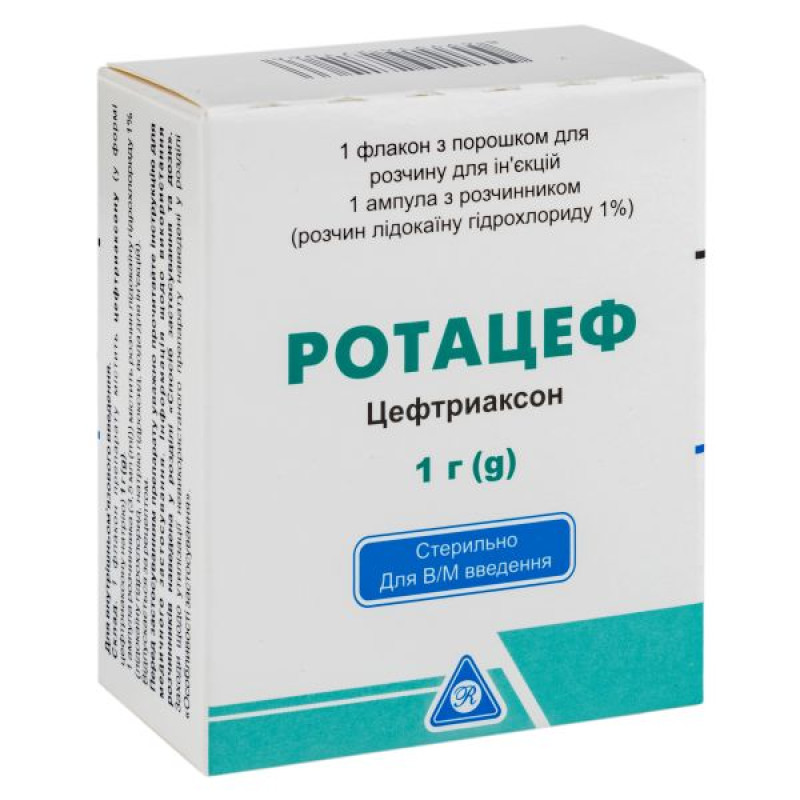
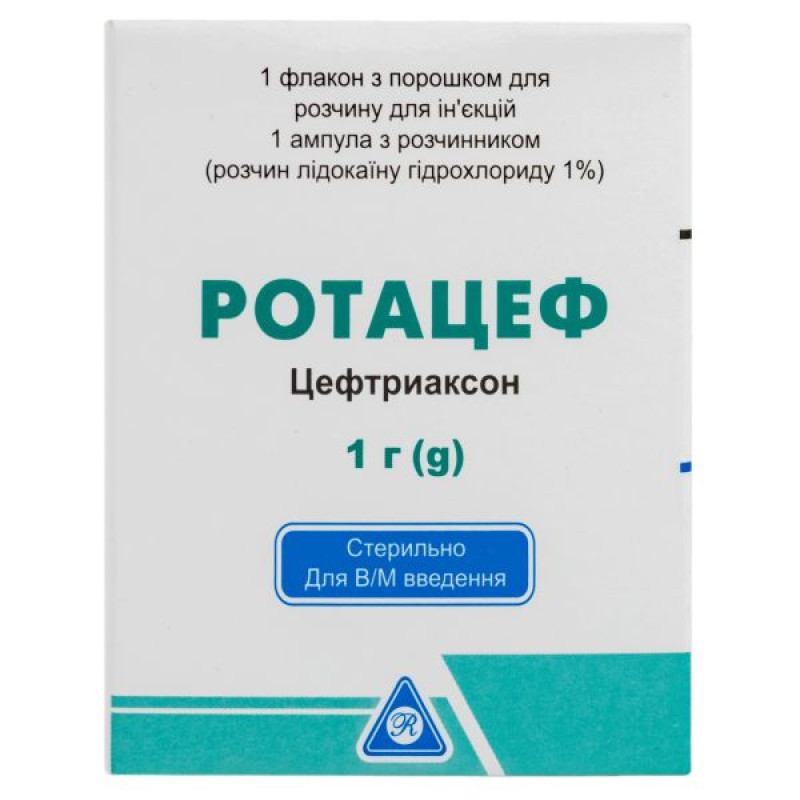
Instructions Rotacef powder for solution for injection 1 g vial with 1% lidocaine in ampoules 3.5 ml No. 1
Composition
active ingredient: ceftriaxone;
1 vial contains ceftriaxone (in the form of ceftriaxone sodium) 0.5 g or 1 g;
1 ampoule of solvent contains a 1% lidocaine hydrochloride solution (lidocaine hydrochloride, sodium hydroxide, water for injection),
or
1 ampoule of solvent contains water for injections.
Dosage form
Powder for solution for injection.
Main physicochemical properties: crystalline powder, partially hygroscopic, almost white or yellowish in color.
Solvent (lidocaine hydrochloride solution 1%): colorless, transparent, odorless solution.
Solvent (water for injections): colorless, clear solution.
Pharmacotherapeutic group
Antibacterials for systemic use. Other β-lactam antibiotics. Third generation cephalosporins. Ceftriaxone. ATX code J01D D04.
Pharmacological properties
Pharmacodynamics.
Mechanism of action.
Ceftriaxone inhibits bacterial cell wall synthesis after binding to penicillin-binding proteins. As a result, cell wall (peptidoglycan) biosynthesis is stopped, which in turn leads to bacterial cell lysis and death.
Resistance.
Bacterial resistance to ceftriaxone may develop as a result of one or more of the following mechanisms:
- hydrolysis by beta-lactamases, including extended-spectrum beta-lactamases, carbapenemases and Amp C enzymes, which can be induced or persistently inhibited in some aerobic Gram-negative bacteria;
- reduced affinity of penicillin-binding proteins for ceftriaxone;
- impermeability of the outer membrane in gram-negative bacteria;
- bacterial efflux pump.
Limit values when determining sensitivity.
Breakpoints for minimum inhibitory concentration (MIC) determined by the European Committee on Antimicrobial Susceptibility Testing (EUCAST):
| Pathogen | Dilution method (minimum inhibitory concentration, mg/L) |
| Sensitive | Resistant |
| Enterobacteriaceae | ≤ 1 | > 2 |
| Staphylococcus spp. | a. | a. |
| Streptococcus spp. (groups A, B, C and G) | b. | b. |
| Streptococcus pneumoniae | ≤ 0.5c. | > 2 |
| Streptococci of the Viridans group | ≤ 0.5 | > 0.5 |
| Haemophilus influenzae | ≤ 0.12c. | > 0.12 |
| Moraxella catarrhalis | ≤ 1 | > 2 |
| Neisseria gonorrhoeae | ≤ 0.12 | > 0.12 |
| Neisseria meningitidis | ≤ 0.12c. | > 0.12 |
| Not related to the species | ≤ 1d. | > 2 |
a. Susceptibility is inferred based on susceptibility to cefoxitin. b. Susceptibility is inferred based on penicillin susceptibility. p. Isolates with MICs exceeding the susceptibility breakpoints are rare. If this is observed, retesting should be performed and, if confirmed, sent to a reference laboratory. d. The cut-off values relate to a daily intravenous dose of 1 g x 1 and a high dose of at least 2 g x 1 |
Clinical efficacy against specific microorganisms.
The prevalence of resistance of individual species may vary, depending on the region and time. When treating serious infections, it is advisable to take into account local information on resistance. If necessary, specialist advice should be sought when the local prevalence of resistance is such that the benefit of use is questionable.
| Typically sensitive species |
Gram-positive aerobes Staphylococcus aureus (methicillin-susceptible)£ coagulase-negative staphylococci (methicillin-susceptible)£ Streptococcus pyogenes (group A) Streptococcus agalactiae (group B) Streptococcus pneumoniae, Streptococci of the Viridans group Gram-negative aerobes Borrelia burgdorferi Haemophilus influenzae Haemophilus parainfluenzae Moraxella catarrhalis Neisseria gonorrhoeae Neisseria meningitidis Proteus mirabilis Providentia spp. Treponema pallidum |
| Species that may acquire resistance |
Gram-positive aerobes Staphylococcus epidermidis+ Staphylococcus haemolyticus+ Staphylococcus hominis + Gram-negative aerobes Citrobacter freundii Enterobacter aerogenes Enterobacter cloacae Escherichia coli% Klebsiella pneumoniae% Anaerobes Bacteroides spp. Fusobacterium spp. Peptostreptococcus spp. Clostridium perfringens |
| Resistant microorganisms |
Gram-positive aerobes Enterococcus spp. Listeria monocytogenes Gram-negative aerobes Acinetobacter baumannii Pseudomonas aeruginosa Stenotrophomonas maltophilia Anaerobes Clostridium difficile Others Chlamydia spp. Chlamydomydophila spp. Mycoplasma spp. Legionella spp. Ureaplasma urealyticum |
£ All methicillin-resistant staphylococci are resistant to ceftriaxone. + Resistance rate of 50% in at least one region. % Strains producing extended-spectrum beta-lactamase are always resistant. |
Pharmacokinetics.
Absorption.
After intramuscular injection, the mean maximum plasma concentration (Cmax) of ceftriaxone is approximately half that observed after intravenous administration of an equivalent dose. Cmax after a single intramuscular injection of 1 g of ceftriaxone is 81 mg/l and is reached 2-3 hours after administration. The area under the plasma concentration-time curve after intramuscular administration is equal to that after intravenous administration of an equivalent dose.
Intravenous administration.
After intravenous bolus administration of ceftriaxone at a dose of 500 mg and 1 g, the mean Cmax of ceftriaxone is approximately 120 and 200 mg/l, respectively. After intravenous infusions of ceftriaxone at a dose of 500 mg, 1 g and 2 g, the level of ceftriaxone in the blood plasma is approximately 80, 150 and 250 mg/l, respectively.
Distribution.
The volume of distribution of ceftriaxone is 7–12 L. Concentrations well above the MIC for most important pathogens are found in tissues including the lungs, heart, biliary tract, liver, tonsils, middle ear and nasal mucosa, bone, as well as cerebrospinal, pleural and synovial fluids, and prostatic secretion. An increase in mean Cmax of 8–15% was observed with repeated administration; steady state was reached in most cases within 48–72 hours, depending on the route of administration.
Penetration into individual tissues.
Ceftriaxone penetrates the meninges. Penetration is more pronounced in cases of inflammation of the meninges. The mean Cmax of ceftriaxone in the cerebrospinal fluid in patients with bacterial meningitis is up to 25% of that in plasma compared to 2% in patients without inflammation of the meninges. Cmax of ceftriaxone in the cerebrospinal fluid is reached approximately 4-6 hours after intravenous injection. Ceftriaxone crosses the placental barrier and is expected to be present in low concentrations in breast milk (see section "Use during pregnancy or lactation").
Protein binding.
Ceftriaxone is reversibly bound to albumin. Plasma protein binding is approximately 95% at plasma concentrations below 100 mg/L. Binding is saturable and the extent of binding decreases with increasing concentration (to 85% at plasma concentrations of 300 mg/L).
Metabolism.
Ceftriaxone is not subject to systemic metabolism, but is converted into inactive metabolites by the intestinal flora.
Breeding.
The total plasma clearance of ceftriaxone (bound and unbound) is 10–22 ml/min. Renal clearance is 5–12 ml/min. 50–60% of ceftriaxone is excreted unchanged by the kidneys, primarily by glomerular filtration, 40–50% is excreted unchanged in the bile. The elimination half-life (T1/2) of ceftriaxone in adults is about 8 hours.
Special categories of patients.
Patients with renal or hepatic insufficiency.
In patients with impaired renal and hepatic function, the pharmacokinetics of ceftriaxone are slightly altered: only a slight increase in T1/2 (less than 2-fold) is noted, even in patients with severe renal impairment.
The moderate increase in T1/2 in renal impairment is due to a compensatory increase in extrarenal clearance resulting from reduced protein binding and a corresponding increase in extrarenal clearance of total ceftriaxone.
In patients with impaired liver function, the half-life of ceftriaxone is not increased due to a compensatory increase in renal clearance. This is also due to an increase in the free fraction of ceftriaxone in plasma, which contributes to a paradoxical increase in the total clearance of ceftriaxone with an increase in the volume of distribution.
Elderly patients.
In patients aged 75 years and older, the mean T1/2 is usually 2–3 times higher than in younger adults.
Children.
The half-life of ceftriaxone is prolonged in neonates to 14 days. The level of free ceftriaxone may further increase as a result of factors such as decreased glomerular filtration and impaired protein binding. In children, the half-life is shorter than in neonates or adults.
Plasma clearance and volume of distribution of total ceftriaxone are higher in neonates, infants and children than in adults.
Linearity/nonlinearity.
The pharmacokinetics of ceftriaxone are non-linear. All major pharmacokinetic parameters based on total ceftriaxone concentrations, with the exception of T1/2, are dose-dependent. Non-linearity is a result of saturation of plasma protein binding and is therefore observed in plasma for total ceftriaxone but not for free (unbound) ceftriaxone.
Pharmacokinetic/pharmacodynamic relationship.
As with other beta-lactams, the pharmacokinetic/pharmacodynamic index that best correlates with in vivo efficacy is the percentage of the dosing interval over which the unbound concentration remains above the MIC of ceftriaxone for the individual target species (i.e., percentage T > MIC).
Indication
The drug is indicated for the treatment of the following infections in adults and children, including full-term newborns (from birth):
bacterial meningitis;
community-acquired pneumonia;
hospital-acquired pneumonia;
acute otitis media;
intra-abdominal infections;
complicated urinary tract infections (including pyelonephritis);
complicated skin and soft tissue infections;
gonorrhea;
syphilis;
bacterial endocarditis.
The medicine can be used for:
treatment of acute complications of chronic obstructive pulmonary disease in adults;
treatment of disseminated Lyme borreliosis (early (stage II) and late (stage III)) in adults and children, including newborns from 15 days of age;
preoperative prevention of infections at the surgical site;
management of neutropenic patients who develop fever with suspected bacterial infection;
treatment of patients with bacteremia due to any of the above infections or if any of the above infections is suspected.
The drug should be used together with other antibacterial drugs if the possible range of bacterial pathogens does not fall within its spectrum of action (see section "Special instructions for use").
Official recommendations on the appropriate use of antibacterial agents should be taken into account.
Contraindication
Hypersensitivity to ceftriaxone or to any other cephalosporin.
History of severe hypersensitivity reactions (e.g. anaphylactic reactions) to any other type of beta-lactam antibacterial agent (penicillins, monobactams and carbapenems).
The use of ceftriaxone is contraindicated:
premature newborns ≤ 41 weeks of gestational age (gestational age + age after birth)*;
full-term newborns (age ≤ 28 days):
with hyperbilirubinemia, jaundice, hypoalbuminemia, or acidosis, as bilirubin binding is likely to be impaired in these conditions*;
who require (or are expected to require) intravenous calcium preparations or infusions of calcium-containing solutions, as there is a risk of precipitation of the calcium salt of ceftriaxone (see sections "Special instructions" and "Adverse reactions" and "Incompatibility").
*In vitro studies have shown that ceftriaxone may displace bilirubin from its association with plasma albumin, leading to a possible risk of bilirubin encephalopathy in such patients.
Before intramuscular administration of ceftriaxone, it is essential to exclude contraindications to the use of lidocaine when used as a diluent (see section "Special instructions for use"). See the instructions for medical use of lidocaine, especially contraindications.
Ceftriaxone solutions containing lidocaine should never be administered intravenously.
Interaction with other medicinal products and other types of interactions
Solvents containing calcium.
Diluents containing calcium, such as Ringer's solution or Hartmann's solution, should not be used to reconstitute the product in vials or to further dilute the reconstituted solution for intravenous administration, as a precipitate may form. Precipitates of the calcium salt of ceftriaxone may also form when ceftriaxone is mixed with calcium-containing solutions in the same infusion line. Ceftriaxone should not be administered simultaneously with calcium-containing intravenous solutions, including calcium-containing solutions for long-term infusion, such as parenteral nutrition solutions, through a Y-line. However, in all patients, except neonates, ceftriaxone and calcium-containing solutions may be administered sequentially, one after the other, provided that the system is thoroughly flushed with a compatible fluid between infusions. In vitro studies using adult and neonatal cord blood plasma have shown that neonates are at increased risk of precipitation of ceftriaxone calcium salt (see sections “Contraindications”, “Special instructions for use”, “Method of administration and dosage” and “Adverse reactions”, “Incompatibility”).
Oral anticoagulants.
Concomitant use of ceftriaxone with oral anticoagulants may potentiate their effects and increase the risk of bleeding. In the case of concomitant use of these agents, frequent monitoring of the international normalized ratio (INR) and appropriate adjustment of the anticoagulant dose are recommended both during and after ceftriaxone therapy (see section "Adverse reactions").
Aminoglycosides.
There is conflicting evidence regarding the potential for increased renal toxicity of aminoglycosides when used concomitantly with cephalosporins. Clinical practice guidelines for monitoring aminoglycoside levels (and renal function) should be carefully followed when these agents are used concomitantly.
Chloramphenicol.
In an in vitro study, antagonism was observed when chloramphenicol was used in combination with ceftriaxone. The clinical significance of this finding is unknown.
Calcium-containing drugs.
There have been no reported cases of interaction between ceftriaxone and oral calcium-containing drugs or between intramuscular ceftriaxone and calcium-containing drugs (intravenous or oral).
Diuretics.
No renal dysfunction has been observed after concomitant administration of high doses of ceftriaxone and potent diuretics (e.g. furosemide).
Concomitant use of probenecid does not reduce the excretion of ceftriaxone.
Impact on laboratory test results.
False-positive Coombs test results are possible in patients taking ceftriaxone.
Ceftriaxone, like other antibiotics, may cause false-positive test results for galactosemia.
Similarly, non-enzymatic methods for measuring urine glucose may give false positive results. For this reason, enzymatic methods should be used during ceftriaxone therapy.
Application features
Hypersensitivity reactions.
As with all beta-lactam antibiotics, serious hypersensitivity reactions, sometimes fatal, have been reported with ceftriaxone (see section 4.8). In the event of a severe hypersensitivity reaction, the drug should be discontinued immediately and appropriate emergency measures should be taken. Before initiating treatment, it should be ascertained whether the patient has a history of severe hypersensitivity reactions to ceftriaxone, other cephalosporins or other types of beta-lactams. The drug should be used with caution in patients with a history of non-severe hypersensitivity to other beta-lactams.
Skin reactions.
Cases of serious skin adverse reactions (Stevens-Johnson syndrome or Lyell's syndrome/toxic epidermal necrolysis and drug reaction with eosinophilia and systemic symptoms (DRESS syndrome)) which can be life-threatening or fatal have been reported with the use of ceftriaxone, but the frequency of these reactions is unknown (see section "Adverse reactions").
Jarisch-Herxheimer reaction.
Some patients with spirochetal infections may develop a Jarisch-Herxheimer reaction shortly after initiation of ceftriaxone therapy. This reaction is usually self-limiting or resolves with symptomatic treatment. If this reaction occurs, the drug may not be discontinued.
Interaction with drugs containing calcium.
Cases of ceftriaxone calcium precipitates in the lungs and kidneys with fatal outcomes have been reported in premature and full-term infants up to 1 month of age. In at least one of these patients, ceftriaxone and calcium were administered at different times and through different intravenous infusion systems. According to the available scientific data, there are no confirmed cases of intravascular precipitates, except in neonates who were administered ceftriaxone and calcium-containing solutions or any other calcium-containing drugs. In vitro studies have shown that neonates are at increased risk of ceftriaxone calcium precipitates compared to patients of other age groups.
When using the drug in patients of any age, the solution should not be mixed or administered simultaneously with any intravenous solutions containing calcium, even when using different infusion systems or administering the drugs into different infusion sites. However, in patients from 28 days of age, ceftriaxone and calcium-containing solutions can be administered sequentially one after the other, provided that the drugs are administered through different infusion systems into different body sites or that the infusion system is replaced or thoroughly flushed with physiological saline between administrations to prevent the formation of a precipitate. For patients requiring continuous infusions of calcium-containing solutions for total parenteral nutrition (TPN), alternative antibacterial agents that do not carry a similar risk of precipitation can be used. If the use of ceftriaxone in patients requiring continuous nutrition is considered necessary, the TPN solutions and ceftriaxone can be administered simultaneously, through different infusion systems and into different body sites. Also, the administration of PPH solutions can be suspended during the ceftriaxone infusion and the infusion systems flushed between the administration of solutions (see sections “Contraindications”, “Adverse Reactions” and “Incompatibilities”).
Application to children.
The safety and efficacy of ceftriaxone in neonates, infants and children have been established at the doses described in the section "Method of administration and dosage". Studies have shown that ceftriaxone, like some other cephalosporins, can displace bilirubin from its association with plasma albumin.
The drug is contraindicated in premature and full-term newborns at risk of developing bilirubin encephalopathy (see section "Contraindications").
Risk of immune-mediated hemolytic anemia.
Cases of immune-mediated haemolytic anaemia have been reported in patients receiving cephalosporin antibacterial agents, including ceftriaxone (see section 4.8). Severe cases of haemolytic anaemia, including fatalities, have been reported during treatment with ceftriaxone in both adults and children.
If anemia develops, the diagnosis of cephalosporin-associated anemia should be considered and the drug discontinued until the etiology of the disease is determined.
With long-term use of the drug, a detailed blood test should be performed regularly.
Risk of colitis/overgrowth of non-susceptible microorganisms.
Antibacterial-associated colitis and pseudomembranous colitis have been reported with nearly all antibacterial agents, including ceftriaxone. The severity of these events may range from mild to life-threatening. Therefore, it is important to consider the possibility of such a diagnosis in patients who develop diarrhoea during or after the use of ceftriaxone (see section 4.8). Discontinuation of the medicinal product and the use of appropriate anti-Clostridium difficile agents should be considered. Medicinal products that inhibit peristalsis should not be used.
As with the use of other antibacterial agents, superinfections caused by microorganisms insensitive to ceftriaxone may occur.
Use in patients with severe renal and hepatic insufficiency.
When using the drug in patients with severe renal and hepatic insufficiency, careful clinical monitoring of safety and efficacy is recommended (see section "Method of administration and dosage").
Impact on serological test results.
Ceftriaxone may cause false-positive Coombs' test results. Ceftriaxone may also cause false-positive results in tests for galactosemia (see section 4.8).
Non-enzymatic methods may give false positive results for glucose in urine. During treatment with ceftriaxone, urine glucose should be measured using enzymatic methods (see section 4.8).
Ceftriaxone may cause false (decreased) blood glucose levels when measured with some monitoring systems. Refer to the instructions for each such system. If necessary, use alternative test methods.
Spectrum of antibacterial activity.
Ceftriaxone has a limited spectrum of antibacterial activity and may not be suitable for use as monotherapy in the treatment of certain types of infection unless the causative agent is already confirmed (see section 4.2). In polymicrobial infections where ceftriaxone-resistant organisms are suspected, additional antibiotics should be considered.
Use of lidocaine.
If lidocaine solution is used as a diluent, ceftriaxone can only be administered intramuscularly. Before using the medicinal product, it is necessary to take into account the contraindications to the use of lidocaine, precautions and other relevant information given in the instructions for medical use of lidocaine (see section "Contraindications"). Lidocaine solution should never be administered intravenously.
Risk of gallstone disease.
In case of shadows on the sonogram, the possibility of ceftriaxone calcium precipitates should be considered. Shadows mistaken for gallstones have been observed on sonograms of the gallbladder, and their frequency increased with ceftriaxone doses of 1 g/day and above. The drug should be used with particular caution in children. Such precipitates disappear after cessation of ceftriaxone therapy. In rare cases, the formation of ceftriaxone calcium precipitates has been accompanied by symptoms. In the presence of symptoms, conservative non-surgical treatment is recommended, and the physician should decide to discontinue the drug based on the results of a benefit-risk assessment in a specific case (see section "Adverse reactions").
Risk of bile stasis.
Cases of pancreatitis, possibly due to biliary obstruction, have been reported with ceftriaxone (see section 4.8). Most of these patients had risk factors for cholestasis and biliary sludge formation, such as previous extensive therapy, severe illness and total parenteral nutrition. It cannot be excluded that the formation of biliary precipitates due to ceftriaxone may be a precipitating or additional factor in the development of this disorder.
Risk of kidney stones.
Cases of kidney stones have been reported, which resolved after discontinuation of ceftriaxone (see section 4.8). If symptoms are present, an ultrasound examination should be performed. The decision to use the drug in patients with a history of kidney stones or hypercalciuria should be made by the physician, taking into account the results of the benefit-risk assessment of the individual case.
Risk of encephalopathy.
Encephalopathy has been reported with ceftriaxone (see section 4.8), particularly in elderly patients with severe renal impairment (see section 4.2) or central nervous system disorders. If ceftriaxone-related encephalopathy is suspected (e.g., decreased level of consciousness, altered mental status, myoclonus, convulsions), discontinuation of the drug should be considered.
1 gram of the medicinal product contains 3.6 mmol sodium. This should be taken into account by patients on a controlled sodium diet.
Disposal of the medicinal product.
Release of the medicinal product into the environment should be minimised. The medicinal product should not be disposed of via sewage systems or household waste. Any unused medicinal product after the end of treatment or the expiry date should be returned in the original packaging to the supplier (doctor or pharmacist) for proper disposal.
Use during pregnancy or breastfeeding
Pregnancy.
Ceftriaxone crosses the placental barrier. There are limited data from the use of ceftriaxone in pregnant women. Animal studies do not indicate direct or indirect harmful effects on embryonal/fetal, peri- and postnatal development. During pregnancy, particularly in the first trimester, the drug should be used only if the benefit outweighs the risk.
Breastfeeding period.
Ceftriaxone is excreted in breast milk in low concentrations, but no effects on the breastfed infant are expected at therapeutic doses. However, the risk of diarrhoea and fungal infections of the mucous membranes cannot be excluded. The possibility of sensitization should be considered. A decision should be made whether to discontinue breast-feeding or to discontinue/abstain from the drug during breast-feeding, taking into account the benefit of breast-feeding for the child and the benefit of therapy for the woman.
Fertility.
Reproductive studies have shown no evidence of adverse effects on male or female fertility.
Ability to influence reaction speed when driving vehicles or other mechanisms
During the use of ceftriaxone, side effects such as dizziness may occur, which may affect the ability to drive or use machines (see section "Adverse reactions"). Caution should be exercised when driving or using machines.
Method of administration and doses
Dosage.
The dose of the drug depends on the severity, sensitivity, location and type of infection, as well as the patient's age and liver and kidney function.
The following are recommended doses for specific indications. In particularly severe cases, the highest dose of ceftriaxone in the recommended range should be used.
Adults and children aged 12 years and over (≥ 50 kg).
| Ceftriaxone dose* | Frequency of administration** | Indication |
| 1–2 g | 1 time per day | Community-acquired pneumonia Acute complication of chronic obstructive pulmonary disease Intra-abdominal infections Complicated urinary tract infections (including pyelonephritis) |
| 2 g | 1 time per day | Hospital-acquired pneumonia Complicated skin and soft tissue infections Bone and joint infections |
| 2–4 g | 1 time per day | Management of neutropenic patients who develop fever and are suspected of having a bacterial infection Bacterial endocarditis Bacterial meningitis |
* In case of documented bacteremia, the highest dose in the recommended range should be considered;
** In case of doses exceeding 2 g per day, administration of the drug twice daily (12-hourly) should be considered.
Indications in adults and children aged 12 years and over (≥ 50 kg) who require special dosing regimens.
Acute otitis media.
The drug can be administered intramuscularly at a dose of 1–2 g once.
Some evidence suggests that in cases where the patient's condition is severe or previous therapy has failed, ceftriaxone may be effective when administered intramuscularly at a dose of 1–2 g per day for 3 days.
Preoperative prevention of infections at the surgical site.
The drug should be administered in a dose of 2 g once before surgery.
Gonorrhea.
The drug should be administered intramuscularly at a dose of 500 mg once.
Syphilis.
The recommended dose of the drug is 0.5-1 g 1 time per day, increasing the dose to 2 g 1 time per day for neurosyphilis for 10-14 days. Dosage recommendations for syphilis, including neurosyphilis, are based on limited data. National or local recommendations should also be taken into account.
Disseminated Lyme borreliosis [early (stage II) and late (stage III)].
The drug is administered at a dose of 2 g once daily for 14–21 days. The recommended duration of treatment varies and national or local recommendations should also be taken into account.
Children.
Children aged 15 days to 12 years (<50 kg).
Children weighing ≥ 50 kg should use the usual adult doses.
| Ceftriaxone dose* | Frequency of administration** | Indication |
| 50–80 mg/kg | 1 time per day | Intra-abdominal infections Complicated urinary tract infections (including pyelonephritis) Community-acquired pneumonia Hospital-acquired pneumonia |
50–100 mg/kg (maximum - 4 g) | 1 time per day | Complicated skin and soft tissue infections Management of neutropenic patients who develop fever and are suspected of having a bacterial infection |
80–100 mg/kg (maximum - 4 g) | 1 time per day | Bacterial meningitis |
100 mg/kg (maximum - 4 g) | 1 time per day | Bacterial endocarditis |
* In case of documented bacteremia, the highest dose in the recommended range should be considered.
** In case of doses exceeding 2 g per day, the issue of administering the drug 2 times a day (with an interval of 12 hours) should be considered.
Indications in children aged 15 days to 12 years (< 50 kg) who require special dosing regimens.
Acute otitis media.
For the initial treatment of acute otitis media, the drug can be used intramuscularly at a dose of 50 mg/kg once. Some data suggest that in cases where the child's condition is severe or previous therapy has been ineffective, ceftriaxone may be effective when administered intramuscularly at a dose of 50 mg/kg per day for 3 days.
Preoperative prevention of infections at the surgical site.
The drug should be administered at a dose of 50–80 mg/kg once before surgery.
Syphilis.
The recommended dose of the drug is 75-100 mg/kg (maximum 4 g) once daily for 10-14 days. Dosage recommendations for syphilis, including neurosyphilis, are based on very limited data. National or local recommendations should also be taken into account.
Disseminated Lyme borreliosis [early (stage II) and late (stage III)].
The drug is administered at a dose of 50–80 mg/kg once daily for 14–21 days. The recommended duration of treatment varies and national or local recommendations should be taken into account.
Newborns aged 0–14 days.
Ceftriaxone is contraindicated for use in premature neonates under 41 weeks of gestational age (gestational age + calendar age).
| Ceftriaxone dose* | Input frequency | Indication |
| 20–50 mg/kg | 1 time per day | Intra-abdominal infections Complicated skin and soft tissue infections Complicated urinary tract infections (including pyelonephritis) Community-acquired pneumonia Hospital-acquired pneumonia Bone and joint infections Management of neutropenic patients who develop fever and are suspected of having a bacterial infection |
| 50 mg/kg | 1 time per day | Bacterial meningitis Bacterial endocarditis |
* In case of documented bacteremia, the highest dose in the recommended range should be considered.
The maximum daily dose of 50 mg/kg should not be exceeded.
Indications in neonates aged 0–14 days who require special dosing regimens.
Acute otitis media.
For the initial treatment of acute otitis media, the drug can be administered intramuscularly at a dose of 50 mg/kg once.
Preoperative prevention of infections at the surgical site.
The drug should be administered at a dose of 20–50 mg/kg once before surgery.
Syphilis.
The recommended dose of the drug is 50 mg/kg once daily for 10–14 days. Dosage recommendations for syphilis, including neurosyphilis