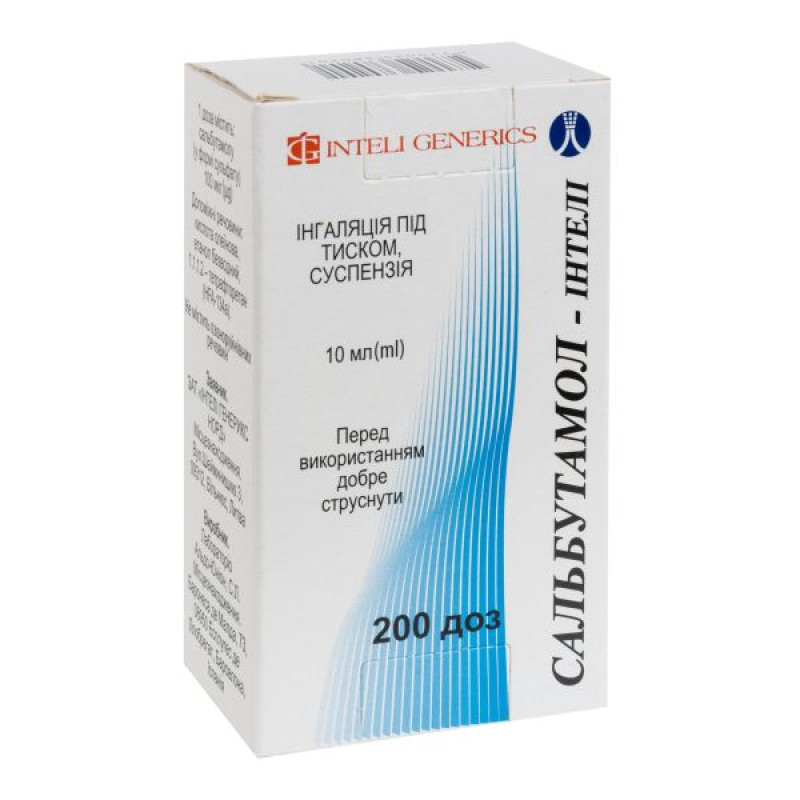
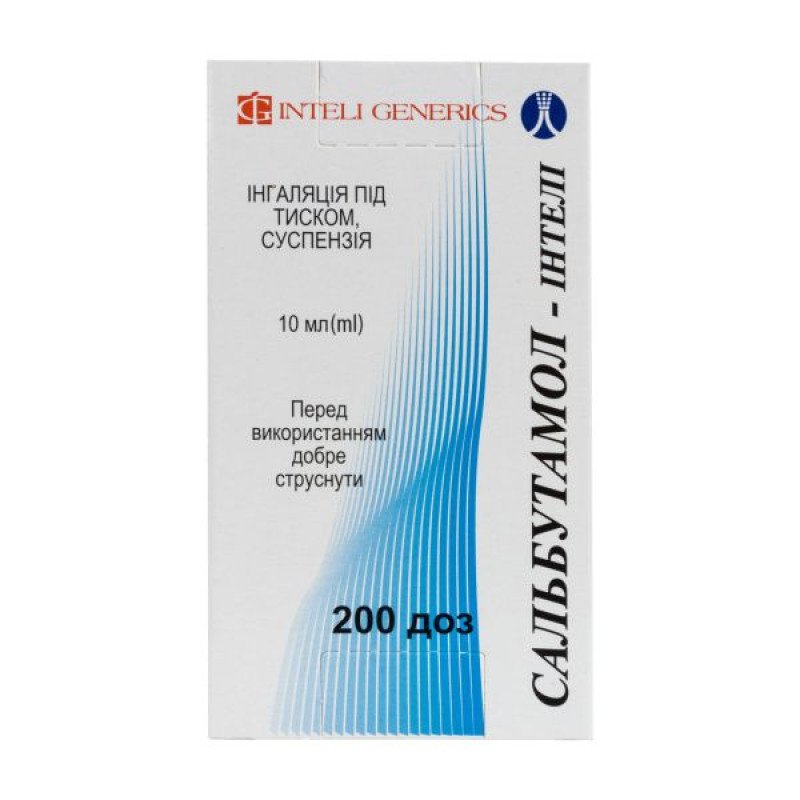
Instructions Salbutamol-Inteli aerosol for inhalation dosed 100 mcg/dose bottle 10 ml 200 doses
Composition
active ingredient: salbutamol;
1 dose contains salbutamol (in sulfate form) 100 mcg;
excipients: oleic acid, anhydrous ethanol, 1,1,1,2-tetrafluoroethane (HFA-134a).
Dosage form
Pressurized inhalation, suspension.
Main physicochemical properties: white suspension of metered aerosol for 200 doses (10 ml).
Pharmacotherapeutic group
Drugs for the treatment of obstructive airway diseases. Selective b2-adrenoceptor agonists. ATC code R03A C02.
Pharmacological properties
Pharmacodynamics
Salbutamol is a selective β2-adrenergic agonist. In therapeutic doses, it acts on the beta2-adrenergic receptors of bronchial smooth muscle, providing rapid (within 5 minutes) and short-acting (4-6 hours) bronchodilation in patients with reversible airway obstruction.
Pharmacokinetics
After inhalation, 10 to 20% of the administered dose reaches the lower respiratory tract. The remainder remains in the inhalation device or in the nasopharynx, from where it is swallowed. The portion of the dose that reaches the respiratory tract is absorbed into the lung tissue and enters the bloodstream, but is not metabolized in the lungs.
After entering the systemic circulation, the drug is metabolized in the liver and excreted mainly by the kidneys in an unchanged state and as a phenol sulfate metabolite.
The dose of the drug that has entered the digestive system from the nasopharynx is absorbed from the gastrointestinal tract, undergoes the first stage of metabolism in the liver to the phenol sulfate compound, and is then excreted by the kidneys. Most of the drug is excreted from the body within 72 hours. Binding to plasma proteins is 10%.
Indication
Short-term (4 to 6 hours) bronchodilation with rapid onset (approximately 5 minutes) in airway obstruction. Relief of asthma attacks in diseases accompanied by reversible airway obstruction, such as bronchial asthma. Prevention of bronchospasm attacks associated with allergen exposure or caused by physical exertion. In the complex therapy of patients with bronchial asthma.
Contraindication
Hypersensitivity to any of the components of the drug. Do not use salbutamol dosage forms that are not intended for intravenous administration to terminate uncomplicated preterm labor or threatened abortion.
Interaction with other medicinal products and other types of interactions
Salbutamol should not be used together with non-selective β-blockers, such as propranolol (including topical ophthalmic preparations containing β-blockers).
Concomitant use of salbutamol with MAO inhibitors is not contraindicated.
Application features
To ensure optimal delivery of the drug to the lungs, the patient's inhalation technique should be checked. Patients should be warned that the taste may be different from that of their previous inhaler.
Sudden and progressive worsening of asthma is a life-threatening condition that requires initiation or increase in the dose of corticosteroids. Daily monitoring of peak expiratory flow is recommended for patients at risk.
Asthma treatment should usually follow a step-by-step program that requires ongoing clinical monitoring with respiratory function tests.
Bronchodilators should not be the sole treatment for patients with severe or unstable asthma. Severe asthma requires ongoing medical monitoring, as these patients are at high risk of severe asthma attacks. In such cases, the physician should consider the use of the maximum recommended dose of inhaled or oral corticosteroids.
An increased need for short-acting bronchodilators, especially inhaled beta2-agonists, to control asthma symptoms is indicative of an exacerbation of the disease. In these cases, treatment should be re-evaluated and a decision should be made to prescribe higher doses of inhaled corticosteroids or consider anti-inflammatory therapy (e.g., inhaled corticosteroids or a course of oral corticosteroids).
If the previously effective dose of inhaled salbutamol fails to provide relief for at least 3 hours, the patient should consult a doctor. The dose or frequency of use should only be increased by a doctor.
To increase the effectiveness of therapy, the patient should be taught to use the inhaler correctly; at the beginning of treatment, the inhaler should be used under the supervision of medical personnel.
Severe asthma exacerbations should be treated as usual.
Use with caution in patients with myocardial ischemia, tachycardia and hypertrophic obstructive cardiomyopathy, glaucoma, and heart rhythm disturbances.
The use of β2-adrenergic antagonists may cause potentially dangerous hypokalemia, especially after the use of parenteral and aerosolized dosage forms. Particular caution should be exercised in severe acute asthma, as this effect may be potentiated by the combined use of xanthine derivatives, steroids, diuretics and hypoxia. In such cases, regular monitoring of serum potassium levels is recommended.
When using sympathomimetic agents, including salbutamol, side effects from the cardiovascular system are possible. According to post-marketing studies, as well as according to data published in literary sources, cases of myocardial ischemia were observed during therapy with salbutamol. Patients with severe heart disease (such as ischemic heart disease, arrhythmia or severe heart failure), when prescribing salbutamol, should be warned about the need to immediately seek medical help if chest pain or other symptoms of exacerbation of heart disease appear. Particular attention should be paid to identifying the causes of such symptoms as shortness of breath and chest pain, since it may consist of disorders of both the respiratory and cardiac systems.
Salbutamol should be used with caution in patients receiving high doses of other sympathomimetics. Like other beta-adrenergic agonists, salbutamol may cause reversible metabolic changes, such as an increase in blood sugar levels. Compensation for such changes in diabetic patients is not always possible, and there have been isolated reports of ketoacidosis in such patients. Concomitant use of corticosteroids may exacerbate this condition.
As with other inhaled medications, paradoxical bronchospasm with immediate worsening of dyspnea after use may occur. In such cases, alternative formulations or other rapid-acting inhaled bronchodilators should be administered immediately. Salbutamol should be discontinued immediately, the patient assessed and, if necessary, another rapid-acting bronchodilator should be administered on a permanent basis.
Ability to influence reaction speed when driving vehicles or other mechanisms
There is no data on the effects, in case of side effects from the nervous system (tremor), driving or working with other mechanisms should be restricted.
Use during pregnancy or breastfeeding
There have been no large, well-controlled clinical studies of salbutamol in pregnant women. Animal studies have shown that salbutamol is toxic to reproduction. Safety in pregnancy has not been established. There have been isolated reports of various congenital malformations in utero, including cleft palate, limb defects and cardiac abnormalities. Some women have taken many other medicines during pregnancy. As with other medicines, salbutamol should be used during pregnancy only if the potential benefit justifies the potential risk to the foetus.
Salbutamol is likely to pass into breast milk, so caution should be exercised when administering it to women who are breastfeeding. It is not known whether the presence of salbutamol in breast milk has a harmful effect on the newborn infant, so its use in women who are breastfeeding should be limited to cases where the benefit of its use for the woman outweighs the possible risk to the child.
Method of administration and doses
Salbutamol-Inteli - aerosol is intended for inhalation use through the mouth only. Patients who have difficulty synchronizing breathing with the use of an inhaler are recommended to additionally use a spacer - a device to facilitate inhalation of inhaled drugs.
Adults (including elderly patients)
For the relief of asthma symptoms, including acute bronchospasm, 1 inhalation (100 mcg) can be used as a minimum starting dose. If necessary, the dose can be increased to 200 mcg (2 inhalations).
Prophylactically, before physical exertion or anticipated contact with allergens, use 200 mcg (2 inhalations) 10-15 minutes before anticipated contact with allergen or before physical exertion. The total daily dose of salbutamol should not exceed 800 mcg (8 inhalations).
For long-term maintenance therapy, it is recommended to use 200 mcg (2 inhalations) 4 times a day.
Children aged 4 to 12 years
For relief of acute bronchospasm, use 1 inhalation (100 mcg). If necessary, the dose can be increased to 200 mcg (2 inhalations).
Children over 12 years of age should use the same doses as adults.
Prophylactically, 10-15 minutes before physical exertion or expected contact with allergens, use 100 mcg (1 inhalation); if necessary, the dose can be increased to 200 mcg (2 inhalations).
For long-term maintenance therapy, it is recommended to use 200 mcg (2 inhalations) 4 times a day.
An increased requirement for β2-agonists may indicate worsening asthma. In these circumstances, the patient's treatment regimen should be reviewed and the need for glucocorticosteroid therapy should be considered.
Instructions for correct use
Before using the inhaler, check the expiration date. If the inhaler is new or has not been used for several days, shake it well and release one dose into the air to make sure it is working.
1. Remove the lid from the dispenser.
2. Hold the inhaler vertically.
3. Shake the inhaler for 20 seconds.
4. Press your lips to the dispenser and inhale fully.
5. Press the aerosol canister while taking a deep breath through your mouth.
6. After inhalation, hold your breath for maximum penetration of the drug.
7. If necessary, continue for a few seconds and repeat the procedure again (3, 4, 5 and 6).
8. Close the lid after use.
The plastic adapter should be cleaned regularly. To clean, remove the metal container and wash the adapter in warm (not hot) soapy water.
Rinse thoroughly, dry the adapter and reassemble the device. After assembly, close the lid.
Children
The drug is contraindicated in children under 4 years of age.
Overdose
The most common signs and symptoms of salbutamol overdose are transient changes pharmacologically induced by beta-agonists, such as tachycardia, tremor, hyperactivity and metabolic disturbances, including hypokalaemia (see sections 4.4 and 4.8).
Hypokalemia may occur as a result of an overdose of salbutamol, therefore serum potassium levels should be monitored. Cases of lactic acidosis have been reported with high therapeutic doses or overdose of short-acting beta2-agonists, therefore serum lactate levels should be monitored and metabolic acidosis should be monitored accordingly, especially in the case of persistent or increasing tachypnea despite improvement in symptoms of bronchospasm, such as wheezing.
Treatment. Treatment is symptomatic. Cardioselective ß-blockers are usually preferred. ß-blockers should be used with caution in patients with a history of bronchospasm.
Adverse reactions
The adverse reactions listed below are classified by organ system and frequency of occurrence: very common (≥ 1/10), common (≥ 1/100 and < 1/10), uncommon (≥ 1/1,000 and < 1/100), rare (≥ 1/10,000 and < 1/1,000), very rare (< 1/10,000), including isolated cases, frequency unknown.
On the part of the immune system
Very rare: hypersensitivity reactions including angioedema, urticaria, bronchospasm, hypotension and collapse.
From the side of metabolism, metabolism
Rare: Hypokalemia. Potentially, the use of β2-agonists may cause severe hypokalemia, increased serum lactate/lactic acidosis.
Neurological disorders
Common: tremor, headache.
Very rare: hyperactivity.
Cardiac disorders
Common: tachycardia.
Uncommon: palpitations.
Very rare: cardiac arrhythmia (including atrial fibrillation, supraventricular tachycardia and extrasystole).
Frequency unknown: myocardial ischemia (see section "Special warnings and precautions for use").
From the vascular side
Rare: peripheral vasodilation.
Respiratory, thoracic and mediastinal disorders
Very rare: paradoxical bronchospasm.
Gastrointestinal tract
Uncommon: irritation of the mucous membranes of the mouth and pharynx.
Musculoskeletal and connective tissue disorders
Uncommon: muscle cramps.
Expiration date
3 years.
Storage conditions
Store at a temperature not exceeding 30 ºС.
Keep out of reach of children.
Do not puncture a pressurized cylinder. Do not throw into a fire, even an empty cylinder.
Protect from direct sunlight. Do not store near heat sources.
Do not freeze.
Packaging
Aluminum canister for 200 doses (10 ml) of 100 mcg salbutamol each, with plastic adapter and cap in a cardboard box.
Vacation category
According to the recipe.
Producer
Laboratorio Aldo-Union, S.L.
Location of the manufacturer and its business address
Baroness de Malda, 73, 08950 Espluges de Llobregat, Barcelona, Spain.