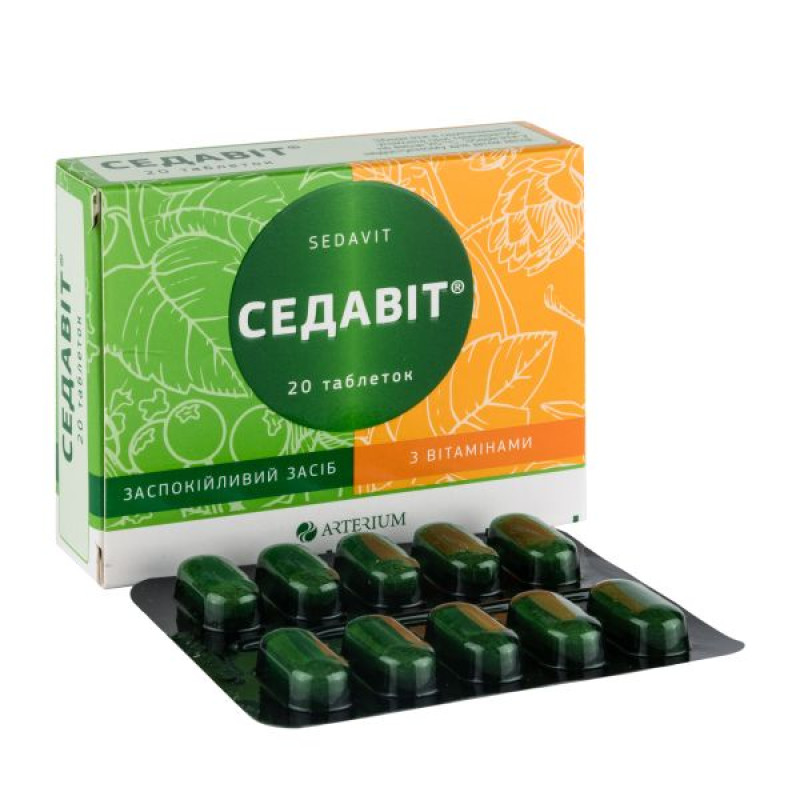
Instructions for use Sedavit tablets blister pack No. 20
Composition
active ingredients: 1 tablet contains Sedavit® thick extract in terms of dry matter* – 170.0 mg, vitamin B6 (pyridoxine hydrochloride in terms of 100% substance) – 3.0 mg, vitamin PP (nicotinamide in terms of 100% substance) – 15.0 mg;
Excipients: potato starch; croscarmellose sodium; lactose monohydrate; microcrystalline cellulose; calcium stearate.
* 1 g of Sedavit® thick extract contains: flavonoids extracted with 35% ethanol (1:4.5) from a mixture of: rhizomes with valerian roots (2 parts), hawthorn fruits (2 parts), St. John's wort herb (1 part), peppermint leaves (2 parts), hop cones (2 parts) - not less than 0.01 g (calculated on dry matter and rutin).
Dosage form
Pills.
Main physicochemical properties: tablets from beige to brown in color, with inclusions, oval in shape, with a biconvex surface, with a score on one side of the tablet.
Pharmacotherapeutic group
Sleeping pills and sedatives.
ATX code N05C M.
Pharmacological properties
Pharmacodynamics
The complex extract for the drug Sedavit® is obtained from rhizomes with valerian roots, hawthorn fruits, St. John's wort, peppermint leaves, hop cones. The pharmacological effect of the drug is due to the properties of the components that make up its composition. Biologically active substances of medicinal plant extracts have a positive effect on the functioning of the nervous and cardiovascular systems and have a predominantly sedative, anxiolytic effect, eliminate feelings of fear, mental tension. Vitamins are components of enzyme systems that participate in redox processes in the body. Pyridoxine hydrochloride (vitamin B6) - normalizes the functioning of the central and peripheral nervous systems, nicotinamide (vitamin PP) - participates in the processes of tissue respiration, fat and carbohydrate metabolism.
Pharmacokinetics
The pharmacological efficacy of a drug depends on the combined action of its components, so kinetic studies are impossible, since all the components together cannot be traced using markers or biological studies.
Indication
A state of constant mental tension (manager's syndrome); neurasthenia and neurasthenic reactions accompanied by irritability, anxiety, fear, fatigue, inattention, memory impairment, mental exhaustion; neurocirculatory dystonia of hypertensive and cardiac type; asthenic syndrome (hypersthenic form); stage I arterial hypertension; insomnia (mild forms); itchy dermatoses (eczema, urticaria); headache caused by nervous tension; migraine; as a symptomatic remedy for climacteric syndrome and mild forms of dysmenorrhea.
Contraindication
Increased individual sensitivity to the components of the drug, depression and conditions accompanied by suppression of the central nervous system, bronchial asthma, spasmophilia, severe arterial hypotension, bradycardia, myasthenia gravis, gastric and duodenal ulcers, ischemic heart disease, liver disease, hyperuricemia, gout, decompensated diabetes mellitus, urolithiasis.
Interaction with other medicinal products and other types of interactions
The drug enhances the effect of substances that have a sedative effect on the central nervous system, as well as alcohol. Mutual weakening of the effects of levodopa and pyridoxine hydrochloride is possible.
Concomitant use of cycloserine, hydralazine, isoniazid, penicillamine, and oral contraceptives causes an increased need for pyridoxine.
St. John's wort may induce cytochrome P450 isoenzymes 3A4, 1A2 and 2C9, which may weaken the effect of other concomitantly used drugs that are metabolized by these isoenzymes. Therefore, concomitant use of the drug with:
indinavir or other antiretroviral drugs;
cyclosporine, digoxin, theophylline, irinotecan, tacrolimus, hypolipidemic agents (simvastatin and others), fexofenadine, tricyclic antidepressants (amitriptyline, nortriptyline), antiepileptic agents (carbamazepine, phenobarbital, phenytoin), selective serotonin reuptake inhibitors (citalopram, fluvoxamine, sertraline, paroxetine), buspirine, as well as triptans (sumatriptan, naratriptan, zolmitriptan) and antihypertensive drugs - calcium channel blockers;
warfarin and other anticoagulants - coumarin derivatives;
oral contraceptives (due to a decrease in the effectiveness of contraceptives with the occurrence of irregular bleeding, the occurrence of unwanted pregnancy cannot be ruled out).
Not recommended for use with cardiac glycosides.
Diuretics – when used in combination with pyridoxine, the effect of diuretics is enhanced.
Sleeping pills and sedatives - when used in combination with pyridoxine, the sleeping pill effect is reduced.
Antiparkinsonian drugs – when used in combination with pyridoxine, the effectiveness of drugs for the treatment of Parkinson's disease is reduced.
With the simultaneous use of nicotinic acid with antithrombotic agents or acetylsalicylic acid, bleeding may develop.
Use with antihypertensive agents leads to increased arterial hypotension, and with antidiabetic agents - to a decrease in the blood sugar-lowering effect of the latter.
Use with other hypolipidemic agents increases the risk of developing toxic effects of the drug, with antispasmodics - the effect of antispasmodics is enhanced.
Simultaneous use with methyldopa leads to a significant decrease in blood pressure, and with probenecid - to a decrease in the effect of probenecid.
It is possible to enhance the photosensitizing effect of other drugs that have a photosensitizing effect (for example, sulfonamides, tetracycline antibiotics and fluoroquinolones).
Application features
This medicine contains lactose. Patients with rare hereditary problems of galactose intolerance, the Lapp lactase deficiency or glucose-galactose malabsorption should not take this medicine.
While using the drug, patients, especially those with fair skin, should avoid prolonged exposure to ultraviolet radiation (sunbathing, solarium, diathermy).
In patients with gastroesophageal reflux (heartburn), heartburn may worsen.
Use the drug with caution in patients with blood pressure fluctuations and diabetes. Blood pressure and blood glucose levels should be monitored.
Do not use with alcohol.
Use during pregnancy or breastfeeding
It is not recommended to prescribe the drug during pregnancy or breastfeeding.
Ability to influence reaction speed when driving vehicles or other mechanisms
When using the drug, you should refrain from driving vehicles and working with potentially dangerous mechanisms.
Method of administration and doses
Adults and children over 12 years of age are prescribed 2 tablets 3 times a day. The drug is taken without chewing, with a small amount of liquid. In case of nausea, the drug should be taken with food. If necessary, the single dose is increased to 3 tablets. In case of adverse reactions from the nervous system (drowsiness, dizziness), 1 tablet is prescribed 3 times a day. The interval between doses of the drug is 8 hours. The drug can be used once, 2–3 tablets 30–60 minutes before a possible emotional stress.
The course of treatment depends on the form and severity of the symptoms of the disease, the nature of concomitant therapy, the achieved treatment effect and is determined by the doctor.
Children
The safety and effectiveness of Sedavit® for children under 12 years of age have not been established, therefore the drug can only be used in children over 12 years of age.
Overdose
Symptoms: increased side effects. Later, these symptoms may be accompanied by a feeling of numbness, joint pain and a feeling of heaviness in the stomach. Symptoms of nicotinamide overdose may also occur: dizziness, convulsions, tremor, sweating, cough, skin rashes, arterial hypotension. Symptoms characteristic of peripheral neuropathy.
Treatment: drug withdrawal, symptomatic therapy.
Side effects
In rare cases, the following undesirable effects may occur:
Allergic reactions, including flushing, rash, itching, swelling, urticaria, anaphylactic reactions, including anaphylactic shock.
From the side of the central and peripheral nervous system: drowsiness, fatigue, dizziness, depressed emotional state, agitation, headache, paresthesia, weakness, decreased performance.
On the part of the digestive tract: nausea, abdominal pain and cramps, vomiting, heartburn, increased gastric secretion, intestinal dysfunction (diarrhea, constipation).
From the cardiovascular system: bradycardia, decreased blood pressure, tachycardia, arrhythmia.
Skin: photosensitivity in sensitive people, dermatitis, dry skin.
Musculoskeletal system: numbness of the extremities, muscle weakness.
Metabolic: with prolonged use in high doses - decreased glucose tolerance.
Biochemical abnormalities: increased levels of aspartate aminotransferase (AST), lactate dehydrogenase (LDH), alkaline phosphatase, blood glucose, hyperuricemia.
Expiration date
2 years.
Storage conditions
Store in the original packaging at a temperature not exceeding 25 °C.
Keep out of reach of children.
Packaging
Tablets No. 10 in a blister, 2 blisters in a pack.
Vacation category
Without a prescription.
Producer
PJSC "Kyivmedpreparat".
Address
Ukraine, 01032, Kyiv, Saksaganskoho St., 139.