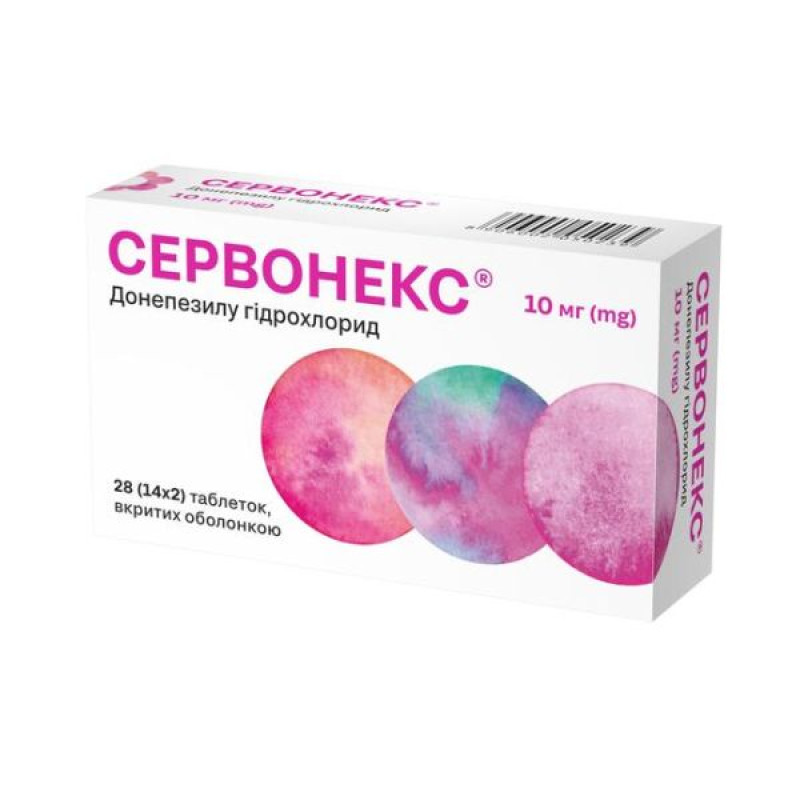
Instructions for use Servonex film-coated tablets 10 mg blister No. 28
Composition
active ingredient: donepezil;
1 tablet contains donepezil hydrochloride 5 mg or 10 mg;
excipients: lactose monohydrate, microcrystalline cellulose, copovidone K 28, pregelatinized starch, magnesium stearate, Opadry II White 31G58920 (talc, titanium dioxide (E 171), hypromellose, polyethylene glycol, lactose monohydrate).
Dosage form
Film-coated tablets.
Main physicochemical properties: white or almost white round biconvex tablets, coated, smooth on both sides.
Pharmacotherapeutic group
Drugs for use in dementia. Cholinesterase inhibitors. ATX code N06D A02.
Pharmacological properties
Pharmacodynamics.
Donepezil hydrochloride is a specific, reversible inhibitor of acetylcholinesterase, the major type of cholinesterase in the brain. In vitro, donepezil hydrochloride has been shown to be 1000 times more potent at inhibiting the activity of this enzyme than it is at inhibiting the activity of butyrylcholinesterase, which is predominantly located outside the central nervous system.
Alzheimer's dementia
In patients with Alzheimer's disease, administration of donepezil at a dose of 5 mg or 10 mg once daily after reaching steady-state concentrations resulted in inhibition of acetylcholinesterase activity (as measured in the cell membrane of erythrocytes) by 63.6% and 77.3%, respectively. It has been shown that inhibition of acetylcholinesterase in erythrocytes by donepezil hydrochloride correlated with changes in the ADAS-cog (Alzheimer's Disease Assessment Scale for Cognitive Function), which is a sensitive scale that allows you to test some aspects of cognitive function. The ability of donepezil hydrochloride to modify the course of the main neurological syndromes has not been studied. Therefore, it is not possible to assess the effect of donepezil on the progression of this disease.
The efficacy of donepezil in the treatment of dementia has been demonstrated in four placebo-controlled studies of 6 months and 1 year duration. It was shown that donepezil caused a dose-dependent statistically significant increase in the relative number of patients who responded to treatment, as determined by appropriate scales of assessment of cognitive function (ADAS-Cog scale), patient status (CIBIC scale + global function index) and activities of daily living with clinical signs of dementia.
Pharmacokinetics.
Absorption
After oral administration, the maximum plasma concentration Cmax is reached after approximately 3-4 hours. Plasma concentration and area under the concentration-time curve (AUC) increase in proportion to the dose. The terminal half-life is approximately 70 hours, so multiple once-daily dosing leads to a gradual achievement of steady-state concentrations. Steady-state concentrations are reached approximately within 3 weeks of initiation of treatment. Once steady-state is reached, donepezil hydrochloride concentrations and the associated pharmacodynamic activity remain almost constant throughout the day.
Food does not affect the absorption of donepezil hydrochloride.
Distribution
Donepezil hydrochloride is approximately 95% bound to plasma proteins. The extent of plasma protein binding of the active metabolite 6-O-desmethyldonepezil is unknown. The distribution of donepezil hydrochloride in various body tissues has not been studied in detail. However, a mass balance study in healthy male volunteers showed that approximately 28% of the label remained unrecovered 240 hours after a single administration of 5 mg of 14C-labeled donepezil hydrochloride. This suggests that donepezil hydrochloride and/or its metabolites may persist in the body for more than 10 days.
Metabolism/excretion
Donepezil hydrochloride can be excreted unchanged in the urine or can be metabolized in the liver by cytochrome P450 isoenzymes to form many metabolites, not all of which have been identified. After a single dose of 5 mg of 14C-labeled donepezil hydrochloride, the plasma radioactivity, expressed as a percentage of the administered dose, was mainly due to intact donepezil hydrochloride (30%), 6-O-desmethyldonepezil (11%, the only metabolite that exhibits the same activity as donepezil hydrochloride), donepezil-cis-N-oxide (9%), 5-O-desmethyldonepezil (7%) and the glucuronide conjugate of 5-O-desmethyl-donepezil (3%). Approximately 57% of the total administered radioactivity was recovered in the urine (17% as unchanged donepezil) and 14.5% was recovered in the feces, indicating that biotransformation and urinary excretion were the major routes of elimination. There was no evidence of enterohepatic recirculation of donepezil hydrochloride and/or any of its metabolites.
Gender, race, and smoking history had no clinically significant effect on plasma concentrations of donepezil hydrochloride. The pharmacokinetics of donepezil have not been formally studied in healthy elderly volunteers or in patients with Alzheimer's disease or vascular dementia. However, the mean plasma concentrations in patients were in good agreement with those in young healthy volunteers.
In patients with mild to moderate hepatic impairment, steady-state concentrations of donepezil were increased, with AUC increasing by 48% and mean Cmax increasing by 39% (see section 4.2).
Indication
Symptomatic treatment of mild to moderate Alzheimer's dementia.
Contraindication
Contraindicated in patients with known hypersensitivity to donepezil hydrochloride, piperidine derivatives, or any of the excipients of the drug.
Interaction with other medicinal products and other types of interactions
Donepezil hydrochloride and/or any of its metabolites do not inhibit the metabolism of theophylline, warfarin, cimetidine or digoxin in humans. Concomitant administration of digoxin or cimetidine does not affect the metabolism of donepezil hydrochloride. In vitro studies have shown that cytochrome P450 isoenzymes, in particular isoenzyme 3A4 and to a lesser extent isoenzyme 2D6, are actively involved in the metabolism of donepezil. In vitro drug interaction studies have shown that ketoconazole and quinidine, which are inhibitors of CYP3A4 and 2D6, respectively, inhibit the metabolism of donepezil. Therefore, these and other inhibitors of the CYP3A4 isoenzyme, such as itraconazole and erythromycin, as well as inhibitors of the CYP2D6 isoenzyme, such as fluoxetine, may inhibit the metabolism of donepezil. In a study in healthy volunteers, ketoconazole increased the mean blood concentration of donepezil by approximately 30%.
Enzyme inducers, such as rifampicin, phenytoin, carbamazepine and alcohol, may reduce donepezil blood concentrations. The extent of the inducing or inhibiting effect is unknown, and caution should be exercised when using such combinations.
Donepezil hydrochloride may interact with drugs with anticholinergic activity. In addition, synergistic activity may occur with concomitant administration of drugs such as succinylcholine, other neuromuscular blocking agents, cholinergic agonists or beta-blockers that affect cardiac conduction.
Cases of atypical changes in blood pressure and heart rate have been described when other cholinomimetics and quaternary anticholinergics, such as glycopyrrolate, were used concomitantly with donepezil.
Cases of QTc prolongation and torsade de pointes have been reported with donepezil. Caution is advised when donepezil is used concomitantly with other medicinal products known to prolong the QTc interval, and clinical monitoring (ECG) may be necessary. Examples of such medicinal products include:
class IA antiarrhythmics (e.g. quinidine);
class III antiarrhythmics (e.g. amiodarone, sotalol);
some antidepressants (e.g. citalopram, escitalopram, amitriptyline);
other antipsychotics (e.g. phenothiazine derivatives, sertindole, pimozide, ziprasidone);
some antibiotics (e.g. clarithromycin, erythromycin, levofloxacin, moxifloxacin).
Application features
The use of donepezil in dementia in patients with severe Alzheimer's disease, other types of dementia, or other types of memory impairment (e.g., age-related cognitive decline) has not been studied.
Anesthesia
Donepezil, as a cholinesterase inhibitor, may enhance succinylcholine-type muscle relaxation during anesthesia.
Cardiovascular disorders
Cholinesterase inhibitors, through their pharmacological action, may have a vagotonic effect on heart rate (e.g., cause bradycardia). This effect may be particularly important in patients with sick sinus syndrome or other supraventricular conduction disorders, such as sinoatrial or atrioventricular block.
Syncope and seizures have been reported. When examining such patients, the possibility of conduction block or long sinus node pauses should be considered.
QTc prolongation and torsade de pointes have been reported in the post-marketing period (see sections 4.5 and 4.8).
Caution is recommended in patients with a personal or family history of QTc prolongation, in patients taking medicinal products that affect the QTc interval, in patients with cardiac disease (e.g., decompensated heart failure, recent myocardial infarction, bradyarrhythmia) or with electrolyte disturbances (hypokalemia, hypomagnesemia). Clinical monitoring (ECG) may be necessary.
Patients at increased risk of ulceration, such as those with a history of peptic ulcer disease or those taking nonsteroidal anti-inflammatory drugs (NSAIDs), should be monitored closely for symptoms. However, in clinical trials with donepezil, there was no increase in the incidence of ulceration or gastrointestinal bleeding compared with placebo.
Genitourinary system
Cholinomimetics may cause lower bladder outlet obstruction, although such disorders were not observed in clinical trials with donepezil.
Neurological disorders
Seizures: Cholinomimetics are thought to have some ability to cause generalized seizures. However, such seizures may also be a manifestation of Alzheimer's disease itself.
Cholinomimetics have the ability to exacerbate or cause extrapyramidal symptoms.
Neuroleptic malignant syndrome (NMS)
NMS is a potentially life-threatening condition characterized by hyperthermia, muscle rigidity, autonomic nervous system disorders, impaired consciousness, and elevated serum creatine phosphokinase levels, which has been reported to occur very rarely in association with donepezil, particularly in patients receiving concomitant neuroleptics. Additional features may include myoglobinuria (rhabdomyolysis) and acute renal failure. If a patient develops signs and symptoms suggestive of NMS or an unexplained high fever without additional clinical manifestations of NMS, treatment should be discontinued.
Lung disease
Cholinesterase inhibitors, due to their cholinomimetic effects, should be administered with caution to patients with a history of bronchial asthma or obstructive pulmonary disease.
Donepezil is not recommended for use with other acetylcholinesterase inhibitors, agonists or antagonists of the cholinergic system.
Significant liver dysfunction:
There are no data for patients with significant hepatic impairment.
Mortality in clinical trials with vascular dementia
In studies of donepezil hydrochloride in patients with vascular dementia, the incidence of fatal events was quantitatively higher than in the placebo group, but this difference was not statistically significant. The majority of fatalities in patients receiving either donepezil hydrochloride or placebo were due to various vascular conditions that would be expected in elderly patients with existing vascular disease. In an analysis of all serious non-fatal and fatal vascular events, there was no difference in the incidence of these events between the donepezil hydrochloride and placebo groups.
Mortality in Alzheimer's disease studies
In the Alzheimer's disease studies, and when these Alzheimer's disease studies were combined with other dementia studies, including vascular dementia studies, the incidence of fatal outcomes in the placebo groups was quantitatively higher than in the donepezil hydrochloride groups.
Excipients.
This medicinal product contains lactose. If you have been told by your doctor that you have an intolerance to some sugars, contact your doctor before taking this medicinal product.
Use during pregnancy or breastfeeding
Pregnancy
There are no reliable data on the use of donepezil in pregnant women.
Animal studies have not shown teratogenic effects, but there have been signs of peri- and postnatal toxicity. The potential risk to humans remains unknown.
Donepezil is not recommended for use during pregnancy unless clearly necessary.
Breastfeeding period
Donepezil is excreted in the milk of rats. Studies in lactating women have not been conducted, so it is unknown whether donepezil hydrochloride is excreted in human milk. Therefore, women should discontinue breastfeeding during treatment with donepezil.
Ability to influence reaction speed when driving vehicles or other mechanisms
Donepezil has minor or moderate influence on the ability to drive and use machines.
Alzheimer's dementia may impair the ability to drive and use machines. In addition, donepezil may cause fatigue, dizziness, and muscle cramps, especially at the beginning of treatment or when the dose is increased. During treatment with donepezil, the doctor should regularly assess the patient's ability to drive or use complex mechanical devices.
Method of administration and doses
Adults
The 5 mg daily dose should be administered for at least 1 month to assess early clinical response to treatment and to achieve steady-state plasma concentrations of donepezil. After clinical evaluation of treatment at 5 mg daily for 1 month, the dose may be increased to 10 mg daily (once daily). The maximum recommended daily dose is 10 mg. Doses greater than 10 mg daily have not been studied.
Treatment should be initiated and supervised by a physician who is an expert in the diagnosis and treatment of dementia in Alzheimer's disease. The diagnosis should be made in accordance with generally accepted guidelines (e.g. DSM IV, ICD 10). Treatment with donepezil should only be initiated if the patient has a caregiver who will regularly monitor the patient's intake of this medication. Supportive treatment can be continued as long as the patient is showing a therapeutic effect. Therefore, the clinical benefit of donepezil treatment should be reassessed regularly. Treatment should be discontinued when the therapeutic effect is no longer observed. Individual response to donepezil cannot be predicted.
After discontinuation of treatment, the positive effect of donepezil gradually decreases.
Kidney and liver dysfunction
The same dosing regimen can be used in patients with renal impairment, as such impairment does not affect the clearance of donepezil hydrochloride.
Due to the possible increase in systemic exposure in mild to moderate hepatic impairment (see section 5.2), the dose should be adjusted according to individual tolerability. No data are available for patients with significant hepatic impairment.
Children
Servonex® is not recommended for children under 18 years of age.
Overdose
Overdose of cholinesterase inhibitors can lead to cholinergic crisis, characterized by severe nausea, vomiting, salivation, increased sweating, bradycardia, hypotension, respiratory depression, collapse, and convulsions. Muscle weakness may occur, which can be fatal if the respiratory muscles are affected.
As with any other drug overdose, general supportive measures should be taken. Tertiary anticholinergics, such as atropine, may be used as an antidote in the event of donepezil overdose. Intravenous atropine sulfate is recommended, titrated to a therapeutic effect: the initial dose is 1-2 mg intravenously, with subsequent doses titrated according to clinical response. Atypical blood pressure and heart rate responses have been reported with other cholinomimetics administered concomitantly with quaternary anticholinergics, such as glycopyrrolate. The ability of donepezil hydrochloride and/or its metabolites to be removed by dialysis (hemodialysis, peritoneal dialysis or hemofiltration) is unknown.
Side effects
The most common side effects are diarrhea, muscle cramps, fatigue, nausea, vomiting, and insomnia.
Hypersensitivity reactions are possible in individuals with individual intolerance to any component of the drug.
The adverse reactions that have been reported are listed below by system organ class and frequency. The frequency of adverse reactions is defined as follows: very common (≥ 1/10), common (≥ 1/100 and < 1/10), uncommon (≥ 1/1,000 and < 1/100), rare (≥ 1/10,000 and < 1/1,000), very rare (< 1/10,000), not known (cannot be estimated from the available data).
Infections and infestations
Common: cold.
Metabolic and nutritional disorders
Common: anorexia.
From the psyche
Common: hallucinations**, agitation**, aggressive behavior**, sleep disturbances**, nightmares**;
Not known: increased libido, hypersexuality.
From the nervous system
Common: syncope*, dizziness, insomnia;
Uncommon: convulsions*;
Rare: extrapyramidal symptoms;
Very rare: neuroleptic malignant syndrome;
Not known: pleurothotonus (Pisa syndrome).
Cardiovascular system
Uncommon: bradycardia;
Rare: sinoatrial block, atrioventricular block;
Frequency unknown: polymorphic ventricular tachycardia, including torsade de pointes; prolongation of the QT interval on the ECG.
Gastrointestinal tract
Very common: nausea, diarrhea;
Common: vomiting, dyspepsia;
Uncommon: gastrointestinal bleeding, gastric and duodenal ulcers, hypersalivation.
Liver and biliary tract disorders
Rare: hepatic dysfunction, including hepatitis***.
Skin and subcutaneous tissue disorders:
Common: rash, itching.
Musculoskeletal and connective tissue disorders:
Common: muscle cramps;
Very rare: rhabdomyolysis****.
From the kidneys and urinary tract:
Common: urinary incontinence.
General disorders and administration site conditions:
Very common: headache;
Common: fatigue, pain.
Examination results:
Uncommon: slight increase in serum muscle creatine phosphokinase concentration.
Injury, poisoning and procedural complications:
Common: accidents, including falls.
**Reports of hallucinations, agitation, and aggressive behavior that resolved after dose reduction or discontinuation of the drug.
***In cases of unexplained hepatic dysfunction, discontinuation of donepezil treatment should be considered.
****Rhabdomyolysis has been reported independently of neuroleptic malignant syndrome and in close temporal association with the initiation of donepezil treatment and dose escalation.
Reporting of suspected adverse reactions.
Reporting adverse reactions after registration of a medicinal product is important. This allows monitoring of the benefit/risk ratio of the medicinal product. Medical and pharmaceutical professionals, as well as patients or their legal representatives, should report all cases of suspected adverse reactions and lack of efficacy of the medicinal product via the Automated Information System for Pharmacovigilance at the following link: https://aisf.dec.gov.ua
Expiration date
3 years.
Storage conditions
Store at a temperature not exceeding 25 ºС.
Keep out of reach of children.
Packaging
14 tablets in a blister. 2 blisters in a cardboard box.
Vacation category
According to the recipe.
Producer
"KUSUM FARM" LLC.
Location of the manufacturer and address of its place of business
40020, Ukraine, Sumy region, Sumy city, Skryabina st., 54.