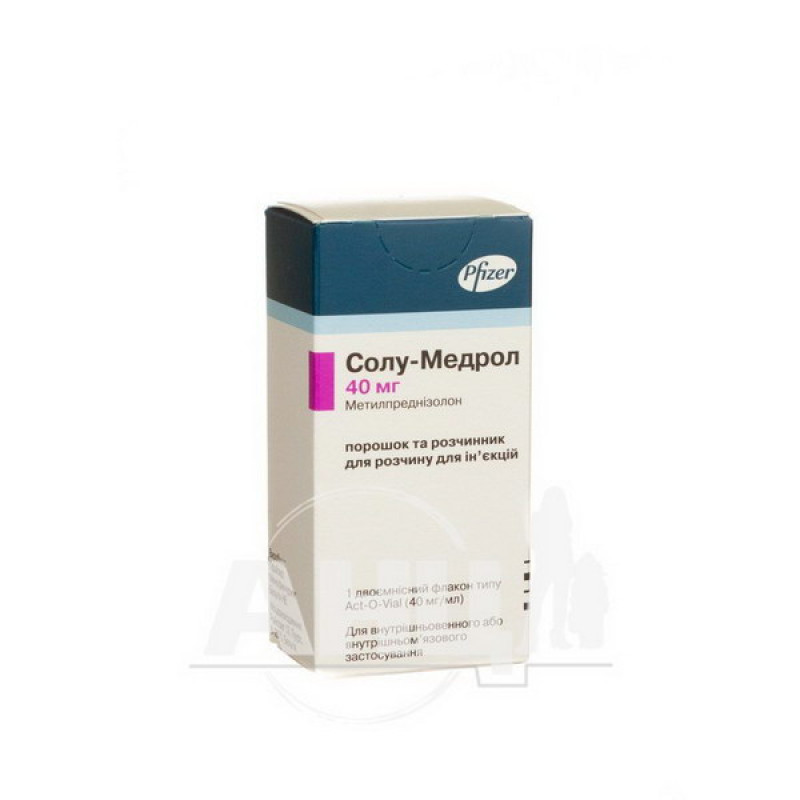
Solu-Medrol is an injectable form of methylprednisolone (synthetic GCS) for intramuscular and intravenous administration. This highly concentrated solution is suitable, in particular, for the treatment of pathological conditions in which an effective and rapid effect of the hormone is required. Methylprednisolone exhibits strong anti-inflammatory, immunosuppressive and anti-allergic effects.
The use of Solu-Medrol should be considered only as an exclusively symptomatic treatment, with the exception of certain endocrine disorders, when it is used as replacement therapy.
Anti-inflammatory treatment.
Rheumatic diseases.
As adjunctive therapy for short-term use (to help the patient survive an acute episode or exacerbation) in the following diseases:
post-traumatic osteoarthritis; synovitis in osteoarthritis; rheumatoid arthritis, in particular juvenile rheumatoid arthritis (in some cases, low-dose maintenance therapy may be required); acute and subacute bursitis, epicondylitis; acute nonspecific tendosynovitis; acute gouty arthritis; psoriatic arthritis; ankylosing spondylitis. Collagenoses (systemic connective tissue diseases).
During an exacerbation or as maintenance therapy in some cases for diseases such as:
systemic lupus erythematosus (and lupus nephritis); acute rheumatic carditis; systemic dermatomyositis (polymyositis); periarteritis nodosa; Goodpasture's syndrome. Dermatological diseases: pemphigus; severe erythema multiforme (Stevens-Johnson syndrome); exfoliative dermatitis bullous dermatitis herpetiformis; severe seborrheic dermatitis; severe psoriasis; mycosis fungoides; urticaria. Allergic conditions.
Control of severe or disabling allergic conditions that do not respond to appropriate conventional treatment, in diseases such as:
bronchial asthma; contact dermatitis; atopic dermatitis; serum sickness, seasonal or perennial allergic rhinitis; hypersensitivity reactions to drugs; urticaria; acute non-infectious laryngeal edema (adrenaline is the drug of first choice). Ophthalmological diseases.
Severe acute and chronic allergic and inflammatory processes in the eye area, including:
Ocular form of Herpes zoster; iritis, iridocyclitis; chorioretinitis, diffuse posterior uveitis and choroiditis; optic neuritis; sympathetic ophthalmia; inflammation of the middle segment of the eye; allergic conjunctivitis; allergic corneal ulcers; keratitis. Gastrointestinal tract diseases.
Critical periods for the following diseases:
ulcerative colitis (systemic therapy); regional enteritis (systemic therapy). Respiratory diseases: pulmonary sarcoidosis; berylliosis, fulminant or disseminated pulmonary tuberculosis, when used simultaneously with appropriate anti-tuberculosis chemotherapy; Loeffler's syndrome, which is not amenable to treatment by other means; aspiration pneumonitis; moderate and severe pneumonia caused by Pneumocystis carinii, in AIDS patients (as an adjuvant therapy during the first 72 hours of anti-pneumocystis therapy); exacerbation of chronic obstructive pulmonary disease. Conditions accompanied by edema.
To induce diuresis or remission in proteinuria in nephrotic syndrome, proteinuria without uremia.
Treatment of hematological and oncological diseases.
Hematological diseases: acquired (autoimmune) hemolytic anemia, idiopathic thrombocytopenic purpura in adults (only intravenous, intramuscular use is contraindicated), secondary thrombocytopenia in adults, erythroblastopenia (erythrocytic anemia); congenital (erythroid) hypoplastic anemia; Oncological disease.
Palliative treatment of diseases such as:
leukemia and lymphoma in adults, acute leukemia in children to improve the quality of life of patients with terminal cancer.
Endocrine disorders.
Primary or secondary adrenal insufficiency. Acute adrenal insufficiency.
In these indications, the drugs of choice are hydrocortisone or cortisone. Under certain circumstances, synthetic analogues can be used in combination with mineralocorticoids.
Treatment of shock: shock due to adrenal insufficiency or shock that does not respond to conventional treatment, in case of confirmed or suspected adrenal insufficiency (hydrocortisone is the drug of choice). If mineralocorticoid effects are undesirable, methylprednisolone may be preferred. Before surgery and in case of severe trauma or illness in patients with established adrenal insufficiency or when there is doubt about the adrenal reserve. Congenital adrenal hyperplasia. Non-purulent thyroiditis. Hypercalcemia associated with malignancy.
Composition
active ingredient: methylprednisolone;
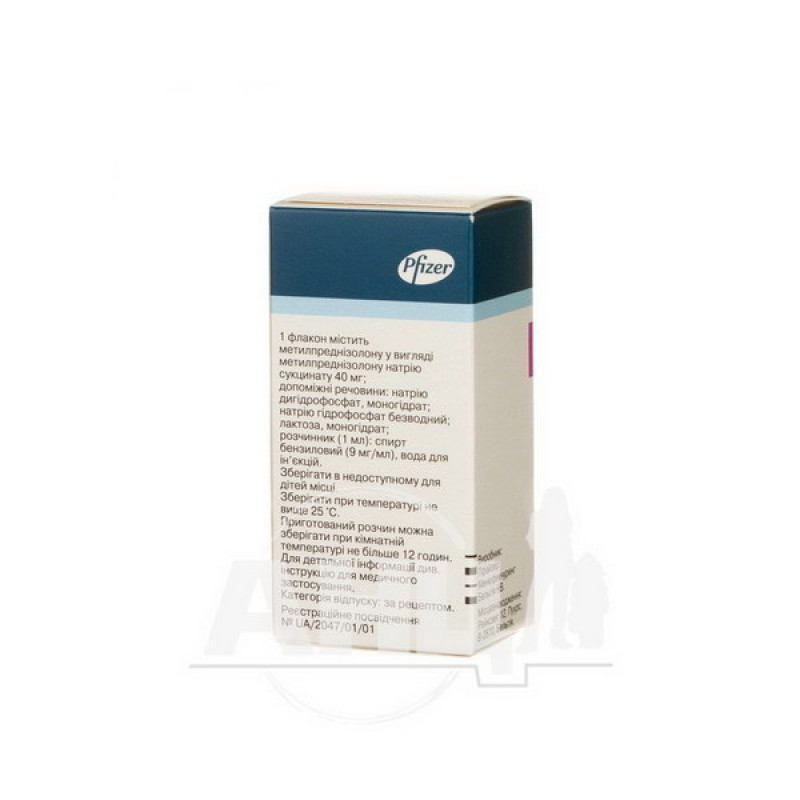
1 vial contains 40 mg of methylprednisolone as methylprednisolone sodium succinate;
Excipients: sodium dihydrogen phosphate monohydrate, sodium phosphate anhydrous
Solvent for dosing: water for injections
Contraindication
Systemic fungal infections.
Solu-Medrol 40 mg is contraindicated in patients with known or suspected allergy to cow's milk.
Hypersensitivity to methylprednisolone or to any of the excipients listed in the "Composition" section.
Methylprednisolone sodium succinate solution may be administered by intravenous or intramuscular injection or by infusion. In primary emergency care, intravenous injection is preferred (see Table 1 for recommended doses). The dose for infants and children may be reduced, but should be guided more by the severity of the condition and the patient's response to treatment than by age or weight. The dose should not be less than 0.5 mg/kg body weight every 24 hours.
In idiopathic thrombocytopenic purpura in adults, the drug is used only intravenously (intramuscular use is contraindicated).
The dose should be reduced or withdrawn gradually if the drug has been administered for more than a few days. If spontaneous remission occurs in a chronic disease, treatment should be discontinued. During long-term therapy, routine laboratory tests should be performed periodically, including urinalysis, blood sugar levels 2 hours after meals, blood pressure and body weight, and chest X-rays should be performed. In patients with a history of ulcers or severe dyspepsia, it is advisable to perform an upper gastrointestinal X-ray. In the event of sudden discontinuation of long-term treatment, medical supervision is also necessary. For intravenous (or intramuscular) injection, the solution is prepared according to the instructions.
Instructions for use of the drug in a two-chamber vial of the Act-O-Vial type.
Press the plastic activator to allow the solvent to enter the lower chamber. Shake gently to mix the solution. Remove the plastic plate covering the center of the stopper. Sterilize the exposed portion of the rubber stopper. Insert a needle (preferably 22G) vertically through the center of the stopper until the tip is visible. Invert the vial and withdraw the required dose of medication. If using a thicker needle, it is important to avoid tilting the needle and insert it perpendicular to the center of the rubber stopper.
Instructions for use of the drug in a vial complete with a solvent.
Under aseptic conditions, add the solvent to the vial with the sterile powder. Only the special solvent is used.
Preparation of perfusion solutions.
First, prepare the reconstituted solution according to the instructions. Therapy can be initiated by injecting methylprednisolone sodium succinate solution over a period of at least 5 minutes (doses up to and including 250 mg) and at least 30 minutes (doses greater than 250 mg). Subsequent doses can be drawn up and administered in a similar manner. If necessary, the drug can be administered in diluted solutions by mixing the reconstituted drug with 5% glucose solution in water, saline, 5% glucose solution in 0.45% or 0.9% sodium chloride. The resulting solutions are physically and chemically stable for 48 hours.
Any unused medicinal product or waste material should be disposed of in accordance with local requirements.
Application features
Use during pregnancy or breastfeeding
Pregnancy.
Some animal studies have shown that corticosteroids administered during pregnancy in high doses may cause fetal malformations. However, corticosteroids do not cause congenital malformations when administered to pregnant women. Despite the results of animal studies, the risk of fetal harm is low when the drug is used during pregnancy. In the absence of adequate studies of the effect of the drug on the human reproductive system and intrauterine development of the fetus, methylprednisolone sodium succinate should be used during pregnancy only after careful assessment of the benefit/risk ratio for the mother and fetus. If long-term corticosteroid treatment is to be discontinued during pregnancy (as with other long-term treatments), this should be done gradually (see also “Method of administration and dosage”).
Corticosteroids readily cross the placental barrier. Some retrospective studies have reported an increased incidence of low birth weight in mothers receiving corticosteroids. In humans, the risk of low birth weight is dose-dependent. This risk can be minimized by using low doses of corticosteroids. Although adrenal insufficiency is rare in infants exposed to corticosteroids in utero, infants exposed to substantial doses of corticosteroids should be carefully observed and evaluated for signs of adrenal insufficiency. The effect of corticosteroids on labor and delivery is unknown.
Breastfeeding.
Corticosteroids, including prednisolone, are excreted in human milk. This drug should be used during breastfeeding only after careful consideration of the benefit/risk ratio for the mother and infant.
Benzyl alcohol can cross the placental barrier.
Children
The drug can be prescribed to children, including infants.
Although visual disturbances have been reported as rare adverse reactions, patients who drive vehicles and/or operate other machinery should be cautious.
Overdose
There is no clinical syndrome of acute overdose of Methylprednisolone sodium succinate. Chronic overdose causes characteristic symptoms of Cushing's syndrome. Methylprednisolone is excreted by dialysis.
Adverse reactions
Systemic adverse reactions are possible. Although they are rare with very short-term therapy, they should always be carefully monitored. This is part of the monitoring of any corticosteroid and is not specific to the specific drug. Possible adverse reactions to glucocorticoids, particularly methylprednisolone, include:
Interaction with other medicinal products and other types of interactions
In order to avoid compatibility and stability problems, it is recommended that methylprednisolone sodium succinate be administered separately from other compounds used in. Drugs that are physically incompatible with methylprednisolone sodium succinate in solution include (the list is not exhaustive): allopurinol sodium, doxapram hydrochloride, tigecycline, diltiazem hydrochloride, calcium gluconate, vecuronium bromide, rocuronium bromide, cisatracurium besylate, glycopyrrolate, propofol.
Storage conditions
Keep out of reach of children.
Store at a temperature not exceeding 25 °C.
The prepared solution can be stored at room temperature for no more than 12 hours.
Shelf life - 2 years.