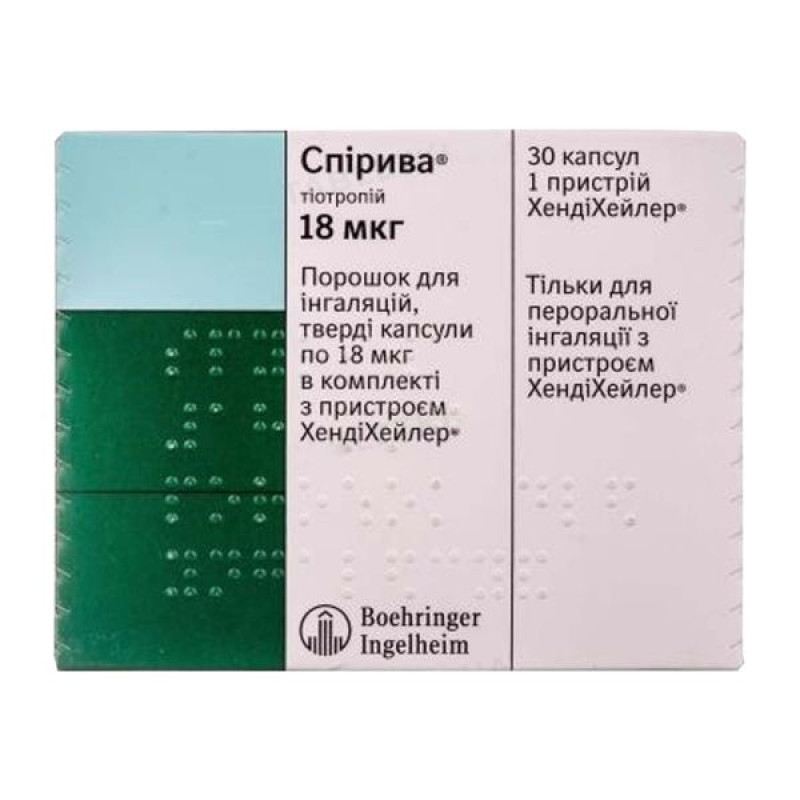
Instructions for use Spiriva inhalation powder, hard capsules 18 mcg, blister with HandiHaler device No. 30
Composition
active ingredient: tiotropium bromide;
1 capsule contains tiotropium bromide monohydrate 22.5 mcg, corresponding to tiotropium 18 mcg;
excipients: micronized lactose monohydrate, lactose monohydrate 200 M.
Dosage form
Inhalation powder, hard capsules.
Main physicochemical properties: size 3 hard gelatin capsules containing white powder, for use with the HANDIHALER device;
Capsule shell: according to the relevant manufacturing procedure, light green, opaque, with a black imprint of the company symbol / TI 01.
Pharmacotherapeutic group
Other agents for the treatment of obstructive airway diseases, inhalation agents. Anticholinergic agents.
ATX code R03B B04.
Pharmacological properties
Pharmacodynamics.
Mechanism of action. Tiotropium bromide is a specific, long-acting muscarinic receptor antagonist, often referred to in clinical practice as an anticholinergic. It has similar affinity for all subtypes of muscarinic receptors (M1 to M5). In the airways, complete and reversible inhibition of M3 receptors by tiotropium bromide results in smooth muscle relaxation. The bronchodilator effect was dose-dependent and lasted for more than 24 hours.
The duration of effect is probably due to a very slow release from M3 receptors; the half-life of tiotropium is significantly longer than that of ipratropium. As an N-quaternary anticholinergic, tiotropium bromide is locally (broncho-) selective when inhaled and exhibits an acceptable therapeutic dose range before systemic anticholinergic effects are observed.
Pharmacodynamic effects: Bronchodilation after inhalation of tiotropium is primarily a local effect on the airways and is not systemic.
Dissociation from M2 receptors is faster than from M3, which in in vitro functional studies resulted in a (kinetic-dependent) selective action for the M3 receptor subtype compared to M2. High activity and slow dissociation from receptors have been clinically correlated with significant and long-lasting bronchodilation in patients with chronic obstructive pulmonary disease (COPD).
Cardiac electrophysiology
In specially conducted studies of the effect of the drug on the QT interval in 53 healthy volunteers, the use of SPIRIVA at doses of 18 mcg and 54 mcg (three doses of 18 mcg) for 12 days did not cause prolongation of the QT interval according to electrocardiogram indicators.
Clinical efficacy and safety
The clinical trial program included four one-year, two 6-month, randomized, double-blind studies in 2663 patients (1308 of whom received tiotropium bromide). The one-year program consisted of two placebo-controlled studies and two active-controlled studies (ipratropium). Both six-month studies were controlled with salmeterol and placebo. All studies included studies of the effects of the drug on lung function and the effects on dyspnea, exacerbations, and health-related quality of life.
Pulmonary function
When tiotropium bromide was administered once daily, significant improvements in lung function (increased forced expiratory volume in one second (FEV1) and forced vital capacity (FVC)) were observed within 30 minutes after the first dose, and the effect lasted for 24 hours. Pharmacodynamic steady state was achieved within one week. In most patients, bronchodilation occurred by day 3.
Based on daily measurements, tiotropium bromide significantly improved morning and evening peak expiratory flow.
The bronchodilator effect of tiotropium bromide was maintained throughout the study period (1 year) without signs of tolerance development.
A randomized, placebo-controlled clinical trial in 105 patients with COPD showed that bronchodilation was sustained over the 24-hour dosing interval compared to placebo, regardless of whether the drug was administered in the morning or evening.
Clinical trials (up to 12 months)
Shortness of breath, exercise tolerance
Tiotropium bromide significantly reduced dyspnea (as assessed using the Transient Dyspnea Index). The improvement was maintained throughout the treatment period.
The effect of the drug on the severity of dyspnea during exercise was investigated in two randomized, double-blind, placebo-controlled studies in 433 patients with moderate to severe COPD. In these studies, SPIRIVA demonstrated a significant increase in symptom-limited endurance exercise time, as measured by cycle ergometry at 75% of maximum capacity, by 19.7% (study A) and 28.3% (study B) compared to placebo, during six weeks of treatment.
In a 9-month, randomized, double-blind, placebo-controlled clinical trial in 492 patients, SPIRIVA improved the overall health-related quality of life as assessed by the St. George Respiratory Questionnaire (SGRQ). The number of patients treated with SPIRIVA who achieved a significant improvement in the overall SGRQ score (i.e., >4 points) was 10.9% higher than in the placebo group (59.1% in the SPIRIVA group vs. 48.2% in the placebo group (p=0.029). The mean difference between groups was 4.19 points (p=0.001; confidence interval: 1.69–6.68). Improvements in SGRQ scores were: 8.19 units for symptoms, 3.91 units for activity, and 3.61 units for impact on daily activities. Improvements in all of these scores were statistically significant.
COPD exacerbation
In a randomized, double-blind, placebo-controlled trial in 1829 patients with moderate to very severe COPD, tiotropium bromide significantly reduced the number of patients with COPD exacerbations (from 32.2% to 27.8%) and resulted in a statistically significant reduction in the number of exacerbations by 19% (from 1.05 to 0.85 events/patient-year of exposure). Hospitalization due to COPD exacerbations was 7.0% in the tiotropium bromide group and 9.5% in the placebo group (p = 0.056). The number of patients hospitalized for COPD was 30% lower (from 0.25 to 0.18 events/patient-year of exposure).
A 1-year, randomized, double-blind, placebo-controlled, parallel-group study evaluated the effects of treatment with SPIRIVA 18 mcg once daily and salmeterol, metered-dose aerosol, 50 mcg twice daily, on the frequency of moderate and severe exacerbations in 7,376 patients with COPD and a history of an exacerbation in the previous year.
Compared with salmeterol, SPIRIVA increased the time to first exacerbation (187 days versus 145 days) with a 17% reduction in the risk of exacerbation (hazard ratio 0.83; 95% confidence interval (CI) 0.77, 0.90, p < 0.001). SPIRIVA inhalation also increased the time to first severe exacerbation (hospitalization) (hazard ratio 0.72; 95% CI 0.61, 0.85; p < 0.001).
Long-term clinical trials (more than 1 year, up to 4 years)
In a 4-year, randomized, double-blind, placebo-controlled clinical trial involving 5,993 randomized patients (3,006 patients receiving placebo and 2,987 patients receiving SPIRIVA), improvements in FEV1 were demonstrated with SPIRIVA compared to placebo. The number of patients who completed treatment after ≥ 45 months was higher in the SPIRIVA group compared to the placebo group (63.8% versus 55.4%, p < 0.001). The annual rate of decline in FEV1 was similar in the SPIRIVA and placebo groups. A 16% reduction in the risk of mortality was observed during treatment. The overall number of deaths was 4.79 per 100 patient-years in the placebo group compared with 4.10 per 100 patient-years in the tiotropium group (hazard ratio (tiotropium/placebo) = 0.84, 95% CI 0.73, 0.97). Treatment with tiotropium reduced the risk of respiratory failure (based on adverse event reports) by 19% (2.09 versus 1.68 events per 100 patient-years, relative risk (tiotropium/placebo) 0.81, 95% CI 0.65, 0.999).
Active-controlled study of tiotropium
A large, long-term, randomized, double-blind, active-controlled study with a follow-up period of up to 3 years was conducted to compare the efficacy and safety of SPIRIVA with the HANDIHALER device and SPIRIVA RESPIMAT (5694 patients used SPIRIVA HANDIHALER; 5711 patients used SPIRIVA RESPIMAT). The primary endpoints were time to first COPD exacerbation, time to all-cause mortality and, in a substudy (906 patients), trough FEV1 (pre-dose).
The time to first COPD exacerbation during the study was numerically comparable between the SPIRIVA with HANDIHALER and SPIRIVA RESPIMAT groups (hazard ratio (SPIRVA with HANDIHALER/SPIRVA RESPIMAT) 1.02; 95% CI 0.97, 1.08). The median number of days to first COPD exacerbation was 719 days for SPIRIVA with HANDIHALER and 756 days for SPIRIVA RESPIMAT.
The bronchodilator effect of SPIRIVA with HANDIHALER was sustained over 120 weeks and was similar to SPIRIVA RESPIMAT. The mean difference in trough FEV1 for SPIRIVA with HANDIHALER compared to SPIRIVA RESPIMAT was 0.010 liters (95% CI 0.018, 0.038 liters).
Pharmacokinetics. Tiotropium bromide is a non-chiral quaternary ammonium compound that is sparingly soluble in water. Tiotropium is administered as a dry powder for inhalation. Typically, when administered by inhalation, most of the delivered dose is deposited in the gastrointestinal tract and a smaller amount in the lungs. Many of the pharmacokinetic data described below were obtained at doses higher than those recommended for treatment.
Absorption: After inhalation of the dry powder, the absolute bioavailability is 19.5%, indicating a high bioavailability of the fraction reaching the lungs. The absolute bioavailability of the oral solution of tiotropium is 2-3%. Peak plasma concentrations of tiotropium were observed 5-7 minutes after inhalation.
At steady state, the maximum plasma level of tiotropium in COPD patients was 12.9 pg/ml and declined rapidly in a multi-compartment model. The minimum plasma concentration of tiotropium at steady state was 1.71 pg/ml. The systemic exposure after inhalation of tiotropium via the HANDIHALER device was similar to that after inhalation of tiotropium via the RESPIMAT inhaler.
Distribution. 72% of the drug is bound to plasma proteins. The volume of distribution is 32 l/kg. Local lung concentrations are unknown, but high lung concentrations are assumed based on the route of administration. Studies in rats have shown that tiotropium does not cross the blood-brain barrier to any significant extent.
Biotransformation: The extent of biotransformation is low, with 74% of the unchanged substance being excreted in the urine after intravenous administration to young healthy volunteers. Tiotropium, as an ester, is non-enzymatically metabolised to the alcohol N-methylscopine and dithienylglycolic acid, which do not bind to muscarinic receptors.
Further, in vitro studies in human liver microsomes and hepatocytes suggest that tiotropium (< 20% of the dose after intravenous administration) is metabolised by cytochrome P450-dependent oxidation and subsequent glutathione conjugation to various phase II metabolites. In vitro studies in human liver microsomes suggest that this enzyme pathway can be inhibited by the inhibitors CYP450 2D6 (and 3A4), quinidine, ketoconazole and gestodene. Thus, CYP450 2D6 and 3A4 are involved in the metabolic transformations responsible for the elimination of a minor part of the dose. Tiotropium does not inhibit cytochrome P450 1A1, 1A2, 2B6, 2C9, 2C19, 2D6, 2E1 and 3A in human liver microsomes, even at supratherapeutic concentrations.
Elimination: The effective half-life of tiotropium is between 27 and 45 hours after administration in COPD patients. Total clearance was 880 ml/min after intravenous administration to young healthy volunteers. After intravenous administration, tiotropium is mainly excreted unchanged in the urine (74%). After inhalation of the dry powder, urinary excretion is 7% (1.3 μg) of the unchanged amount within 24 hours, the remainder is not absorbed from the intestine and is excreted in the feces. Renal clearance of tiotropium exceeds creatinine clearance, indicating urinary excretion. After continuous daily inhalation administration in COPD patients, pharmacokinetic steady state was reached after 7 days without further accumulation.
Linearity/non-linearity: Tiotropium exhibits linear pharmacokinetic properties in the therapeutic range regardless of dosage form.
Pharmacokinetics in the elderly: As with all drugs that are primarily excreted in the urine, renal clearance of tiotropium is reduced in the elderly (365 ml/min in COPD patients < 65 years of age compared to 271 ml/min in COPD patients ≥ 65 years of age). This did not result in a corresponding increase in AUC0-6,ss or Cmax,ss.
Pharmacokinetics in patients with renal impairment: Inhaled tiotropium once daily in COPD patients at steady state with mild renal impairment (creatinine clearance 50-80 ml/min) resulted in a small increase in AUC0-6,ss (by 1.8-30%) and similar Cmax values compared to patients with normal renal function (creatinine clearance > 80 ml/min).
In COPD patients with moderate or severe renal impairment (creatinine clearance <50 ml/min), intravenous administration of tiotropium resulted in a two-fold increase in total exposure (82% higher AUC0-4h, 52% higher Cmax) compared to patients with normal renal function, as confirmed by plasma concentrations after dry powder inhalation.
Japanese COPD patients In a cross-sectional comparison, the mean peak plasma concentration of tiotropium at 10 minutes after administration at steady state was 20-70% higher in Japanese compared to Caucasians after inhaled tiotropium, but there was no evidence of increased mortality or risk of cardiac complications in Japanese patients compared to Caucasians. There are insufficient pharmacokinetic data for other races or ethnic groups.
Pharmacokinetics/pharmacodynamics relationship: There is no direct relationship between pharmacokinetics and pharmacodynamics.
Indication
Maintenance bronchodilator therapy for the relief of symptoms in chronic obstructive pulmonary disease (COPD).
Contraindication
Spiriva inhalation powder is contraindicated in patients with known hypersensitivity to tiotropium bromide, atropine or its derivatives (ipratropium or oxitropium) or to any of the other ingredients of the product.
Interaction with other medicinal products and other types of interactions
Although no formal drug interaction studies have been performed, tiotropium bromide has been used concomitantly with other drugs (sympathomimetic bronchodilators, methylxanthines, oral and inhaled steroids used in the treatment of COPD) without clinical evidence of drug interactions.
The use of long-acting beta-adrenergic agonists or inhaled corticosteroids has not been shown to alter tiotropium exposure.
However, the use of Spiriva in combination with anticholinergic drugs has not been studied and is therefore not recommended.
Application features
Tiotropium bromide is a bronchodilator administered once daily for maintenance therapy and is not intended for the initial treatment of acute attacks of bronchospasm or for the relief of acute symptoms.
Immediate hypersensitivity reactions are possible after the use of SPIRIVA.
As with other anticholinergic drugs, SPIRIVA should be used with caution in patients with narrow-angle glaucoma, prostatic hyperplasia or bladder neck obstruction (see section 4.8).
Inhaled medications can cause inhalation-induced bronchospasm.
The drug should be used with caution in the following patients: those who have recently had a myocardial infarction (<6 months); those with any unstable or life-threatening arrhythmia or arrhythmia that required intervention or change of therapy within the last year; hospitalized with heart failure (NYHA class III or IV) within the last year. These patients were excluded from clinical trials. In such conditions, the anticholinergic effect may be harmful to them.
Since tiotropium bromide plasma concentrations are increased in patients with moderate to severe renal impairment (creatinine clearance ≤ 50 ml/min), SPIRIVA should only be used if the expected benefit outweighs the potential risk. There are no data on the long-term use of SPIRIVA in patients with renal impairment (see section 5.2).
Patients should avoid getting the powder in their eyes. Patients should be warned that this may lead to acceleration or worsening of angle-closure glaucoma, eye pain or discomfort, temporary blurred vision, a sensation of halos or colored spots before the eyes in combination with redness of the eye in the form of conjunctival or corneal hyperemia.
If the listed symptoms appear in any combination, patients should stop using tiotropium bromide and immediately seek specialized medical attention.
Dry mouth, which is observed with anticholinergic therapy, may be associated with caries in the future.
SPIRIVA should not be used more than once a day.
SPIRIVA contains 5.5 mg of lactose monohydrate per capsule. This amount does not usually cause problems in patients with lactose intolerance. Patients with rare hereditary problems of galactose intolerance, the Lapp lactase deficiency or glucose-galactose malabsorption should not take this medicine. The excipient lactose monohydrate may contain small amounts of milk proteins which may cause allergic reactions.
Use during pregnancy or breastfeeding
Pregnancy: There are very limited data from the use of tiotropium in pregnant women. Preclinical studies do not indicate direct or indirect harmful effects with respect to reproductive toxicity at clinically relevant doses. As a precautionary measure, the use of SPIRIVA should be avoided during pregnancy.
Breastfeeding. It is not known whether tiotropium bromide passes into breast milk. Despite the results of studies conducted in rodents, which showed that tiotropium bromide is excreted in breast milk only in small amounts, the use of the drug during breastfeeding is not recommended.
Fertility: No clinical data are available on the effects of tiotropium on fertility. Preclinical studies of tiotropium did not indicate any adverse effects on fertility.
The ability to influence the reaction speed when driving or working with other mechanisms
No studies on the effects on the ability to drive or use machines have been conducted. The occurrence of dizziness, headache or blurred vision may affect the ability to drive or use machines.
Method of administration and doses
Dosage
The medicinal product is intended for inhalation use only.
The recommended dose of tiotropium bromide is to inhale the contents of one capsule once daily using the HandiHaler inhaler. The inhalation should be done at the same time of day.
The recommended dose should not be exceeded.
SPIRIVA capsules are not intended for oral use.
SPIRIVA, capsules, should not be swallowed.
SPIRIVA capsules should only be used with the HANDIHALER inhalation device.
Special groups
Elderly patients can use tiotropium bromide according to the dose recommended by the doctor.
Patients with renal impairment may be treated with tiotropium bromide at the recommended dose. Information on the use of SPIRIVA in patients with moderate to severe renal impairment (creatinine clearance ≤ 50 ml/min) is provided in the sections “Special warnings and precautions for use” and “Pharmacokinetics”.
Patients with hepatic insufficiency can use SPIRIVA at the dose recommended by the doctor (see section "Pharmacokinetics").
Cystic fibrosis. The safety and efficacy of SPIRIVA 18 mcg in children and adolescents have not been established. Data are not available.
Instructions for use.
The HANDIHALER is an inhalation device specifically designed to allow patients to inhale the medication contained in SPIRIVA capsules. The HANDIHALER device should not be used to administer any other medication. It is a single-patient, reusable device.
To ensure proper use of the drug, it is necessary to inform the patient how to use the inhaler.
To use the HANDIHALER inhalation device, patients should follow the steps below.
When using SPIRIVA, you should follow your doctor's recommendations.
After first use, the HandiHaler inhalation device can be used for one year, provided it is used as intended.
Dust cap. Mouthpiece. Basis. Spray button. Platform with a central camera. | |
| 1. To open the dust cap, press the spray button all the way down and release. | |
2. Open the dust cap by lifting it upwards. Then open the mouthpiece by lifting it up. | |
| 3. Remove the SPIRIVA capsule from the blister (immediately before use) and place it on the platform with the central chamber as shown in the figure. It does not matter which side you place the capsule in the chamber (5). | |
| 4. Close the mouthpiece tightly until it clicks, leaving the dust cap open. | |
5. Hold the HandiHaler device with the mouthpiece facing up and press the spray button all the way down once and release. This makes holes in the capsule shell and allows the drug to be released when inhaled. | |
6. Exhale completely. Important: Do not exhale into the mouthpiece under any circumstances. | |
7. Lift the HandiHaler device to your mouth and place your lips tightly around the mouthpiece. Keep your head straight and breathe in slowly and deeply, but in such a way that you can hear or feel the capsule vibrate. Inhale until your lungs are full; then hold your breath for as long as possible and at the same time remove the mouthpiece from your mouth. Resume breathing. Repeat the steps shown in figures 6 and 7 one more time to completely empty the capsule. | |
8. Open the mouthpiece again. Remove the used capsule and discard. Close the mouthpiece and dust cap to store the HANDIHALER device. | |
Cleaning the HANDIHALER device The HandiHaler device should be cleaned once a month. Open the dust cap and mouthpiece. Then open the base by lifting the spray button. Rinse the entire inhaler with warm water to remove the powder. Dry the HandiHaler thoroughly by blotting any remaining water with a paper towel and air drying, leaving the dust cap, mouthpiece and base open. Air drying takes 24 hours, so cleaning should start immediately after use to ensure the device is ready for the next use. If necessary, the mouthpiece can be cleaned externally with a damp, but not wet, cloth. | |
Opening the blister A. Separate the SPIRYVA blister strips by tearing along the perforation. | |
B. Open (immediately before use) to the “STOP” mark. If another capsule is accidentally opened, it should be discarded. | |
C. Remove the capsule | |
SPIRIVA capsules contain only a small amount of powder, so the capsule is only partially filled.
Children
The drug is not intended for use in children (under 18 years of age).
Overdose
High doses of Spiriva may cause anticholinergic signs and symptoms.
However, systemic anticholinergic side effects were absent in healthy volunteers after a single dose of up to 340 mcg tiotropium bromide.
No significant adverse reactions, other than dry mouth, were observed after 7 days of administration of tiotropium bromide up to 170 mcg in healthy volunteers.
In multiple-dose studies in COPD patients, administration of a maximum daily dose of 43 mcg tiotropium bromide for 4 weeks did not cause significant adverse reactions.
Acute intoxication with oral administration of tiotropium capsules is unlikely due to low oral bioavailability.
Side effects
Brief information on the safety of the medicinal product
Many of the listed undesirable effects can be attributed to the anticholinergic properties of SPIRIVA.
Adverse drug reactions were identified from data obtained from clinical trials and spontaneous reporting during the post-marketing period. The clinical trial database includes 9,647 patients who received tiotropium in 28 placebo-controlled clinical trials with treatment periods ranging from 4 weeks to 4 years.
Frequency of adverse reactions according to MedDRA:
very common (≥ 1/10);
common (≥ 1/100, < 1/10);
uncommon (≥ 1/1000, < 1/100);
rare (≥ 1/10,000, < 1/1,000);
rare (<1/10,000);
unknown (cannot be determined from available data).
Metabolic and nutritional disorders:
unknown – dehydration.
Central nervous system disorders:
infrequently - dizziness, headache, taste disturbance;
isolated – insomnia.
Visual disturbances:
infrequently - blurred vision;
rare – glaucoma, increased intraocular pressure.
Cardiovascular system disorders:
infrequently - atrial fibrillation;
rare – supraventricular tachycardia, tachycardia, palpitations.
Respiratory, thoracic and mediastinal disorders:
infrequently - pharyngitis, dysphonia, cough;
rare – bronchospasm, nosebleeds, laryngitis, sinusitis.
Gastrointestinal disorders:
often - dry mouth;
infrequently - gastroesophageal reflux disease, constipation, candidiasis of the oral cavity and pharynx;
isolated - intestinal obstruction, including paralytic intestinal obstruction; glossitis, dysphagia, stomatitis, nausea;
unknown – dental caries.
Skin, subcutaneous tissue and immune system disorders:
infrequently - rash;
rare - urticaria, itching, hypersensitivity (including immediate-type allergic reactions), angioedema;
unknown - anaphylactic reaction, skin infections and ulceration, dry skin.
Musculoskeletal and connective tissue disorders:
not known – joint swelling.
Renal and urinary tract disorders:
infrequently - dysuria, urinary retention;
isolated – urinary tract infection.
Description of selected adverse reactions
In controlled clinical trials, the most commonly observed anticholinergic adverse reaction was dry mouth, occurring in approximately 4% of patients.
In 28 clinical trials, dry mouth led to discontinuation of the drug in 18 of 9647 patients (0.2%).
Serious side effects consistent with anticholinergic effects include glaucoma, constipation, intestinal obstruction including paralytic ileus, and urinary retention.
Other special patient groups
The number of anticholinergic effects may increase with age.
Reporting of suspected adverse reactions
Reporting adverse reactions after the registration of a medicinal product is important. This allows monitoring of the benefit/risk ratio of the medicinal product. Medical and pharmaceutical professionals, as well as patients or their legal representatives, should report all cases of suspected adverse reactions and lack of efficacy of the medicinal product via the Automated Information System for Pharmacovigilance at the link: https://aisf.dec.gov.ua.
Expiration date
2 years.
After first opening the blister strip, use within 9 days.
Storage conditions
Store at a temperature not exceeding 25 °C. Protect from direct sunlight, heat and frost. Keep out of the reach of children.
Packaging
10 capsules with inhalation powder in a blister; 3 blisters in a cardboard box.
10 capsules with inhalation powder in a blister; 1 or 3 blisters complete with a HANDIHALER device in a cardboard box.
Vacation category
According to the recipe.
Producer
Boehringer Ingelheim Pharma GmbH & Co.KG, Germany.
Location of the manufacturer and address of its place of business
Binger Strasse 173, 55216 Ingelheim am Rhein, Germany/Binger Strasse 173, 55216 Ingelheim am Rhein, Germany.