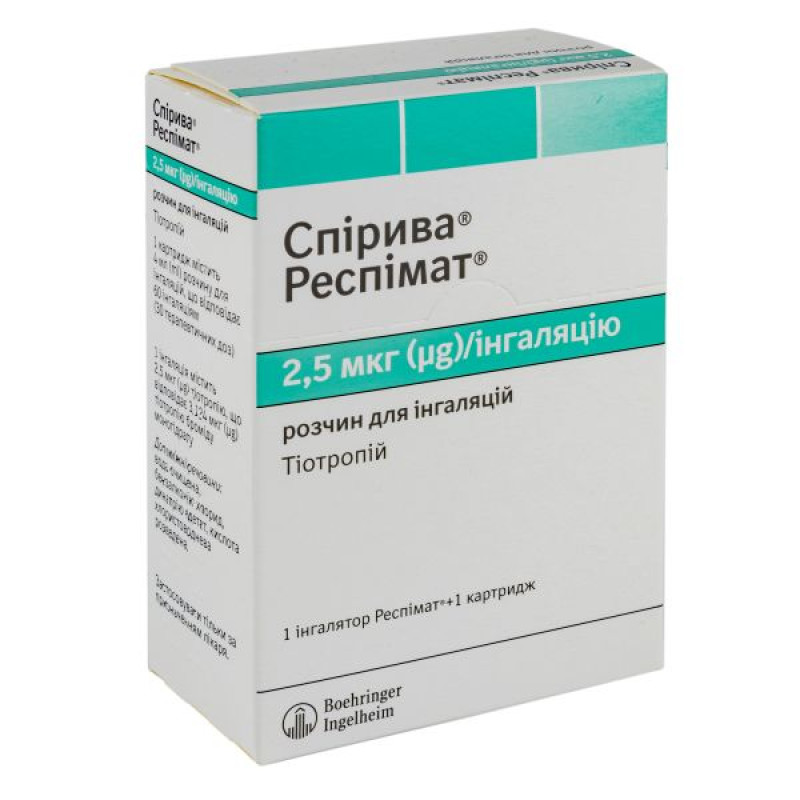
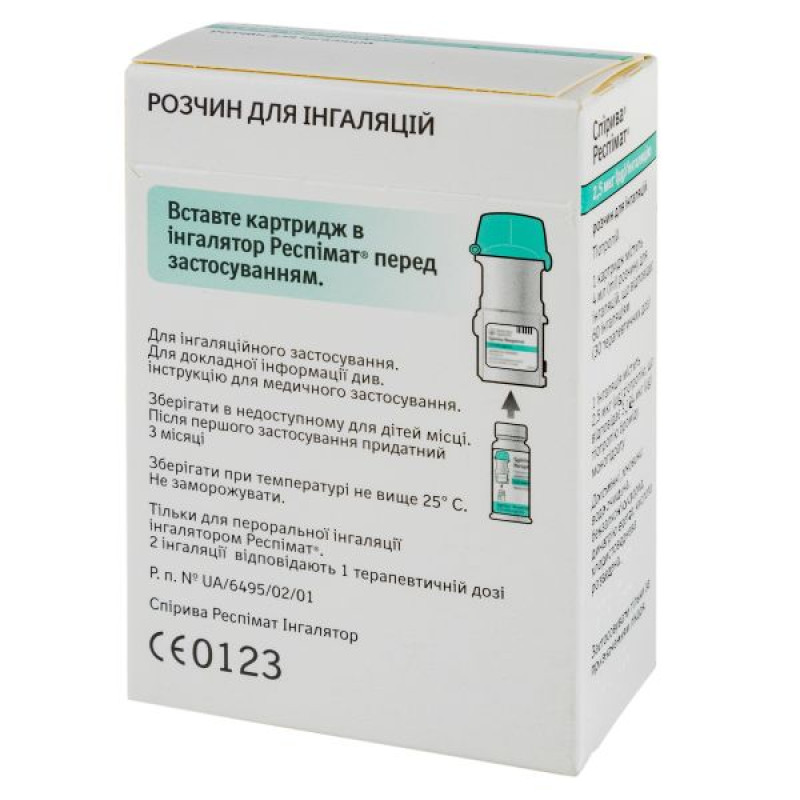
Instructions Spiriva Respimat inhalation solution 2.5 mcg/ing Respimat inhaler cartridge 4 ml 60 inhalations
Composition
active ingredient: tiotropium bromide monohydrate, which corresponds to tiotropium;
1 inhalation contains 3.124 μg tiotropium bromide monohydrate, corresponding to 2.5 μg tiotropium;
Excipients: benzalkonium chloride, disodium edetate, purified water, diluted hydrochloric acid.
Dosage form
Solution for inhalation.
Main physicochemical properties: cartridges with a volume of up to 4.5 ml, filled with liquid, clamped into aluminum cylinders for the RESPIMAT inhaler, with a pressed-in protective gasket.
Pharmacotherapeutic group
Other drugs for the treatment of obstructive airway diseases, inhalation agents. Anticholinergics. Tiotropium bromide.
ATX code R03B B04.
Pharmacological properties
Pharmacodynamics.
Mechanism of action
Tiotropium bromide is a specific, long-acting muscarinic receptor antagonist. Tiotropium has similar affinity for receptor subtypes M1 to M5. In the airways, tiotropium bromide competitively and reversibly binds to M3 receptors on bronchial smooth muscle, antagonizing the cholinergic (bronchoconstrictor) effects of acetylcholine, resulting in relaxation of bronchial smooth muscle. The effect was dose-dependent and lasted for more than 24 hours. As tiotropium is a locally bronchoselective N-quaternary anticholinergic, it exhibits an acceptable therapeutic range before systemic anticholinergic effects occur when administered by inhalation.
Pharmacodynamic effects
Dissociation of tiotropium bromide, especially from M3 receptors, is very slow. At the same time, the half-life is significantly longer than that of ipratropium. Dissociation from M2 receptors is faster than from M3, which in functional studies in vitro revealed a greater selectivity (kinetic controlled) for the M3 receptor subtype than M2. It was found that high activity, very slow dissociation from receptors and local selective action upon inhalation were clinically correlated with significant and long-lasting bronchodilation in patients with COPD and asthma.
Clinical efficacy and safety for patients with COPD
The Phase III clinical development program included two one-year, two 12-week and two 4-week randomized double-blind studies in 2901 patients with COPD (1038 patients received 5 mcg tiotropium). The one-year program included two placebo-controlled trials. The two 12-week trials included both active (ipratropium) and placebo controls. All six studies included measurements of pulmonary function. In addition, the two one-year studies included measures of dyspnea, health-related quality of life, and exacerbation rate.
Placebo-controlled studies. Pulmonary function
Tiotropium inhalation solution administered once daily provided significant improvements in lung function (forced expiratory volume in one second and forced vital capacity) within 30 minutes of the first dose compared with placebo (mean improvement in FEV1 at 30 minutes: 0.113 liters; 95% confidence interval (CI): 0.102 to 0.125 liters, p<0.0001). The improvements in lung function were maintained over 24 hours at steady state compared with placebo (mean improvement in FEV1: 0.122 liters; 95% CI: 0.106 to 0.138 liters, p<0.0001).
Pharmacodynamic steady state was achieved after one week.
SPIRIVA RESPIMAT significantly improved morning and evening peak expiratory flow rate as measured by the patient daily compared to placebo (mean improvement in peak expiratory flow rate: mean improvement in morning by 22 L/min; 95% CI: 18 to 55 L/min, p<0.0001; evening by 26 L/min; 95% CI: 23 to 30 L/min, p<0.0001). SPIRIVA RESPIMAT resulted in a reduction in the use of rescue bronchodilators compared to placebo (mean reduction in the use of rescue medications by 0.66 events per day, 95% CI: 0.51 to 0.81 events per day, p<0.0001).
The bronchodilator effects of SPIRIVA RESPIMAT were maintained throughout the one-year period of use without signs of intolerance.
Dyspnea, health-related quality of life, COPD exacerbations in long-term 1-year studies.
Dyspnea: SPIRIVA RESPIMAT significantly reduced the incidence of dyspnea (as assessed by the Transient Dyspnea Index) compared with placebo (mean improvement of 1.05 points; 95% CI: 0.73 to 1.38 points, p<0.0001). The improvement was maintained throughout the treatment period.
Health-related quality of life. The mean improvement in patients' overall quality of life (as measured by the St. George's Hospital Respiratory Function Questionnaire) with SPIRIVA RESPIMAT compared to placebo in two one-year studies was 3.5 points (95% CI: 2.1 to 4.9, p<0.0001). A reduction of 4 points is considered clinically meaningful.
Results from three one-year, randomized, double-blind, placebo-controlled clinical trials of SPIRIVA RESPIMAT treatment demonstrated a significant reduction in the risk of COPD exacerbation compared with placebo. A COPD exacerbation was defined as a combination of at least two respiratory events/symptoms lasting three days or more that required a change in treatment (administration of antibiotics and/or systemic corticosteroids and/or a significant change in the prescribed respiratory medication). Treatment with SPIRIVA RESPIMAT resulted in a reduction in the risk of hospitalization for COPD exacerbation (significant risk reduction in a large study of patients with exacerbations).
The results of the pooled analysis of the two phase III trials and a separate analysis of the additional study in patients with exacerbations are presented in Table 1. All respiratory medications, except anticholinergics and long-acting β-agonists, were permitted as concomitant therapy, i.e., short-acting β-agonists, inhaled corticosteroids, and xanthines. Long-acting β-agonists were also permitted in the exacerbation study in patients with exacerbations.
Table 1
Statistical analysis of COPD exacerbations and hospitalizations due to COPD exacerbations in patients with moderate to very severe COPD
| Study (NSpiriva, Nplacebo) | End point | Spiriva Respimat | Placebo | % risk reduction (95% CI)a | |
|---|
| 1-year phase III studies, pooled analysisd (670, 653) | Number of days to first COPD exacerbation | 160a | 86a | 29 (16 to 40)b | < 0.0001b |
| Average exacerbation rate per patient-year | 0.78c | 1.00c | 22 (from 8 to 33)c | 0.002c |
| Time to first hospitalization for COPD exacerbation | | | 25 (-16 to 51)b | 0.20b |
| Average frequency of hospitalizations due to exacerbations per patient-year | 0.09 seconds | 0.11 seconds | 20 (from -4 to 38) c | 0.096 seconds |
| 1-year phase IIIb study in patients with exacerbations (1939, 1953) | Number of days to first COPD exacerbation | 169a | 119a | 31 (from 23 to 37)b | < 0.0001b |
| Average exacerbation rate per patient-year | 0.69c | 0.87c | 21 (from 13 to 28)c | < 0.0001c |
| Time to first hospitalization for COPD exacerbation | | | 27 (from 10 to 41)b | 0.003b |
| Average frequency of hospitalizations due to exacerbations per patient-year | 0.12c | 0.15c | 19 (from 7 to 30)c | 0.004c |
a Time to first event: number of days on treatment until 25% of patients experience at least one COPD exacerbation/hospitalization due to COPD exacerbation. In Study A, 25% of patients on placebo experienced an exacerbation by day 112, while 25% of patients on SPIRIVA RESPIMAT experienced an exacerbation by day 173 (p=0.09); in Study B, 25% of patients on placebo experienced an exacerbation by day 74, while 25% of patients on SPIRIVA RESPIMAT experienced an exacerbation by day 149 (p<0.0001).
b Hazard ratios were estimated using the Cox proportional hazards model. The percentage risk reduction ratio is 100 (1 ─ hazard ratio).
c Poisson regression. Risk reduction is 100 (1 is the relative risk).
d Pooling of results was noted during study design. Exacerbation endpoints improved significantly in separate analyses of the two 1-year studies.
Actively controlled long-term study of tiotropium
A large, long-term, randomized, double-blind, active-controlled study with a follow-up period of up to 3 years was conducted to compare the efficacy and safety of SPIRIVA RESPIMAT and SPIRIVA with the HANDIHALER inhaler (SPIRVA) (5,711 patients received SPIRIVA RESPIMAT; 5,694 patients received SPIRIVA). The primary endpoints were time to first COPD exacerbation, time to death from any cause and, in a substudy (906 patients), trough FEV1 (pre-dose).
The time to first COPD exacerbation during the study was numerically similar between SPIRIVA RESPIMAT and SPIRIVA (hazard ratio (SPIRIVA RESPIMAT/SPIRIVA) 0.98 with 95% CI 0.93 to 1.03). The median time to first COPD exacerbation was 756 days with SPIRIVA RESPIMAT and 719 days with SPIRIVA.
The post-marketing comparative study TIOSPIR of SPIRIVA RESPIMAT and SPIRIVA with HANDIHALER demonstrated similar rates of all-cause mortality, including vital signs control, in the treatment groups studied (hazard ratio (SPIRVA with HANDIHALER/SPIRVA RESPIMAT): 0.96, 95% CI 0.84-1.09). Treatment exposure was 13,135 and 13,050 patient-years, respectively.
In placebo-controlled studies with vital signs monitored until the end of the planned treatment period, an increase in all-cause mortality was observed in the SPIRIVA RESPIMAT group compared to the placebo group (odds ratio (95% confidence interval) 1.33 (0.93, 1.92) with a duration of SPIRIVA RESPIMAT treatment of 2574 patient-years; the increase in mortality was observed in patients with known cardiac arrhythmias. The SPIRIVA group had a 13% reduction in the risk of death (hazard ratio including vital signs control (tiotropium/placebo), = 0.87; 95% CI 0.76 to 0.99). The exposure to SPIRIVA treatment was 10,927 patient-years. No increase in the risk of death was observed in the subgroup of patients with known cardiac arrhythmias. heart rhythm disturbances in a placebo-controlled study of SPIRIVA, as well as in the TIOSPIR study comparing SPIRIVA RESPIMAT and SPIRIVA.
Clinical efficacy and safety for patients with asthma
The Phase III clinical program in adult patients with persistent asthma included two 1-year, randomized, double-blind, placebo-controlled studies in 907 asthmatic patients (453 patients treated with SPIRIVA RESPIMAT) receiving combination therapy with an inhaled corticosteroid (ICS) (≥ 800 mcg budesonide/day or equivalent) and a long-acting β-agonist. The studies included lung function measurements and assessment of severe exacerbations as primary endpoints.
PrimoTinA study in patients with asthma
In two one-year studies in patients with persistent asthma symptoms on maintenance therapy including at least an ICS (≥ 800 mcg budesonide/day or equivalent) in combination with a long-acting β-agonist, SPIRIVA RESPIMAT demonstrated clinically meaningful improvements in lung function compared to placebo when used in combination with background therapy.
At week 24, the mean improvement in peak and trough FEV1 was 0.110 liters (95% CI: 0.063 to 0.158 liters, p<0.0001) and 0.093 liters (95% CI: 0.050 to 0.137 liters, p<0.0001), respectively. The improvement in lung function compared with placebo was maintained over 24 hours.
In the PrimoTinA studies in patients with asthma, treatment of patients (N=453) with a combination of an ICS with a long-acting β-agonist and tiotropium reduced the risk of severe asthma exacerbations by 21% compared with treatment of patients (N=454) with a combination of an ICS with a long-acting β-agonist and placebo. The risk reduction in terms of the average rate of severe asthma exacerbations per patient-year was 20%.
These results were supported by a 31% reduction in the risk of asthma exacerbation and a 24% reduction in the risk of asthma exacerbations per patient-year (see Table 2).
Table 2
Exacerbation in patients with persistent asthma symptoms on ICS (≥800 mcg budesonide/day or equivalent) in combination with long-acting β-agonists (PrimoTinA study in asthma patients)
| Research | End point | SPIRIVA RESPIMAT in combination with at least one long-acting ICS/β-agonist (N=453) | Placebo in combination with at least one long-acting ICS/β-agonist (N=454) | % risk reduction (95% CI) | |
| Two one-year phase III studies, pooled analysis | Number of days to first serious asthma exacerbation | 282c | 226c | 21b (0, 38) | 0.0343 |
| Average number of severe asthma exacerbations per patient-year | 0.530 | 0.663 | 20d (0, 36) | 0.0458 |
| Number of days until first worsening of asthma | 315c | 181c | 31b (18, 42) | <0.0001 |
| Average number of asthma exacerbations per patient-year | 2,145 | 2,835 | 24d (9, 37) | 0.0031 |
a ≥ 800 mcg budesonide/day or equivalent.
b Hazard ratio, confidence interval, and p-value derived from Cox proportional hazards model, considering only effective treatment. Percentage risk reduction is 100 (1 ─ hazard ratio).
c Time to first event: number of days on treatment until 25%/50% of patients experienced at least one serious asthma exacerbation/worsening.
d Relative risk was estimated from Poisson regression using log-exposure (in years) as an adjustment. The percent risk reduction is 100 (1 = relative risk).
Pediatric patients
COPD
The European Medicines Agency has waived the obligation to submit the results of studies with SPIRIVA RESPIMAT in all subsets of the paediatric population with COPD (see section 4.2 for information on paediatric use).
All phase III studies in pediatric patients with persistent asthma (1–17 years) were randomized, double-blind, placebo-controlled trials. All patients received background therapy, which included ICS (inhaled corticosteroids).
Severe asthma
Teenagers 12-17 years old
The 12-week PensieTinA-asthma study enrolled 392 patients (130 treated with SPIRIVA RESPIMAT) who had persistent asthma symptoms while receiving high-dose ICS (inhaled corticosteroids) with one background therapy drug or medium-dose ICS with two background therapy drugs.
For patients aged 12–17 years, high-dose ICS was >800–1600 mcg budesonide/day or equivalent, and medium-dose ICS (inhaled corticosteroids) was 400–800 mcg budesonide/day or equivalent. In addition, patients aged 12–14 years could receive an ICS dose of >400 mcg budesonide/day or equivalent and at least one background medication or ≥200 mcg budesonide/day or equivalent and at least two background medications.
In this study, when SPIRIVA RESPIMAT was used as an adjunct to main treatment, a significant improvement in lung function was observed compared to placebo, but the differences in peak and residual FEV1 (forced expiratory volume in 1 second) were not statistically significant.
At week 12, the mean improvement in peak and residual FEV1 was 0.090 L (95% CI: -0.019 to 0.198 L, p=0.1039) and 0.054 L (95% CI: -0.061 to 0.168 L, p=0.3605), respectively.
At week 12, SPIRIVA RESPIMAT significantly improved morning and evening peak expiratory flow (FEV) (morning 17.4 L/min; 95% CI: 5.1 to 29.6 L/min; evening 17.6 L/min; 95% CI: 5.9 to 29.6 L/min).
Children (6─11 years old)
The 12-week VivaTinA-asthma study enrolled 400 patients (130 treated with SPIRIVA RESPIMAT) who had persistent asthma symptoms despite receiving high-dose ICS with one background medication or medium-dose ICS with two background medications. High-dose ICS was > 400 mcg budesonide/day or equivalent, and medium-dose ICS was 200–400 mcg budesonide/day or equivalent.
In this study, SPIRIVA RESPIMAT as an adjunct to primary treatment resulted in significant improvements in lung function compared to placebo.
At week 12, the mean improvement in peak and residual FEV1 was 0.139 L (95% CI: 0.075 to 0.203 L, p<0.0001) and 0.087 L (95% CI: 0.019 to 0.154 L, p=0.0117), respectively.
Moderate asthma
Teenagers (12-17 years old)
In the 1-year RubaTinA-asthma study, 397 patients (134 treated with SPIRIVA RESPIMAT) with persistent asthma symptoms on a medium dose of ICS (200-800 mcg budesonide/day or equivalent in patients aged 12-14 years or 400-800 mcg budesonide/day or equivalent in patients aged 15-17 years) showed significant improvements in lung function compared to placebo when SPIRIVA RESPIMAT was used as an adjunct to main treatment.
Children (6─11 years old)
In the 1-year CanoTinA-asthma study, 401 patients (135 treated with SPIRIVA RESPIMAT) who remained symptomatic on a medium dose of ICS (200-400 mcg budesonide/day or equivalent) showed significant improvements in lung function compared to placebo when SPIRIVA RESPIMAT was added to main treatment.
Children (1-5 years old)
One 12-week, randomized, double-blind, placebo-controlled, phase II/III clinical trial (NinoTinA-asthma) was conducted in 101 children (31 treated with SPIRIVA RESPIMAT) with asthma who were receiving background therapy including ICS. In 98 patients, the study drug was administered using the Aerochamber Plus Flow-Vu® portable valve spacer with a medical mask.
The primary objective of the study was to assess safety, and the assessment of efficacy was an exploratory objective.
The number and percentage of patients reporting adverse events, regardless of drug relationship, are shown in Table 3. The number of asthma adverse events was lower in the SPIRIVA RESPIMAT group than in the placebo group. The exploratory efficacy assessment did not reveal any differences between SPIRIVA RESPIMAT and placebo.
Table 3
Number of patients with adverse events reported in ≥ 5 patients in the NinoTinA-asthma study (children aged 1 to 5 years)
| Indicator | Placebo, N (%) | RESPIMAT RESPIMAT, N (%) |
|---|
| Number of patients | 34 (100.0) | 31 (100.0) |
| Patients with any AE | 25 (73.5) | 18 (58.1) |
| Nasopharyngitis | 5 (14.7) | 2 (6.5) |
| Upper respiratory tract infection | 1 (2.9) | 5 (16.1) |
| Bronchial asthma* | 10 (29.4) | 2 (6.5) |
| Hyperthermia | 6 (17.6) | 3 (9.7) |
*MedDRA low-level terms in the context of the preferred term “bronchial asthma”: “intensification of bronchial asthma” or “exacerbation of bronchial asthma”
The European Medicines Agency has waived the obligation to submit the results of studies with SPIRIVA RESPIMAT in the paediatric subpopulation below 1 year of age (see section 4.2 for information on use in paediatric patients).
Tiotropium bromide is a non-chiral quaternary ammonium compound that is sparingly soluble in water. Tiotropium bromide is available as an inhalation solution for use with the RESPIMAT inhaler. Approximately 40% of the inhaled dose accumulates in the lungs, with the remainder deposited in the gastrointestinal tract. Some of the pharmacokinetic data described below were obtained at doses higher than those recommended for therapy.
Absorption. Urinary excretion data after inhalation of the solution in healthy volunteers suggest that approximately 33% of the inhaled dose reaches the systemic circulation. Food is not expected to affect the absorption of this quaternary ammonium compound. The absolute bioavailability of tiotropium solution for oral administration is 2-3%. Peak plasma concentrations of tiotropium were observed 5-7 minutes after inhalation. At steady state, peak plasma levels of tiotropium in COPD patients were 10.5 pg/ml and declined rapidly in a multistep manner. The steady state plasma concentration was 1.60 pg/ml. The steady state peak plasma concentration of tiotropium of 5.15 pg/ml was achieved 5 minutes after inhalation of the same dose in asthmatic patients.
The systemic exposure of tiotropium after inhalation administration using the RESPIMAT inhaler was similar to the systemic exposure of tiotropium after inhalation administration using the HANDIHALER device.
Distribution. The drug is 72% bound to plasma proteins, the volume of distribution is 32 l/kg. Local lung concentrations are unknown, but high lung concentrations are assumed due to the route of administration. Studies in rats have shown that tiotropium does not cross the blood-brain barrier in any way.
Biotransformation. The extent of biotransformation is low. This is reflected in the urinary excretion of 74% of unchanged substance after intravenous administration to healthy young volunteers. The ester of tiotropium bromide is non-enzymatically metabolised to an alcohol (N-methylscopine) and an acid (dithienylglycolic acid), which do not bind to muscarinic receptors. In vitro studies with human liver microsomes and human hepatocytes indicate that some portion of the drug (< 20% of the dose after intravenous administration) is metabolised by cytochrome P450 (CYP)-dependent oxidation and subsequent glutathione conjugation to form various phase II metabolites.
In vitro studies with liver microsomes have shown that the enzymatic pathway can be inhibited by the CYP 2D6 (and 3A4) inhibitors quinidine, ketoconazole and gestodene. Thus, CYP 2D6 and 3A4 are involved in the metabolic pathway responsible for the elimination of a minor portion of the dose.
Tiotropium bromide, even at concentrations exceeding therapeutic levels, does not inhibit CYP 1A1, 1A2, 2B6, 2C9, 2C19, 2D6, 2E1 or 3A in human liver microsomes.
Elimination. The effective half-life of tiotropium ranges from 27 to 45 hours after inhalation in healthy volunteers and patients with COPD. The effective half-life of tiotropium was 34 hours after inhalation in patients with asthma. After intravenous administration to healthy young volunteers, the total clearance was 880 ml/min. Tiotropium administered intravenously is excreted mainly in the urine (74%). After inhalation of the solution in patients with COPD, the urinary excretion to steady state is 18.6% of the dose (0.93 μg), the remainder is not absorbed from the intestine and is excreted in the feces.
After inhalation of the solution in healthy volunteers, urinary excretion is 20.1-29.4% of the dose, the remainder is not absorbed by the intestine and is excreted in the feces.
In patients with asthma, 11.9% (0.595 mcg) of the dose is excreted unchanged in the urine over 24 hours after administration at steady state.
Renal clearance of tiotropium exceeds creatinine clearance, indicating urinary excretion.
After long-term once-daily inhalation in COPD patients, pharmacokinetic steady state was reached by day 7 without further accumulation of tiotropium.
Linearity/non-linearity: Tiotropium exhibits linear pharmacokinetic properties in the therapeutic range regardless of the pharmaceutical form.
Elderly: As with all drugs that are primarily excreted by the kidneys, tiotropium is associated with a reduced renal clearance in elderly patients (347 ml/min in COPD patients < 65 years compared to 275 ml/min in COPD patients > 65 years). This did not result in a corresponding increase in AUC0-6,ss or Cmax,ss. No age-related differences in tiotropium exposure were observed in patients with asthma.
Patients with renal impairment.
In COPD patients with moderate to severe renal impairment (creatinine clearance < 50 ml/min), a single intravenous dose of tiotropium resulted in a doubling of the overall exposure (AUC0-4h 82% higher and Cmax 52% higher) compared to COPD patients with normal renal function, as confirmed by plasma tiotropium concentrations after inhalation of the dry powder formulation. In asthma patients with mild renal impairment (creatinine clearance 50-80 ml/min), inhaled tiotropium did not result in a corresponding increase in exposure compared to patients with normal renal function.
Patients with hepatic impairment: Hepatic impairment has no significant effect on the pharmacokinetics of tiotropium. Tiotropium is mainly eliminated by renal elimination (up to 74% in young healthy volunteers) and by simple non-enzymatic ester cleavage to pharmacologically inactive products.
Japanese COPD patients. In a cross-sectional comparison, mean peak plasma concentrations of tiotropium at 10 min after dosing at steady state were 20-70% higher in Japanese patients compared to Europeans following inhaled tiotropium, but there was no evidence of increased mortality or risk of cardiac complications in Japanese patients compared to Europeans. There are insufficient pharmacokinetic data for other races or ethnic groups.
Pediatric patients
Bronchial asthma
Peak and total exposure (AUC and urinary excretion) of tiotropium in asthmatic patients aged 6-11 years, 12-17 years and ≥18 years were comparable. Based on urinary excretion, total exposure to tiotropium in patients aged 1-5 years was 52-60% lower than in other age groups. After adjustment for body surface area, total exposure data were comparable across age groups. A portable valve spacer with a medical mask was used for patients aged 1-5 years to administer SPIRIVA RESPIMAT.
COPD
Pediatric patients were not included in the COPD program (see section “Method of administration and dosage”).
Pharmacokinetics/pharmacodynamics relationship: There is no direct relationship between pharmacokinetics and pharmacodynamics.
Indication
COPD
Spiriva Respimat is indicated for maintenance bronchodilator therapy to relieve symptoms in patients with chronic obstructive pulmonary disease (COPD).
Asthma
SPIRIVA RESPIMAT is indicated for additional maintenance bronchodilator therapy in adults and children aged 6 years and over with severe asthma who have had one or more severe asthma exacerbations in the previous year (see sections “Method of administration and dosage”, “Pharmacodynamics”).
Contraindication
Hypersensitivity to tiotropium bromide, atropine or its derivatives, such as ipratropium or oxitropium, or to any of the other ingredients of the drug.
Interaction with other medicinal products and other types of interactions
Although no specific drug interaction studies have been conducted, tiotropium bromide has been used concomitantly with other drugs used in the treatment of COPD and asthma, including sympathomimetic bronchodilators, methylxanthines, oral and inhaled steroids, antihistamines, mucolytics, leukotriene modifiers, cromones, anti-immunoglobulin E, without clinical evidence of adverse reactions.
The use of long-acting beta-adrenergic agonists and inhaled corticosteroids has not been shown to affect tiotropium.
Concomitant use of tiotropium bromide with other anticholinergic drugs has not been studied and is therefore not recommended.
Application features
Tiotropium bromide is a bronchodilator that is prescribed once daily for maintenance therapy. The drug is not intended for the initial treatment of acute attacks of bronchospasm, i.e. for emergency care. In the event of an acute attack, a short-acting beta-2-agonist should be used.
SPIRIVA RESPIMAT should not be used as monotherapy for the treatment of asthma. Patients with asthma should continue to take anti-inflammatory medications, such as inhaled corticosteroids, without changing the dose after administration of SPIRIVA RESPIMAT, even if symptoms may improve.
Immediate hypersensitivity reactions may occur after administration of tiotropium bromide inhalation solution.
Due to its anticholinergic activity, tiotropium bromide should be used with caution in patients with angle-closure glaucoma, prostatic hyperplasia or bladder neck obstruction.
The use of inhaled medications can cause bronchospasm caused by the inhalation itself.
Since plasma concentrations of tiotropium bromide increase with decreasing renal function in patients with moderate to severe renal impairment (creatinine clearance ≤ 50 ml/min), tiotropium bromide should only be used if the expected benefit outweighs the potential risk. There is no long-term experience in patients with severe renal impairment (see section 5.2).
Patients should be instructed to avoid contact with the eyes as this may precipitate or worsen narrow-angle glaucoma, eye pain or discomfort, temporary blurred vision, halos or colored spots in the eyes, combined with redness of the eye in the form of conjunctival hyperemia and corneal edema. If these symptoms occur in any combination, tiotropium bromide should be discontinued and specialized medical care should be sought.
Dryness of the oral mucosa observed with anticholinergic therapy may be associated with dental caries in the case of long-term therapy.
Tiotropium bromide should not be used more than once daily (see section “Overdose”).
SPIRIVA RESPIMAT is not recommended for use in patients with cystic fibrosis. SPIRIVA RESPIMAT may worsen the signs and symptoms of cystic fibrosis (e.g. serious adverse events, exacerbation of lung disease, respiratory tract infections) when used in patients with cystic fibrosis.
Excipients
Benzalkonium chloride may cause bronchopulmonary obstruction and difficulty breathing. Patients with asthma are at increased risk of these adverse events. The product contains 0.0011 mg of benzalkonium chloride per inhalation. An inhalation is the dose available to the patient after it has passed through the mouthpiece. 2 inhalations correspond to one therapeutic dose.
Use during pregnancy or breastfeeding
Pregnancy
There are very limited data from the use of tiotropium in pregnant women. Animal studies do not indicate direct or indirect harmful effects with respect to reproductive toxicity at clinically relevant doses.
As a precautionary measure, it is preferable to avoid the use of SPIRIVA RESPIMAT during pregnancy.
Breast-feeding
It is not known whether tiotropium bromide is excreted in human milk. Although studies in rodents have shown that tiotropium bromide is excreted in human milk only in small amounts, the use of SPIRIVA RESPIMAT is not recommended during breastfeeding. Tiotropium bromide is a long-acting compound. A decision on whether to continue/discontinue breast-feeding or to continue/discontinue therapy with SPIRIVA RESPIMAT should be made taking into account the benefit of breast-feeding for the child and the benefit of therapy for the woman.
Fertility
There are no clinical data on the effect of tiotropium on fertility. Preclinical studies of tiotropium have shown no adverse effects on fertility.
Ability to influence reaction speed when driving vehicles or other mechanisms
No studies have been conducted on the ability to influence the reaction rate when driving vehicles or working with other mechanisms.
Dizziness or blurred vision may affect your reaction time when driving or operating other machinery.
Method of administration and doses
Method of application
The medicinal product is intended for inhalation use only. The cartridge can only be used with the RESPIMAT inhalation device.
Two puffs using the RESPIMAT inhaler contain one dose.
The recommended dose for adults is 5 micrograms tiotropium as two inhalations using the RESPIMAT inhaler once daily at the same time of day.
Do not exceed the recommended dose.
In the treatment of asthma, the full benefit of the drug is seen after several doses of the drug. Doro