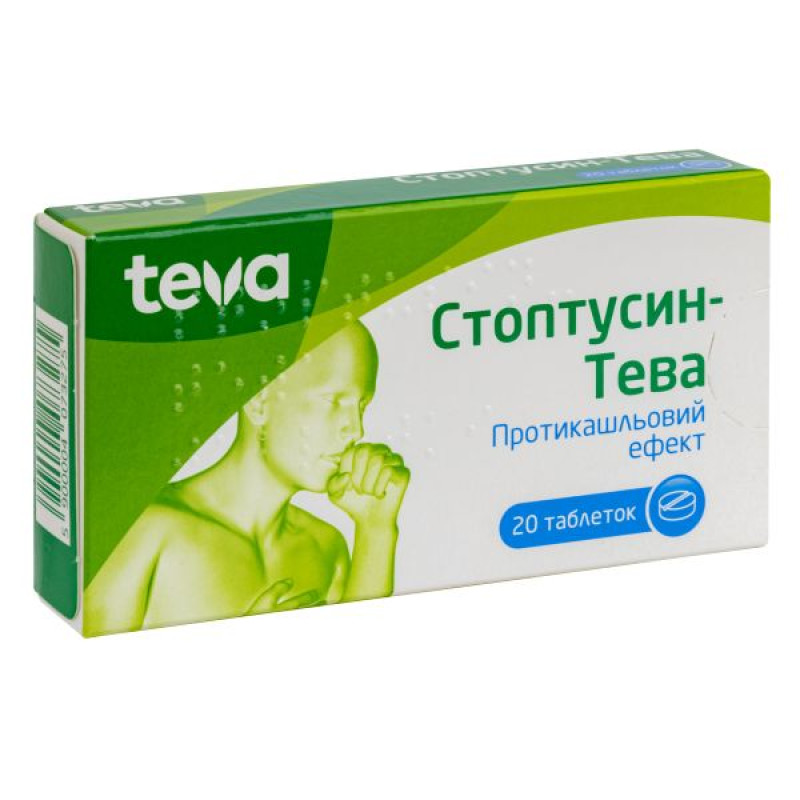
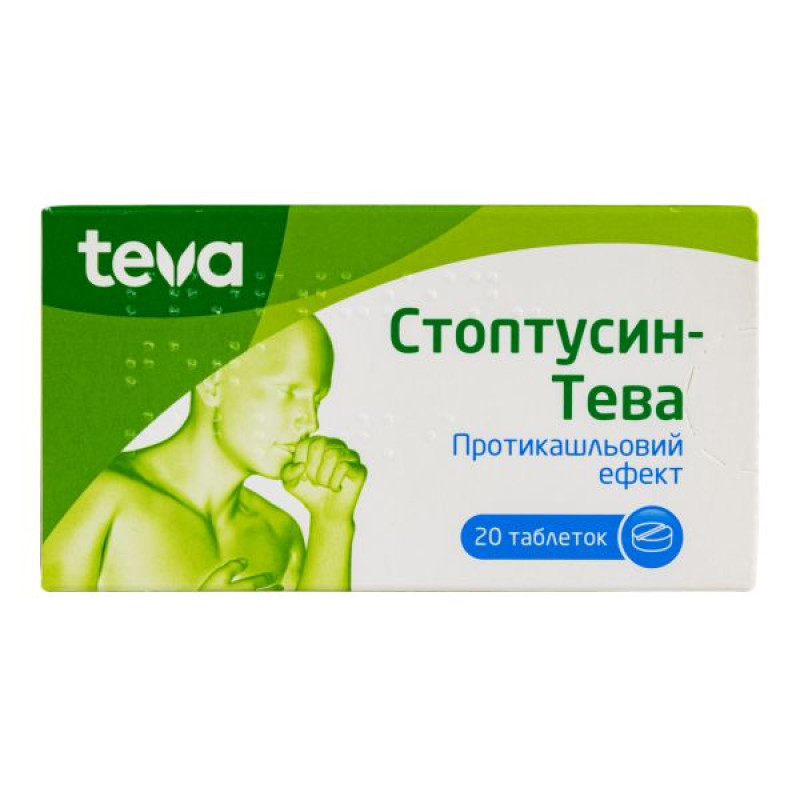
Instructions for Stoptussin-Teva tablets No. 20
Composition
active ingredient: butamirate citrate, guaifenesin;
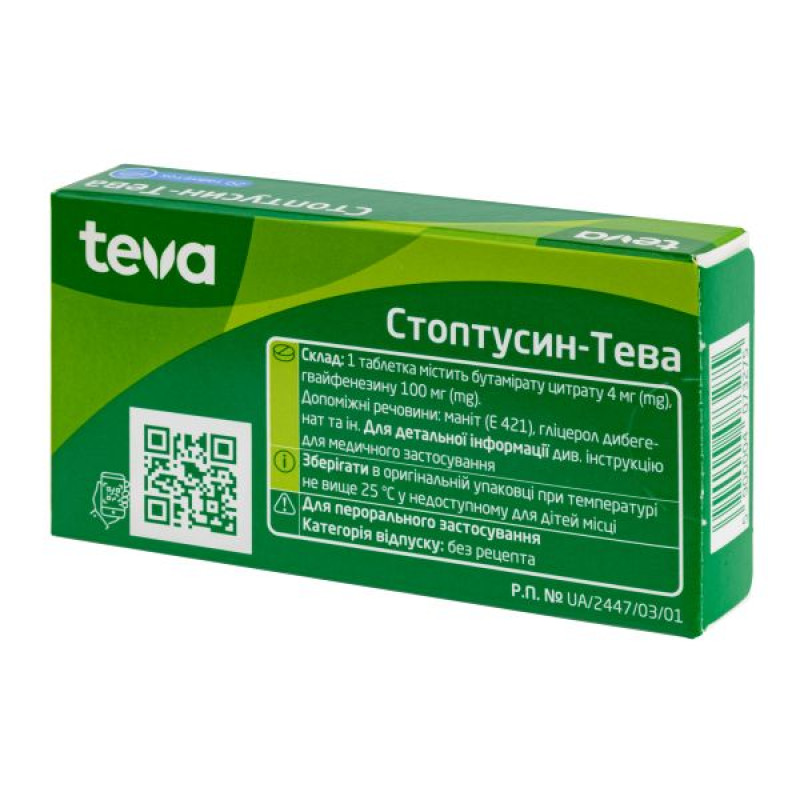
1 tablet contains: butamirate citrate 4 mg, guaifenesin 100 mg;
Excipients: colloidal anhydrous silicon dioxide, mannitol (E 421), microcrystalline cellulose, glycerol tribehenate, magnesium stearate.
Dosage form
Pills.
Main physicochemical properties: round, white tablets with a break line on one side.
Pharmacotherapeutic group
Combined preparations containing antitussives and expectorants. ATX code R05F B02.
Pharmacological properties
Pharmacodynamics
A combined drug that has antitussive, mucolytic and expectorant effects. Butamirate citrate belongs to non-opioid antitussive substances of peripheral action. It exhibits a local anesthetic effect on nerve endings that transmit ascending signals of irritation from the respiratory tract. Unlike opioid antitussive substances, it does not exhibit a central inhibitory effect, does not suppress the respiratory center, and does not cause addiction.
The antitussive effect of butamirate citrate is complemented by the expectorant effect of guaifenesin. Guaifenesin has secretolytic (by directly enhancing the secretion of bronchial glands and stimulating the elimination of acidic glycoproteins from acinar cells) and secretomotor properties (reduces the viscosity of sputum and facilitates the evacuation of mucus and its expectoration).
Pharmacokinetics
Butamirate citrate is rapidly and completely absorbed, 98% of it binds to plasma proteins. It is metabolized to form two metabolites, which also have antitussive effects. 90% of the metabolites are excreted by the kidneys, and only a small part of them is excreted in the feces. The biological half-life is approximately 6 hours.
Guaifenesin is rapidly and easily absorbed from the gastrointestinal tract after oral administration. A small amount binds to plasma proteins. It is excreted by the kidneys, mainly in the form of metabolites, a small part in an unchanged state. The biological half-life is 1 hour.
Indication
Dry, irritable, paroxysmal cough of various origins.
Contraindication
Hypersensitivity to any of the components of the drug, myasthenia gravis, I trimester of pregnancy (see section "Use during pregnancy or breastfeeding"). Stoptussin-Teva should not be used in children under 12 years of age.
Interaction with other medicinal products and other types of interactions
Since butamirate suppresses the cough reflex, the simultaneous use of expectorants should be avoided, as this may lead to mucus stagnation in the respiratory tract, which increases the risk of bronchospasm and respiratory tract infection.
Lithium and magnesium enhance the effect of guaifenesin.
Guaifenesin enhances the analgesic effect of paracetamol and acetylsalicylic acid, enhances the suppressive effect of alcohol, sedatives, hypnotics, general anesthetics on the central nervous system, and also enhances the effect of muscle relaxants. The central nervous effect of muscle relaxants may increase the undesirable effects of guaifenesin, especially muscle weakness.
Impact on laboratory test results
Guaifenesin may cause false-positive results in diagnostic tests for 5-hydroxyindoleacetic acid (photometric method using nitrosonaphthol as a reagent) and vanillylmandelic acid in urine. Given this, treatment with Stoptussin-Teva should be discontinued 48 hours before urine collection for these tests.
Application features
During treatment, patients should refrain from drinking alcoholic beverages.
Stoptussin-Teva should not be used in patients with a productive cough and/or persistent or chronic cough associated with smoking, asthma, chronic bronchitis or emphysema.
Use the drug with caution in asthma, tuberculosis, and pneumoconiosis.
If the cough persists or worsens, treatment should be reviewed.
Ability to influence reaction speed when driving vehicles or other mechanisms
The drug may adversely affect activities requiring increased attention (driving a car, operating machinery, and working at heights), due to the possibility of drowsiness and dizziness.
Use during pregnancy or breastfeeding
Pregnancy
There have been no controlled studies in pregnant women or animal studies.
An increased incidence of inguinal hernia in newborns has been reported with the use of guaifenesin in the first trimester of pregnancy. Therefore, the drug is contraindicated in the first trimester of pregnancy.
The use of the drug in the II and III trimesters of pregnancy is possible only after careful consideration of the benefit/risk ratio.
Breast-feeding
It is not known whether butamirate citrate or guaifenesin passes into breast milk. Experience in nursing mothers is limited, therefore the risk of adverse effects in infants cannot be excluded. It is recommended to discontinue breastfeeding during the period of use of this medicinal product.
Method of administration and doses
Follow the dosage depending on the patient's body weight:
up to 50 kg - ½ tablet 4 times a day;
50-70 kg - 1 tablet 3 times a day;
70-90 kg - 1 and ½ tablets 3 times a day;
from 90 kg - 2 tablets 3 times a day.
The interval between individual doses should be 4-6 hours. The tablet can be divided in half.
The drug is recommended to be used after meals, washed down with sufficient liquid (water, tea, juice).
Children
The medicine should be used in children aged 12 years and older according to indications (doses and method of administration are given in the section “Method of administration and doses”).
Overdose
In case of overdose, signs of toxic effects of guaifenesin predominate: drowsiness, muscle weakness, nausea, vomiting, diarrhea, dizziness, arterial hypotension. Radionegative urolithiasis is possible.
There is no specific antidote.
Treatment: gastric lavage, use of activated charcoal, symptomatic therapy aimed at maintaining the functions of the cardiovascular and respiratory systems, kidney function and maintaining electrolyte balance.
Adverse reactions
When taken at the recommended dosage, the drug is well tolerated by patients. Side effects usually disappear after the dose is reduced.
Metabolism and nutrition disorders: anorexia.
From the nervous system: headache, drowsiness.
Respiratory system: difficulty breathing.
From the side of the organs of hearing and labyrinth: dizziness.
Gastrointestinal: discomfort in the digestive system, nausea, abdominal pain, vomiting, diarrhea. If you experience stomach discomfort or other unusual effects, you should stop using the drug and consult a doctor.
Skin and subcutaneous tissue disorders: allergic reactions, including anaphylactic shock, angioedema, skin rashes, itching, urticaria, exanthema.
From the urinary system: urolithiasis.
Expiration date
5 years.
Storage conditions
Store in the original packaging at a temperature not exceeding 25 °C, out of the reach of children.
Packaging
10 tablets in a blister, 2 blisters in a box.
Vacation category
Without a prescription.
Producer
Teva Czech Industries s.r.o.
Location of the manufacturer and its business address
Ostravska Street 305/29, Komarov, 747 70 Opava, Czech Republic.