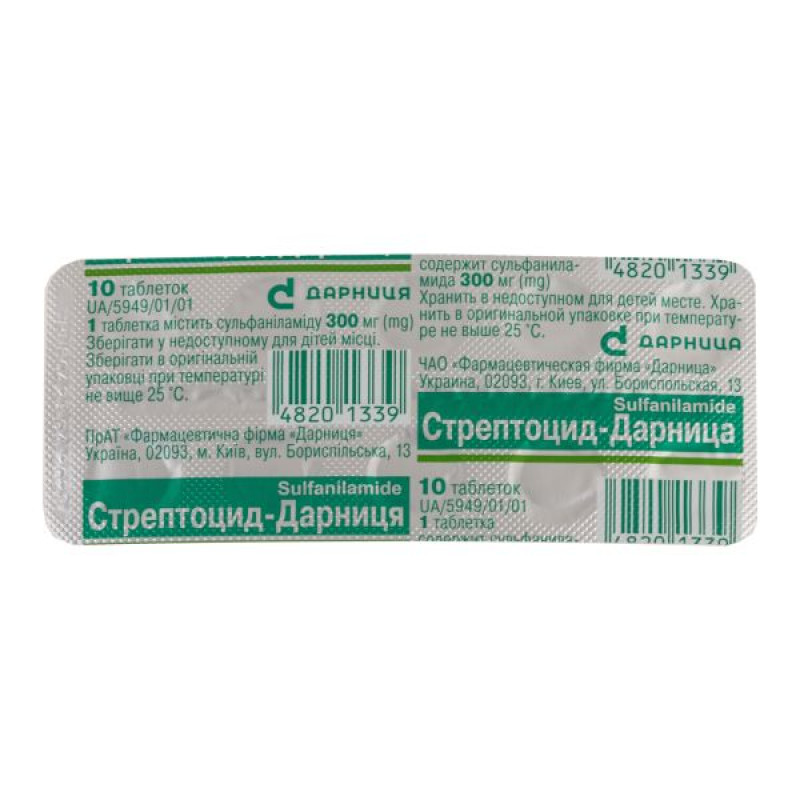
Instructions for use Streptocide-Darnitsa tablets 300 mg No. 10
Composition
active ingredient: sulfanilamide;
1 tablet contains sulfonamide 300 mg;
Excipients: potato starch, povidone, colloidal anhydrous silicon dioxide, stearic acid.
Dosage form
Pills.
Main physicochemical properties: white tablets, flat-cylindrical in shape, with a score and a bevel.
Pharmacotherapeutic group
Antibacterials for systemic use. Short-acting sulfonamides. ATX code J01E B06.
Pharmacological properties
Pharmacodynamics.
Streptocide, like other sulfonamides, disrupts the formation of growth factors in microorganisms - folic, dihydrofolic acids, other compounds containing para-aminobenzoic acid in their molecule. Due to the fact that its structure is close to the structure of streptocide, the latter, as a competitive antagonist of the aforementioned acid, is included in the metabolic chain of microorganisms and disrupts metabolic processes, which leads to a bacteriostatic effect. The drug belongs to short-acting sulfonamides. Streptocide has a bacteriostatic effect on streptococci, meningococci, pneumococci, gonococci, Escherichia coli, pathogens of toxoplasmosis and malaria. It is significantly inferior in effectiveness to modern antibiotics. Currently, many strains of microorganisms, especially hospital ones, are resistant to streptocide.
The activity of streptocide increases in an alkaline environment.
Enterococci, Pseudomonas aeruginosa, and anaerobes are insensitive to streptocide.
Pharmacokinetics.
When administered orally, the drug is rapidly absorbed: the maximum concentration of streptocide in the blood is observed after 1-2 hours, after 4 hours the drug is detected in the cerebrospinal fluid. A decrease in the maximum concentration in the blood by 50% is noted in less than 8 hours. About 95% of the drug is excreted by the kidneys.
Indication
Infectious-inflammatory diseases caused by microorganisms sensitive to the drug: infectious diseases of the skin and mucous membranes (wounds, ulcers, bedsores), enterocolitis, pyelitis, cystitis.
Contraindication
Individual sensitivity to sulfonamides, sulfones and other components of the drug; history of severe toxic-allergic reactions to sulfonamides;
nephrosis, nephritis;
Graves' disease;
acute hepatitis;
suppression of bone marrow hematopoiesis;
renal and/or hepatic failure;
decompensated chronic heart failure;
congenital deficiency of glucose-6-phosphate dehydrogenase, porphyria;
diseases of the hematopoietic system: anemia, leukopenia;
hyperthyroidism;
azotemia.
Interaction with other medicinal products and other types of interactions
When used simultaneously:
– with nonsteroidal anti-inflammatory drugs, sulfonylurea derivatives, antithrombotic agents, vitamin K antagonists – the effect of these drugs is enhanced;
– with folic acid, bactericidal antibiotics (including penicillins, cephalosporins) – the effectiveness of sulfonamides decreases;
– with bactericidal antibiotics, oral contraceptives – the effect of these drugs is reduced;
– with PAS and barbiturates – the activity of sulfonamides increases;
– with pyrazolone derivatives, indomethacin and salicylates – the activity and toxicity of sulfonamides increases;
– with methotrexate and difenin – the toxicity of sulfonamides increases;
– with erythromycin, lincomycin, tetracycline – antibacterial activity is mutually enhanced, the spectrum of action is expanded;
– with rifampicin, streptomycin, monomycin, kanamycin, gentamicin, oxyquinoline derivatives (nitroxoline) – the antibacterial effect of the drugs does not change;
– with nalidixic acid (Nevigramon) – sometimes antagonism is observed;
– with chloramphenicol, nitrofurans – the total effect is reduced;
– with drugs containing para-aminobenzoic acid esters (novocaine, anestezin, dicaine), – the antibacterial activity of sulfonamides is inactivated.
Sulfonamides should not be prescribed simultaneously with hexamethylenetetramine (urotropine), with antidiabetic drugs (sulfonylurea derivatives), with diphenin, neodicoumarin, and other indirect anticoagulants.
Streptocide may enhance the effect and/or toxicity of methotrexate by displacing it from protein binding and/or weakening its metabolism.
When used simultaneously with other drugs that cause bone marrow suppression, hemolysis, or hepatotoxicity, there is a risk of developing toxic effects.
Concomitant use with methenamine (urotropine) is not recommended due to the increased risk of crystalluria with acidic urine.
Phenylbutazone (butadione), salicylates and indomethacin can displace sulfonamides from their binding to plasma proteins, thereby increasing their concentration in the blood. When used together with para-aminosalicylic acid and barbiturates, the activity of sulfonamides increases; with chloramphenicol - the risk of agranulocytosis increases.
Application features
During treatment with streptocide, it is necessary to systematically monitor kidney function, peripheral blood parameters, and blood glucose levels.
During long-term treatment with the drug, it is necessary to periodically perform blood tests (biochemical and general blood tests). Prescribing the drug in insufficient doses or early discontinuation of the drug may contribute to the increase in the resistance of microorganisms to sulfonamides.
Sulfonamides should not be used to treat infections caused by group A beta-hemolytic streptococcus because they do not eradicate it and therefore cannot prevent complications such as rheumatic fever and glomerulonephritis.
The drug should be prescribed with caution to patients with chronic heart failure, liver disease and impaired renal function. In renal failure, cumulation of sulfonamide and its metabolites in the body is possible, which can lead to the development of a toxic effect.
Streptocide-Darnitsa should be prescribed with caution to patients with severe allergic diseases or bronchial asthma, with diseases of the blood system. If signs of a hypersensitivity reaction appear, the drug should be discontinued.
Sulfonamides, including streptocide, should be used with caution in patients with diabetes mellitus, as sulfonamides can affect blood sugar levels. High doses of sulfonamides have a hypoglycemic effect.
Since sulfonamides are bacteriostatic, not bactericidal drugs, a full course of therapy is necessary to prevent recurrence of infection and the development of resistant forms of microorganisms.
Given the similarity of chemical structure, sulfonamides should not be used in people with hypersensitivity to furosemide, thiazide diuretics, carbonic anhydrase inhibitors, and sulfonylurea derivatives.
Patients need to consume sufficient fluids to prevent crystalluria and the development of urolithiasis.
Elderly people are at increased risk of developing severe adverse skin reactions, hematopoiesis suppression, and thrombocytopenic purpura (the latter especially when combined with thiazide diuretics).
The drug should be avoided in patients over 65 years of age due to an increased risk of severe adverse reactions.
It is recommended to avoid exposure to direct sunlight and artificial ultraviolet radiation due to the possibility of photosensitization when using sulfonamides.
During treatment, it is necessary to adhere to the dosage regimen, apply the recommended dose at intervals of 24 hours, do not miss a dose. In case of missing a dose, do not double the next dose.
If the signs of the disease do not disappear or, conversely, the state of health worsens or undesirable phenomena occur, it is necessary to suspend the use of the drug and consult a doctor regarding further use of the drug.
Use during pregnancy or breastfeeding
The drug is contraindicated during pregnancy or breastfeeding.
If it is necessary to use the drug, breastfeeding should be discontinued.
Ability to influence reaction speed when driving vehicles or other mechanisms
There is no information on the effect of the drug on the ability to drive vehicles and operate complex mechanisms.
Until the individual reaction to the drug is determined, one should refrain from driving or operating other mechanisms, since during treatment with sulfonamides, such adverse reactions from the nervous system as dizziness, convulsions, ataxia, drowsiness, depression, and psychosis are possible.
Method of administration and doses
Take orally during or after meals, drinking 150-200 ml of water. A single dose for adults and children over 12 years of age is 600 mg - 1.2 g, daily dose - 3-6 g. Divide the daily dose into 5 doses.
Children aged 3 to 6 years – 300 mg per dose, from 6 to 12 years – 300-600 mg per dose. The frequency of administration for children is 4-6 times a day.
The duration of treatment is determined individually and depends on the severity and course of the disease, the localization of the process, and the effectiveness of therapy.
Higher doses for adults: single dose – 2 g, daily dose – 7 g.
The maximum daily dose for children is 900 mg – 2.4 g.
Children
The medicine is used in children aged 3 years and over.
Overdose
Possible increased side effects.
Overdose may cause anorexia (lack of appetite), nausea, vomiting, colic-like pain, headache, drowsiness, dizziness, fainting. With prolonged use, fever, hematuria, crystalluria, cyanosis, tachycardia, paresthesia, diarrhea, cholestasis, renal failure with anuria, toxic hepatitis, leukopenia, agranulocytosis.
Treatment. In case of overdose, it is recommended to consult a doctor. Before providing medical care, rinse the stomach with a 2% solution of sodium bicarbonate and take a suspension of activated charcoal or other enterosorbents. Drinking plenty of fluids, forced diuresis, hemodialysis are indicated. Symptomatic treatment.
Adverse reactions
From the blood and lymphatic system: leukopenia, agranulocytosis, aplastic anemia, thrombocytopenia, hypoprothrombinemia, eosinophilia, hemolytic anemia in glucose-6-phosphate dehydrogenase deficiency.
Cardiovascular system: tachycardia, myocarditis.
Nervous system: headache, neurological reactions including aseptic meningitis, ataxia, mild intracranial hypotension, convulsions, dizziness, drowsiness/insomnia, fatigue, depression, peripheral or optic neuropathies, visual disturbances, psychosis, depressed state, paresthesia.
On the part of the respiratory system: pulmonary infiltrates, fibrosing alveolitis.
On the part of the digestive tract: thirst, dry mouth, dyspeptic phenomena, nausea, vomiting, diarrhea, anorexia, pancreatitis, pseudomembranous colitis.
On the part of the hepatobiliary system: increased activity of liver enzymes (ALT, AST, alkaline phosphatase), cholestatic hepatitis, hepatonecrosis, hepatomegaly, jaundice, cholestasis.
On the part of the urinary system: change in urine color (rich yellow-brown color), crystalluria with an acidic urine reaction; nephrotoxic reactions are possible: interstitial nephritis, tubular necrosis, renal failure, hematuria, shock kidney with anuria.
Skin and subcutaneous tissue disorders: skin hyperemia, skin rashes (including erythematous-squamous, papular), itching, urticaria, allergic dermatitis, photosensitivity, exfoliative dermatitis, erythema nodosum, cyanosis.
On the part of the immune system: hypersensitivity reactions, including toxic epidermal necrolysis (Lyell's syndrome), Stevens-Johnson syndrome, systemic lupus erythematosus, serum sickness syndrome, anaphylactic reactions, angioedema, rhinitis.
General disorders: drug-induced fever, pain in the right hypochondrium and lower back.
Others: difficulty breathing, periarteritis nodosa, hypothyroidism, hypoglycemia.
Expiration date
5 years.
Do not use the medicine after the expiry date stated on the packaging.
Storage conditions
Store in original packaging at a temperature not exceeding 25 ° C. Keep out of the reach of children.
Packaging
10 tablets in a blister pack, 1 blister pack in a pack; 10 tablets in blister packs.
Vacation category
According to the recipe.
Producer
PrJSC "Pharmaceutical Company "Darnitsa".
Location of the manufacturer and its business address
Ukraine, 02093, Kyiv, Boryspilska St., 13.