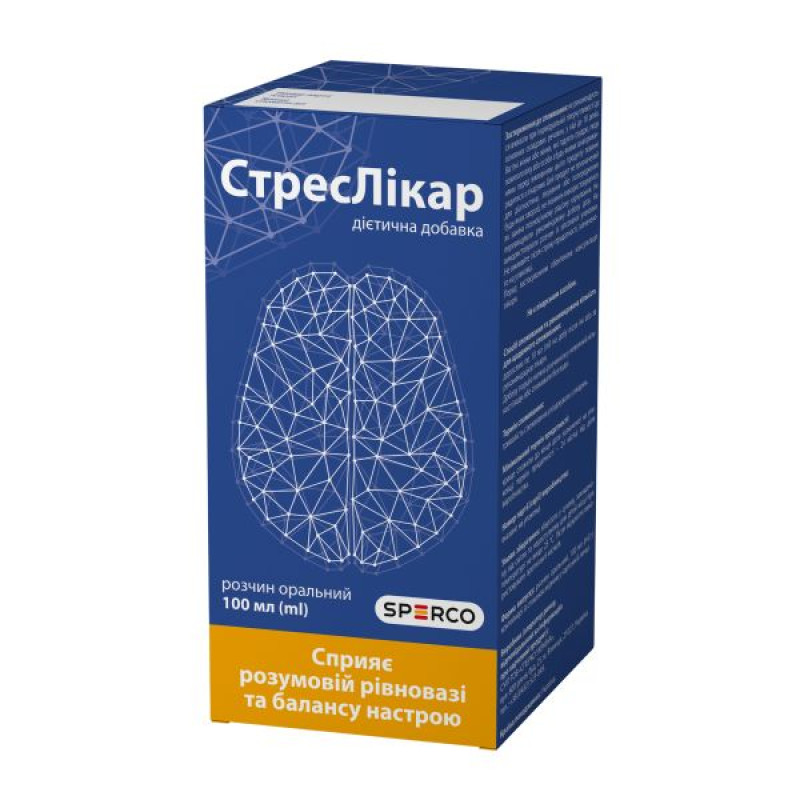
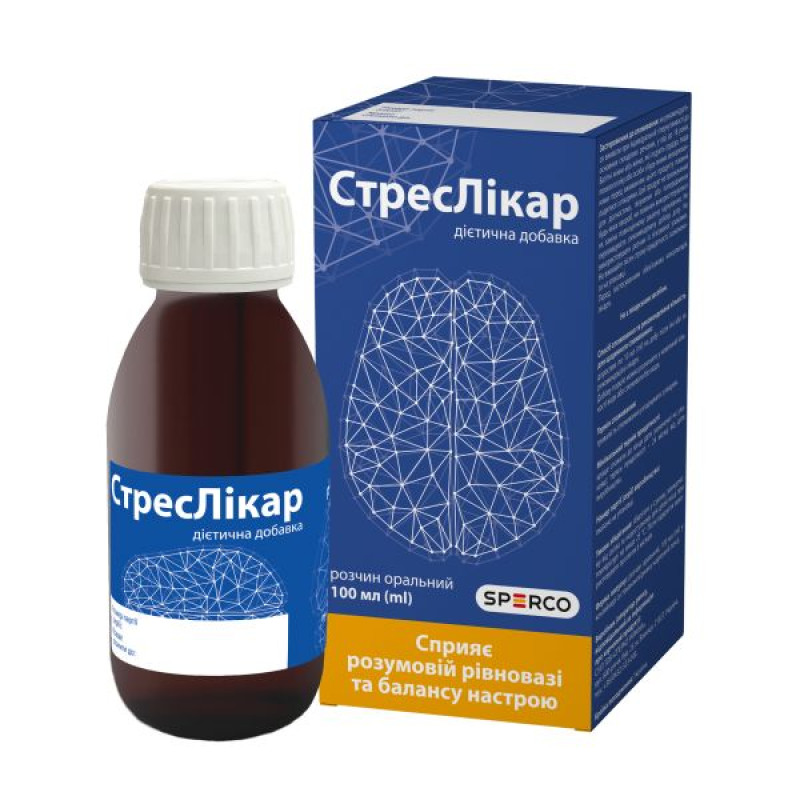
Instructions for StressLikar oral solution 100 ml bottle
Composition
Ingredients: purified water, α-glycerophosphocholine (choline alfoscerate), glycine, magnesium citrate, γ-aminobutyric acid, acidity regulator (malic acid), preservative (sodium benzoate), pyridoxine hydrochloride, thiamine mononitrate, flavoring.
The recommended daily serving of 10 milliliters (ml) contains:
- Choline, from α-glycerophosphocholine - 243 mg (mg)
- Magnesium, from magnesium citrate - 60 milligrams (mg)
- γ-aminobutyric acid - 250 mg (mg)
- Vitamin B6 - 2 mg (mg)
- Vitamin B1 - 1.5 mg (mg)
- Glycine - 500 mg (mg)
Properties of the constituent components
Scientifically proven properties of ingredients*:
Choline - must be obtained from the diet, as endogenous synthesis is insufficient to support the body's needs, α-glycerophosphocholine is a water-soluble form of choline.
Choline performs important and diverse functions in neurotransmission, membrane synthesis, lipid transport, and carbohydrate metabolism. Choline maintains the energy reserve of neurons, stimulates the synthesis of acetylcholine. Adequate intake and/or supplementation of choline is considered important for healthy brain function, behavior, has a positive effect on memory, and may help older people recover from impairments.
Choline and its metabolites (phosphatidylcholine) are important for maintaining the structural integrity of cell membranes, remodeling synaptic connections, modulating neuronal morphology, and neurotransmission.
Choline is involved in the biosynthesis of structural components of neuronal membranes (phospholipids), as confirmed by magnetic resonance spectroscopy. It ensures the functioning of membrane ion exchange pumps, the modulation of which is necessary for the normal conduction of nerve impulses.
Choline is considered a “neuroprotective” and “essential neurocognitive nutrient” that is crucial for normal brain growth and function. Experimental studies have shown that choline inhibits the activation of certain phospholipases (A1, A2, C, and D), reducing the formation of free radicals, preventing the destruction of membrane systems, and preserving antioxidant defense systems such as glutathione.
Choline helps improve cognitive function, prevents age-related memory decline and neurological changes. Choline improves attention and consciousness, including in cognitive and neurological disorders (1,2,3,4).
Magnesium participates in metabolic reactions of energy formation, accumulation, transfer and utilization, regulation of the state of the cell membrane (exchange of calcium and sodium ions) and synthesis of neurotransmitters.
Magnesium deficiency is accompanied by increased mental and physical fatigue during ordinary activities, a feeling of depression due to inadequate energy utilization.
- γ-aminobutyric acid, or GABA, is an amino acid
γ-Aminobutyric acid, or GABA, is an amino acid known as the main inhibitory neurotransmitter in the central nervous system. Its physiological role is related to the modulation of synaptic transmission, promoting neuronal development and relaxation, and preventing insomnia and depression. GABA has been shown to help maintain brain activity, memory, and cognitive function, especially in the elderly. GABA promotes mental concentration and stimulates physical and mental abilities.
Additional use of vitamins B1, B6 replenishes the insufficient intake of vitamins with food, ensures the presence of the necessary amount of coenzymes in the body. B vitamins are components of enzyme systems that regulate the metabolism of proteins, fats and carbohydrates. However, each of the B vitamins performs a specific biological role (5-9).
Vitamin B1 (thiamine) is necessary for many physiological functions, including: glucose metabolism, maintenance of nerve membrane function, synthesis of myelin and the neurotransmitters acetylcholine and serotonin, as well as amino acids. The most important function of thiamine, as a cofactor in carbohydrate conversion, is considered to be the promotion of cellular energy metabolism to provide energy to nerve cells.
Thiamine is indirectly necessary for the synthesis of nucleic acids, neurotransmitters and myelin, thus thiamine contributes to the speed of nerve conduction. Thiamine is also a coenzyme of enzymes that are necessary for the normal functioning of the digestive tract, cardiac activity and endocrine glands.
Vitamin B6
Vitamin B6 (pyridoxine) is involved in over 140 coenzymes. It has important functions in the synthesis of neurotransmitters: dopamine from L-DOPA (L-3,4-dihydroxyphenylalanine), serotonin from 5-HTP (5-hydroxytryptophan) and gamma-aminobutyric acid (GABA) from glutamate. Thus, pyridoxine affects the adrenergic, serotonergic and glutamatergic systems, and plays an important role in tryptophan metabolism. Pyridoxine exhibits a neuroprotective role, which is associated with its ability to regulate glutamatergic systems (since GABA is the main inhibitory, and glutamate is an excitatory neurotransmitter).
Coenzyme forms of pyridoxine are necessary in the metabolism of homocysteine, proteins, carbohydrates and fats, as well as the synthesis of sphingolipids and, therefore, are important for the formation of myelin in nerve cells.
To date, there is no data on the carcinogenic, mutagenic, or teratogenic properties of vitamins B1 and B6.
- Glycine
Glycine is an amino acid in the human body. Glycine acts as a precursor to several key metabolites: creatine (energy storage in muscles), glutathione, heme (oxygen binding in the blood), purine, and porphyrin. Glycine also has the property of improving sleep quality and neurological function. Glycine modulates several neuropeptides in the central nervous system, which may indirectly contribute to improving occasional sleepiness and fatigue caused by sleep restriction, as well as improving sleep quality in people who have trouble sleeping.
Please note that these studies are provided for informational purposes only and are not intended to be medical advice. If you are considering taking StressLikar or any other dietary supplement, you should first consult with a healthcare professional.
Consumption recommendations
StressLikar can be recommended as a dietary supplement to the diet as an additional source of choline, vitamin B6, B1, magnesium, amino acid glycine and γ-aminobutyric acid. The effective combination of components supports the normal functional state of the nervous and cardiovascular systems, increases resistance to mental and stressful stress, promotes mental balance and mood balance.
The ingredients of the StressMedicine product help support:
- normal functioning of the central and peripheral nervous systems, including during physical and/or mental fatigue caused by increased psycho-emotional stress;
- restoration of normal cognitive functions, including in the elderly, or after illnesses;
- normal process of falling asleep and improving sleep quality;
- anxiety reduction and/or relaxation;
- normal blood glucose and cholesterol levels.
Choline supports normal nerve impulse transmission, participates in the biosynthesis of structural components of neuronal membranes, supports cognitive functions, helps preserve memory and brain function, and supports heart health.
Vitamins B1, B6 and magnesium contribute to the reduction of tiredness and fatigue, normal functioning of the nervous system and mental activity.
Glycine is a building block for structural and functional proteins in the body, is a component of the antioxidant glutathione, participates in the synthesis of heme (blood oxygen binding), creatine (energy storage in muscles), and provides the basic structure for glucose synthesis.
Precautions for consumption
Not recommended for use in case of individual hypersensitivity to the main components, under the age of 18. Pregnant or breastfeeding women, the elderly or people with any diseases should consult a doctor before using this product. This product is not intended for the diagnosis, treatment or prevention of any diseases, and should not be used as a substitute for a complete diet. Do not exceed the recommended daily dose. Do not use the solution from a damaged package. Do not use after the expiration date indicated on the package.
Before use, consultation with a doctor is mandatory.
It is not a medicine.
Consumption method
Method of consumption and recommended daily intake: adults 10 ml (ml) per day after meals or as recommended by a doctor.
The daily portion can be dissolved in a small amount of water or consumed without water.
Duration of consumption: consult your doctor for the duration of consumption.
Minimum shelf life
It is best to consume by the end of the date indicated on the package; the shelf life is 24 months from the date of manufacture.
Storage conditions
Store in a dry place, protected from light and out of reach of children at a temperature not exceeding 25 ° C. After opening, use within 6 months.
Release form
Oral solution, 100 ml (ml) in a container with a measuring cup in a cardboard pack.
Producer
Manufacturer (market operator responsible for information about the food product): SUIP LLC "SPERKO UKRAINE", 600-richchia st., building 25, Vinnytsia, 21027, Ukraine, tel.: +38 (0432) 523-049.
Country of origin: Ukraine.
List of used literature*:
1. Dietary Reference Values for choline EFSA Journal2016;14(8):4484
2. Lippelt DP, vander Kint S, vanHerk K, Naber M. No Acute Effects of Choline Bitartrate Food Supplements on Memory in Healthy, Young, Human Adults. PLoS One. 2016 Jun 24;11(6):e0157714. doi: 10.1371/journal.pone.0157714. PMID: 27341028; PMCID: PMC4920398.\
3. Wiedeman AM, Barr SI, Green TJ, Xu Z, Innis SM, Kitts DD. Dietary Choline Intake: Current State of Knowledge Across the Life Cycle. Nutrients. 2018 Oct 16;10(10):1513. doi: 10.3390/nu10101513. PMID: 30332744; PMCID: PMC6213596.
4. Chin EWM, Goh ELK. Modulating neuronal plasticity with choline. Neural Regen Res. 2019 Oct;14(10):1697-1698. doi: 10.4103/1673-5374.257516. PMID: 31169177; PMCID: PMC6585560
5. https://compendium.com.ua/info/339274
6. Jong-HoPark JH, Saposnik G., Ovbiagele B., Markovic D., Towfighi A. Effect of B-vitamins on stroke risk among individuals with vascular disease who are not on antiplatelets: A meta-analysis//Int J Stroke.2016 Feb;11(2):206-11. doi: 10.1177/1747493015616512.
7. https://compendium.com.ua/akt/67/2636/cyanocobalaminum
8. https://compendium.com.ua/akt/80/2873/pyridoxine
9. https://compendium.com.ua/akt/84/2771/thiaminum