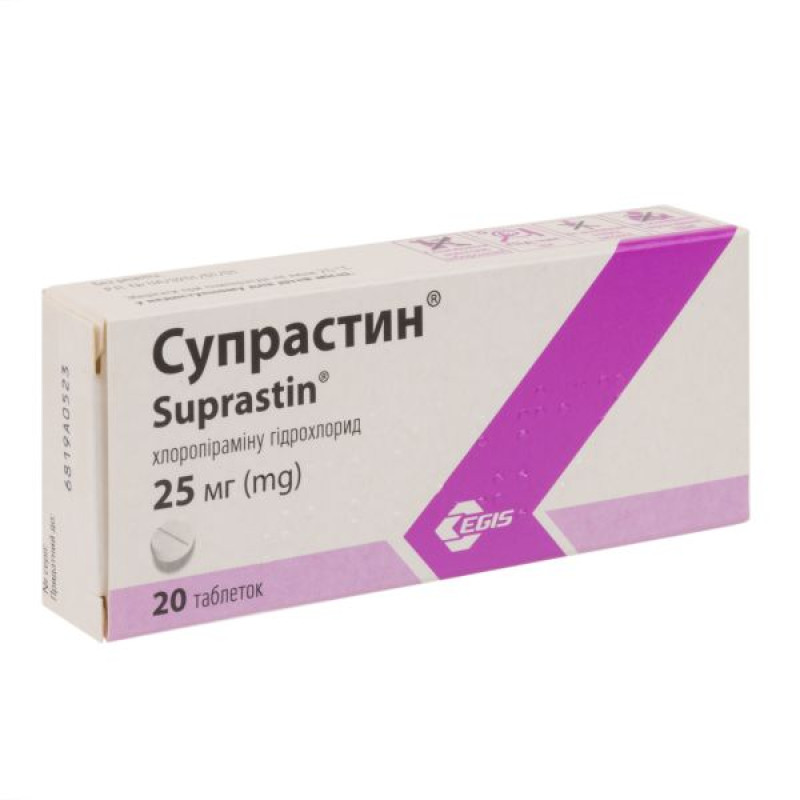
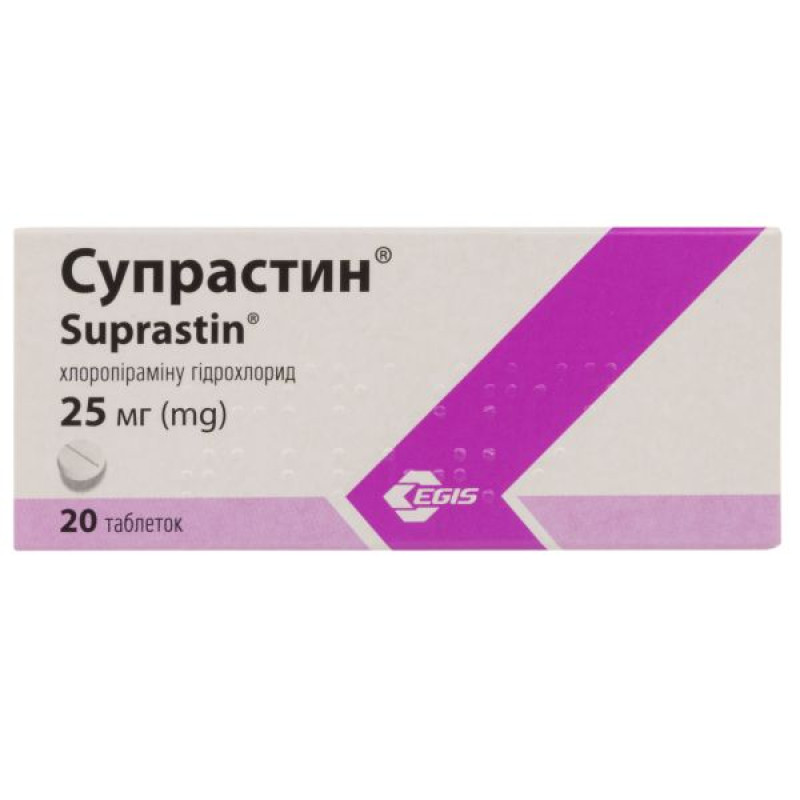
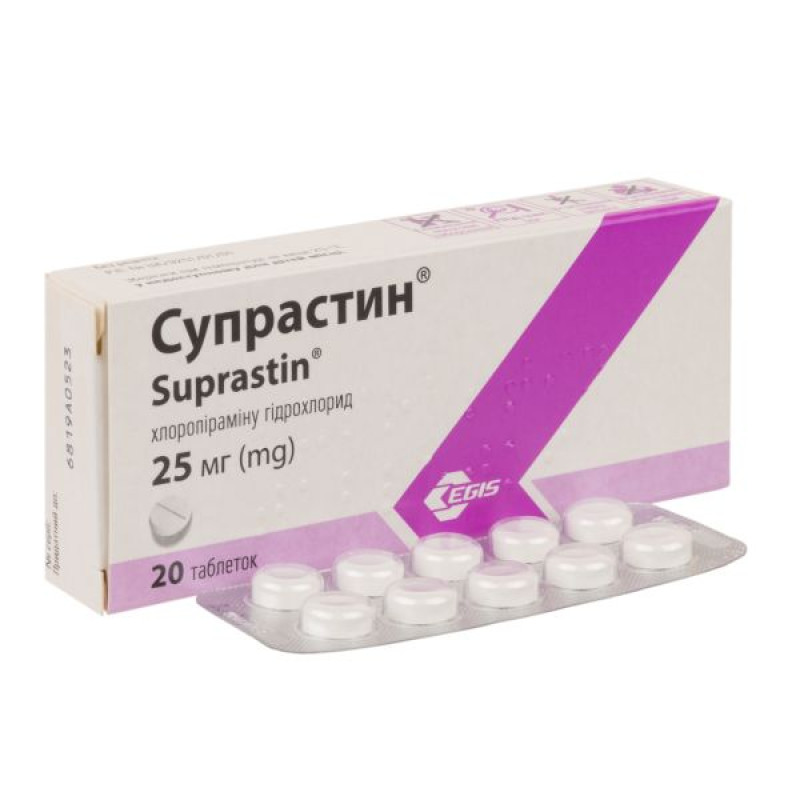
Instructions Suprastin tablets 25 mg No. 20
Composition
active ingredient: chloropyramine;
1 tablet contains 25 mg of chloropyramine hydrochloride;
excipients: stearic acid, gelatin, sodium starch glycolate (type A), talc, potato starch, lactose monohydrate.
Dosage form
Pills.
Main physicochemical properties:
white or grayish-white tablets in the form of a disc with a bevel, engraved with "SUPRASTIN" on one side and a score on the other, odorless or almost odorless.
Pharmacotherapeutic group
Antihistamines for systemic use.
Chloropyramine. ATX code R06A C03.
Pharmacological properties
Pharmacodynamics
Chloropyramine, a chlorinated analogue of tripelenamine (pyribenzamine), is a first-generation antihistamine belonging to the ethylenediamine group.
In preclinical and clinical studies – as with tripelenamine – chloropyramine has been shown to be effective in the treatment of hay fever and other allergic diseases. The mechanism of action of the drug is to block histamine H1 receptors.
Very low doses of chloropyramine given to guinea pigs protected the animals from the effects of histamine at doses 120 times the lethal dose. The drug also acts on smooth muscle, capillary permeability, and the central nervous system.
Pharmacokinetics
After oral administration, chloropyramine is rapidly absorbed from the gastrointestinal tract. The therapeutic effect develops within 15–30 minutes after administration, reaches a maximum within the first hour after administration and lasts for 3–6 hours. Metabolized in the liver. Excreted mainly in the urine as metabolites. In children, the drug may be excreted faster than in adult patients.
In case of impaired renal function, the excretion of the active substance may decrease.
In liver failure, the metabolism of chloropyramine slows down, which requires adjustment of the drug dose.
Indication
Allergic diseases such as seasonal allergic rhinitis; conjunctivitis; urticaria; dermographism; contact dermatitis; food allergy; allergic reactions caused by drugs; allergy caused by insect bites; itching. As an adjunct therapy in systemic anaphylactic reactions and angioedema.
Contraindication
Hypersensitivity to any component of the drug; acute attacks of bronchial asthma; angle-closure glaucoma; gastric ulcer; acute myocardial infarction; arrhythmia; simultaneous administration of monoamine oxidase inhibitors (MAO); urinary retention, prostatic hypertrophy; hypersensitivity to other ethylenediamine derivatives.
Interaction with other medicinal products and other types of interactions
MAO inhibitors increase and prolong the anticholinergic effect of Suprastin®. Particular caution should be exercised when prescribing the drug simultaneously with sedatives, barbiturates, hypnotics, tranquilizers, opioid analgesics, tricyclic antidepressants, atropine, muscarinic parasympatholytics due to the possibility of mutual potentiation of each other's effects.
Alcohol increases the depressant effects of the drug on the central nervous system, therefore, during treatment with the drug, the consumption of alcoholic beverages should be avoided.
When combined with ototoxic drugs, warning signs of ototoxicity may be masked.
Antihistamines can prevent skin reactions in allergy testing, so taking such medications should be stopped a few days before a scheduled skin allergy test.
Application features
Elderly patients, debilitated patients
The drug should be prescribed with particular caution to these groups of patients, as they are more sensitive to certain side effects of antihistamines (dizziness, drowsiness, decreased blood pressure).
Liver dysfunction. In case of liver dysfunction, dose adjustment of the drug is necessary: a dose reduction may be necessary, since in liver diseases the metabolism of the active substance is reduced.
Due to the anticholinergic and sedative effects of the drug, special caution should be exercised when using the drug in elderly patients, patients with impaired liver function, or with cardiovascular disorders.
If the drug is used late in the evening, symptoms of gastroesophageal reflux may worsen.
Alcohol enhances the sedative effect of chloropyramine on the central nervous system, therefore, during treatment with the drug, you should avoid drinking alcoholic beverages.
Prolonged use of antihistamines can rarely cause disorders of the hematopoietic system (leukopenia, agranulocytosis, thrombocytopenia, hemolytic anemia). If undesirable effects are observed during long-term use of the drug (fever, laryngitis, ulceration of the oral mucosa, pallor, jaundice, hematomas, bleeding), treatment should be discontinued and blood counts monitored.
Each tablet contains 116 mg of lactose. Patients with rare hereditary problems of galactose intolerance, the Lapp lactase deficiency or glucose-galactose malabsorption should not take this medicine.
Ability to influence reaction speed when driving vehicles or other mechanisms
During the use of the drug, especially at the beginning of treatment, drowsiness and deterioration of psychomotor functions may occur (see section "Special instructions for use"). Therefore, taking into account possible adverse reactions from the central nervous system, driving or working with other mechanisms is prohibited at the beginning of therapy for a period established individually in each specific case.
Use during pregnancy or breastfeeding
There are no preclinical animal studies.
The use of the drug during pregnancy or breastfeeding is contraindicated.
Adequate and well-controlled clinical studies in pregnant women have not been conducted, although cases of retrolental fibroplasia (RLF) have been described in newborns whose mothers received antihistamines during the last 2 weeks of pregnancy.
Method of administration and doses
Tablets should be taken orally during meals, without chewing, with sufficient liquid.
Adults.
The daily dose for adults is usually 75–100 mg (3–4 tablets per day).
For children.
For children aged:
from 3 to 6 years: 1/2 tablet 2 times a day; from 6 to 14 years: 1/2 tablet 2–3 times a day.
The dose may be increased depending on the patient's response and the development of side effects, but the daily dose for children should never exceed 2 mg/kg of body weight.
The maximum daily dose is 4 tablets (100 mg).
Treatment is considered complete after the disappearance of symptoms of the disease. If symptoms of adverse reactions specified in the relevant section appear, treatment should be discontinued.
Children
The drug should be used in children over 3 years of age.
Overdose
Intentional or accidental overdose of antihistamines can be fatal, especially in children. In case of an overdose of Suprastin®, symptoms similar to atropine intoxication develop: hallucinations, restlessness, ataxia, impaired coordination of movements, athetosis, convulsions. In children, a state of excitement dominates. Dry mouth, dilated pupils, flushing, sinus tachycardia, urinary retention, fever, and increased temperature may also occur. In adults, fever and flushing are not always observed; the period of excitement is accompanied by convulsions and postictal depression. In addition, coma and cardiopulmonary collapse may occur, which can lead to death within 2–18 hours.
Due to the anticholinergic effect of the drug, gastric emptying may be slowed down, therefore, gastric lavage and administration of activated charcoal are necessary within 12 hours after overdose.
Monitoring of cardiopulmonary function is recommended. Treatment is symptomatic. Specific antidote is unknown.
Adverse reactions
From the side of the central nervous system: sedative effect, increased fatigue, dizziness, ataxia, nervousness, tremor, convulsions, headache, euphoria, encephalopathy, blurred vision, drowsiness, deterioration of psychomotor functions.
From the cardiovascular system: arterial hypotension, tachycardia, arrhythmia.
On the part of the digestive tract: pain and discomfort in the epigastric region of the stomach, dry mouth, nausea, vomiting, diarrhea, constipation, anorexia, increased appetite, worsening of symptoms of gastroesophageal reflux.
From the blood system: leukopenia, agranulocytosis, thrombocytopenia, hemolytic anemia, other pathological changes in the blood.
On the part of the organs of vision: increased intraocular pressure, glaucoma.
Renal and urinary disorders: dysuria, urinary retention.
Skin and subcutaneous tissue disorders: photosensitivity, allergic reactions.
Musculoskeletal and connective tissue disorders: myopathy.
On the part of the immune system: allergic reactions, including skin hyperemia, rash, itching, urticaria, angioedema.
Expiration date
5 years.
Storage conditions
Store at a temperature not exceeding 25 ° C in a place inaccessible to children.
Packaging
10 tablets in a blister; 2 blisters in a cardboard box.
Vacation category
Without a prescription.
Producer
CJSC Pharmaceutical Plant EGIS.
Location of the manufacturer and its business address
1165, Budapest, Bekenfeldi Street, 118-120, Hungary.