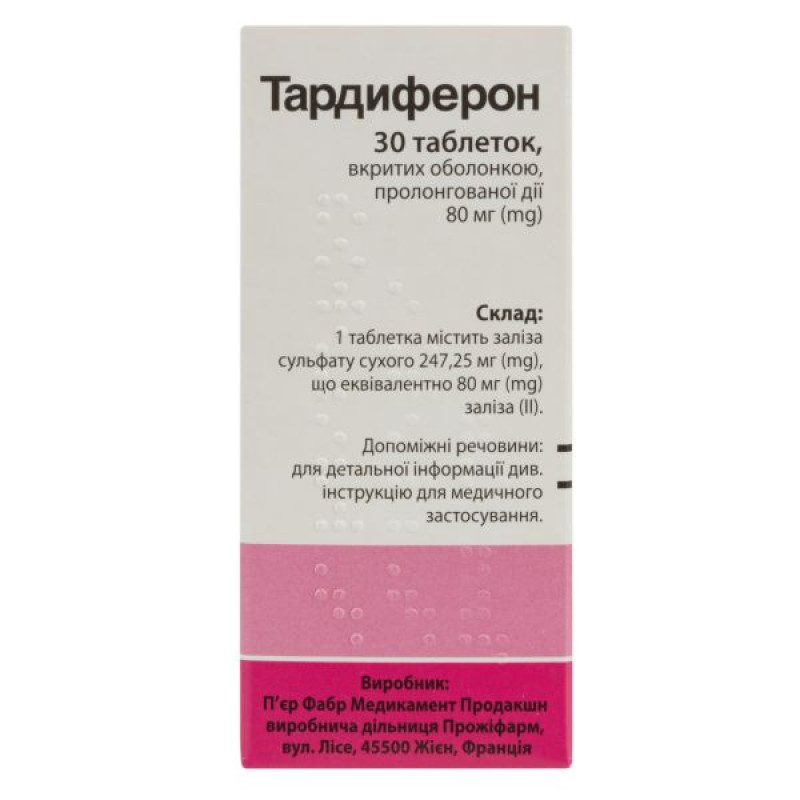
Instructions Tardiferon prolonged-release film-coated tablets 80 mg No. 30
Composition
active ingredient: 1 tablet contains 247.25 mg of dry ferrous sulfate, which is equivalent to 80 mg of iron (II);
excipients: maltodextrin, microcrystalline cellulose, ammonium methacrylate copolymer dispersion (type B), ammonium methacrylate copolymer dispersion (type A), talc, glycerol dibehenate, triethyl citrate, yellow iron oxide (E 172), red iron oxide (E 172), titanium dioxide (E 171); sepifilm LP010 (hypromellose, microcrystalline cellulose, stearic acid).
Dosage form
Film-coated, prolonged-release tablets.
Main physicochemical properties: round, orange-pink, film-coated tablets.
Pharmacotherapeutic group
Antianemic agents. Iron preparations. Iron preparations for oral administration. Ferrous sulfate.
ATX code B03A A07.
Pharmacological properties
Pharmacodynamics
Tardiferon belongs to complex iron preparations of prolonged action. Contains divalent iron ion, the use of which replenishes iron deficiency in the body and stimulates hematopoiesis. The drug replenishes iron deficiency in the body, necessary for the synthesis of hemoglobin.
Iron plays a key physiological role in many functions, such as: oxygen transport, ATP, DNA synthesis, and electron transfer.
Pharmacokinetics
Absorption occurs in the duodenum and proximal small intestine.
The combination of ferrous sulfate and excipients promotes continuous and gradual release of iron. Absorption increases when iron stores decrease and decreases when they increase.
Iron salts are usually poorly absorbed (10–20% of the dose taken). The gradual release of iron promotes better absorption over a long period of time.
Iron absorption may be altered by the intake of certain foods or beverages during concomitant administration of certain medicinal products (see sections “Special warnings and precautions for use”, “Interaction with other medicinal products and other types of interactions”).
There is no active mechanism for iron excretion.
The average iron excretion in healthy subjects is 0.8–1 mg/day.
The main routes of iron excretion are the gastrointestinal tract (enterocyte desquamation, heme degradation through erythrocyte extravasation), the urogenital tract, and the skin. Excess absorbed iron is excreted in the feces.
Preclinical safety data
Preclinical data revealed no special hazard for humans based on conventional studies of safety pharmacology, repeated dose toxicity, genotoxicity, carcinogenic potential, and reproductive and developmental toxicity at the recommended doses.
Indication
Iron deficiency (hypochromic) anemia. Prevention of iron deficiency anemia in women during pregnancy, when adequate intake of iron from food cannot be ensured.
Contraindication
Excessive iron content in the body, especially normo- or hypersideremic anemia, such as thalassemia, refractory anemia, anemia due to medullary insufficiency. Hypersensitivity to the active substance or to any of the excipients.
Interaction with other medicinal products and other types of interactions
Since iron ions inhibit the absorption of oral tetracyclines, concomitant administration of these drugs should be avoided.
Combinations that are not recommended
Iron salts (for parenteral administration)
Lipothymia or shock is possible due to the rapid release of iron from its complex form and saturation of transferrin.
Combinations requiring special precautions
Bisphosphonates
Reduced absorption of bisphosphonates in the gastrointestinal tract due to the formation of poorly absorbed complexes.
Do not take iron salts simultaneously with bisphosphonates (if possible, an interval of at least 30 minutes to more than 2 hours should be ensured, depending on the bisphosphonate).
Cyclins (for oral use)
Reduced absorption of cyclins and iron in the gastrointestinal tract.
Do not take iron salts simultaneously with cyclines (if possible, an interval of more than 2 hours should be ensured).
Fluoroquinolones
Reduced absorption of fluoroquinolones in the gastrointestinal tract.
Do not take iron salts simultaneously with fluoroquinolones (if possible, an interval of more than 2 hours should be ensured).
Penicillamine
Reduced absorption of penicillamine in the gastrointestinal tract.
Do not take iron salts simultaneously with penicillamine (if possible, an interval of more than 2 hours should be ensured).
Zinc, strontium
Do not take iron salts simultaneously with zinc and strontium (if possible, an interval of more than 2 hours should be ensured).
Thyroid hormones
Reduced absorption of thyroid hormones in the gastrointestinal tract.
Do not take thyroid hormones at the same time as iron (if possible, an interval of more than 2 hours should be ensured).
Cholestyramine
Decreased iron absorption in the gastrointestinal tract.
Do not take iron salts at the same time as cholestyramine (they should be taken, for example, 1–2 hours before or 4 hours after taking cholestyramine).
Decreased absorption of iron salts in the gastrointestinal tract, which is associated with calcium.
Do not take iron salts with meals or with calcium.
Methyldopa, levodopa
Reduced absorption of dopamine derivatives in the gastrointestinal tract.
Do not take iron salts simultaneously with methyldopa and levodopa (if possible, an interval of more than 2 hours should be ensured).
Magnesium, aluminum and calcium salts, oxides and hydroxides (gastrointestinal mineral preparations)
Reduced absorption of iron salts in the gastrointestinal tract.
Do not take iron salts simultaneously with gastrointestinal mineral preparations (if possible, an interval of more than 2 hours should be ensured).
Other forms of interaction
Phytic acid (whole grains), polyphenols (tea, coffee, red wine), calcium (milk, dairy products) and some proteins (eggs) significantly slow down the absorption of iron.
Do not take iron salts at the same time as these foods (if possible, an interval of more than 2 hours should be ensured).
Application features
It should be noted that iron deficiency anemia associated with inflammatory syndromes is not treatable with iron preparations.
In case of anemia, it is necessary to establish the etiological causes of its occurrence.
The drug may turn stool black, which may interfere with the diagnosis of chronic bleeding in the digestive tract. The fecal occult blood test sometimes gives false positive results.
If tablets containing ferrous sulphate are accidentally inhaled (by choking), necrosis of the bronchial mucosa may occur, which may lead to coughing, expectoration of blood, bronchial stenosis and/or lung infection (even if this occurred several days or months before the onset of symptoms). Elderly patients and patients with swallowing difficulties should only be treated after careful assessment of the risk of the patient inhaling tablets containing ferrous sulphate. Alternative dosage forms should be considered. If tablets are accidentally inhaled (by choking), a doctor should be consulted (see section "Adverse reactions").
According to published data, brownish-black pigmentation of the gastrointestinal mucosa (pseudomelanosis/melanosis) has been observed rarely in elderly patients receiving iron preparations and with chronic kidney disease, diabetes mellitus and/or hypertension. This pigmentation may interfere with gastrointestinal surgery and should be taken into account, especially when surgery is planned. It is therefore recommended to warn the surgeon about iron intake, taking into account this risk (see section "Adverse reactions").
Due to the risk of mouth ulcers and tooth discoloration, the tablets should not be sucked, chewed or held in the mouth; they should be swallowed whole with water.
Do not take with medications containing iron.
Use with caution in patients with the following diseases: leukemia, chronic liver and kidney diseases, inflammatory diseases of the gastrointestinal tract, gastric and duodenal ulcers, intestinal diseases (enteritis, ulcerative colitis, Crohn's disease). Exacerbation is possible in patients with rheumatoid arthritis. To prevent constipation, the drug should be washed down with plenty of fluids.
Approximately every 4 weeks, the following parameters should be determined to assess the degree of iron deficiency, response to treatment, and the need for continued iron supplementation: hemoglobin, red blood cell count, mean red blood cell volume, mean red blood cell hemoglobin content, reticulocyte count, serum iron, transferrin.
Both correction of anemia (Hb, MCV) and restoration of iron stores (serum ferritin, serum transferrin receptor, and transferrin saturation ratio) should be monitored.
Serum ferritin measurement allows for the assessment of iron storage; a serum ferritin level < 15 μg/L indicates a lack of iron stores in the body.
Ability to influence reaction speed when driving vehicles or other mechanisms
Tardiferon has no or negligible influence on the ability to drive or use machines.
Use during pregnancy or breastfeeding
There are limited data on the use of iron in the first trimester of pregnancy to assess the risk of malformations. Clinical trial data show that taking iron supplements during pregnancy does not affect birth weight, preterm birth, or neonatal death.
Animal studies do not indicate reproductive toxicity.
Therefore, iron salts are used during pregnancy if necessary.
Iron is present in breast milk in small amounts. Its concentration is independent of maternal intake. As a result, no effects of iron on newborns/infants are expected.
Tardiferon can be used during breastfeeding.
Fertility
Animal studies have not shown any effect on male or female fertility.
Method of administration and doses
The tablets should not be sucked, chewed or held in the mouth; they should be swallowed whole with water. The tablets should be taken before or during meals (except for specific products mentioned in the section "Interaction with other medicinal products and other types of interactions"), depending on gastrointestinal tolerability.
Prevention
Pregnant women: 1 tablet per day or 1 tablet every other day during the last two trimesters of pregnancy (or from the 4th month).
Treatment of iron deficiency anemia.
Children over 7 years old – 1 tablet per day (in the morning); children over 10 years old and adults – 1–2 tablets per day (in the morning and evening).
Duration of treatment
Treatment should be sufficient to correct the anemia and restore iron stores. Treatment of iron deficiency anemia lasts from 3 to 6 months, depending on the depletion of stores, and may be continued after consultation with a doctor.
Monitoring of efficacy is only useful 3 months after the start of treatment and should include correction of anemia (Hb, MCV) and restoration of iron stores (serum ferritin, serum transferrin receptor and transferrin saturation coefficient).
Children
Do not use in children under 7 years of age.
Overdose
Cases of overdose with iron salts have been reported, particularly in children. The risk of toxicity associated with overdose begins at a dose of elemental iron of 20 mg/kg and increases from 60 mg/kg.
Iron poisoning develops in 5 consecutive symptomatic stages:
a digestive stage, which includes signs of irritation of the gastrointestinal mucosa, associated in most cases with abdominal pain, nausea, vomiting, diarrhea and bleeding (hematemesis, melena), which can progress to necrosis; a clinical latency stage with stabilization or regression of gastrointestinal symptoms; a systemic stage with the occurrence of metabolic acidosis with anion gap, coagulopathy and hemodynamic instability (hypovolemia, hypotension) with organ hypoperfusion (acute renal failure, lethargy and coma, often convulsive), which can lead to a state of shock; a hepatotoxicity stage, the symptoms of which can vary from elevated transaminases to coagulopathy and hepatic encephalopathy.
Even when symptoms of poisoning have subsided, gastrointestinal stenosis associated with gastrointestinal wound healing is possible. Therefore, monitoring for suggestive signs is recommended.
Diagnosis is based primarily on clinical symptoms and is confirmed by high serum iron levels; abdominal X-rays may be performed (confirming the presence of tablets in the gastrointestinal tract). Treatment should be initiated as soon as possible:
Symptomatic treatment: the patient should be closely monitored. Shock, dehydration and acid-base disturbances are treated according to standard practice in specialist units (maintenance of respiration, volaemia, fluid and electrolyte balance and diuresis of the patient). Gastrointestinal decontamination: decontamination may be considered in specialist settings in certain specific situations but should not be routinely used. In particular, enteral irrigation with polyethylene glycol solution may be considered if there are significant amounts of iron tablets or calculi in the gastrointestinal tract visible on the patient's radiograph. This should then be continued until clear effluent is obtained. Iron chelation treatment: depending on the serum iron concentration, severity or persistence of symptoms, a chelating agent is recommended if the poisoning is severe. Deferoxamine is the first-line treatment. For more detailed information, see the deferoxamine Summary of Product Characteristics.
Adverse reactions
Depending on the frequency, adverse reactions are divided into the following categories: very common (≥ 1/10), common (≥ 1/100, < 1/10), uncommon (≥ 1/1000, < 1/100), rare (≥ 1/10,000, < 1/1000), isolated (< 1/10,000), with an unknown frequency (available data do not allow to estimate the frequency of these reactions).
On the part of the immune system
With unknown frequency: hypersensitivity reactions, urticaria.
Respiratory, thoracic and mediastinal disorders
Uncommon: laryngeal edema.
Frequency not known: 2pulmonary necrosis, 2pulmonary granuloma, 2bronchial stenosis, 2pharyngeal ulcers.
From the digestive tract
Common: constipation, diarrhea, bloating, abdominal pain, change in stool color, nausea.
Uncommon: abnormal bowel movements, dyspepsia, vomiting, gastritis.
Frequency not known: 1 dental dyschromia, 1 oral ulcers, gastrointestinal melanosis, 2 esophageal lesions, 2 esophageal ulcers.
Skin and subcutaneous tissue disorders
Uncommon: pruritus, erythematous rash.
1 Tooth dyschromia and oral ulcers are possible if tablets are chewed, sucked, or held in the mouth.
2 In patients, especially the elderly and those with swallowing disorders, esophageal lesions (esophageal ulcers), throat ulcers, bronchial granulomas and/or bronchial necrosis may occur, which may lead to bronchial stenosis if tablets containing ferrous sulfate are accidentally inhaled (see section "Special instructions").
According to published data, brownish-black pigmentation of the gastrointestinal mucosa (pseudomelanosis/melanosis) has been observed rarely in elderly patients receiving iron preparations and with chronic kidney disease, diabetes mellitus and/or hypertension. This pigmentation may interfere with gastrointestinal surgery and should be taken into account (see section "Special instructions").
Reporting of suspected adverse reactions
Reporting suspected adverse drug reactions is important. This allows the benefit-risk balance of the medicine to be monitored. Healthcare professionals are asked to report any suspected adverse reactions via the national reporting system.
Expiration date
3 years.
Storage conditions
Store in original packaging.
Keep out of reach of children.
Packaging
10 tablets in a blister; 3 blisters in a cardboard box.
Vacation category
According to the recipe.
Producer
Pierre Fabre Medicine Production.
Location of the manufacturer and its business address
Prozhipharm production site, rue Lisset, 45500 Gien, France.