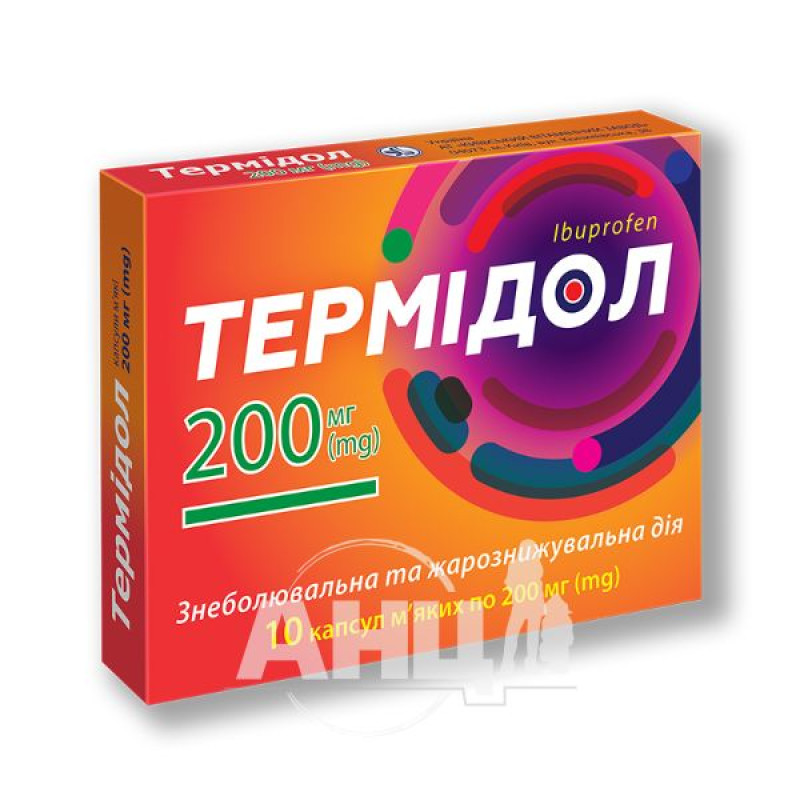
Termidol capsules are used for the symptomatic treatment of mild to moderate pain of various origins (headache, toothache, painful menstruation), including colds and fever.
Composition
Active ingredient: ibuprofen.
1 capsule contains 200 mg or 400 mg of ibuprofen.
Excipients: polyethylene glycol (macrogol), potassium hydroxide, purified water.
Contraindication
Hypersensitivity to ibuprofen or to any of the components of the drug; hypersensitivity reactions (e.g. bronchial asthma, rhinitis, angioedema or urticaria) previously observed after taking ibuprofen, acetylsalicylic acid or other NSAIDs; active or recurrent gastric ulcer/bleeding in history (two or more severe episodes of ulceration or bleeding); history of gastrointestinal bleeding or perforation associated with the use of NSAIDs; severe hepatic impairment, severe renal impairment, severe heart failure (NYHA class IV); children weighing less than 20 kg (for a dose of 200 mg); children weighing less than 40 kg or children under 12 years of age; last trimester of pregnancy; cerebrovascular or other bleeding in the active phase; hemorrhagic diathesis or blood clotting disorders; hematopoiesis disorders of unknown etiology; severe dehydration (caused by vomiting, diarrhea or insufficient fluid intake); the use of the drug simultaneously with other NSAIDs, including selective cyclooxygenase-2 (COX-2) inhibitors, is contraindicated.
Method of application
Administer orally to adults and children over 12 years of age weighing 40 kg or more. A single dose for children over 12 years of age weighing 40 kg or more and adults is 1 capsule of 400 mg ibuprofen. If necessary, 1 capsule can be taken every 6 hours. The maximum daily dose is 1200 mg (3 capsules per day). Use the minimum effective dose necessary to treat symptoms for the shortest possible period of time.
Application features
Pregnant women
Inhibition of prostaglandin synthesis may adversely affect pregnancy and/or embryonal/fetal development. Epidemiological data suggest an increased risk of miscarriage, congenital heart defects and gastroschisis following exposure to prostaglandin synthesis inhibitors in early pregnancy. The absolute risk of cardiovascular malformations increased from 1% to approximately 1.5%. The risk is believed to increase with increasing dose and duration of therapy.
NSAIDs should not be taken during the first two trimesters of pregnancy unless, in the opinion of the physician, the expected benefit to the patient outweighs the possible risk to the fetus. If ibuprofen is used by a woman attempting to conceive, or during the first and second trimesters of pregnancy, the lowest possible dose should be used for the shortest possible period of time.
During the third trimester of pregnancy, all prostaglandin synthesis inhibitors may pose the following risks:
for the fetus: cardiopulmonary toxicity (characterized by premature closure of the ductus arteriosus and pulmonary hypertension); renal dysfunction, which may progress to renal failure, accompanied by oligohydramnios; for the mother and newborn, at the end of pregnancy: possible increase in bleeding time, antiplatelet effect, which may develop even at very low doses; inhibition of uterine contractions, leading to delay or prolongation of labor. Therefore, ibuprofen is contraindicated during the third trimester of pregnancy.
Children
200 mg capsules – not for use in children weighing less than 20 kg.
400 mg capsules – not for use in children under 12 years of age and weighing less than 40 kg.
Drivers
If you experience dizziness, drowsiness or visual disturbances while taking ibuprofen, you should avoid driving or operating other machinery. Single use of ibuprofen or its use for a short period usually does not require any special precautions. This mainly applies to the simultaneous use of the drug with alcohol.
Overdose
Most patients who have taken clinically significant amounts of NSAIDs have only developed nausea, vomiting, epigastric pain, and very rarely diarrhea. Tinnitus, headache, and gastrointestinal bleeding may also occur. In more severe poisoning, toxic lesions of the central nervous system are possible, manifested as vertigo, drowsiness, sometimes - an excited state and disorientation or coma. Sometimes patients experience convulsions. In severe poisoning, hyperkalemia and metabolic acidosis may develop, an increase in prothrombin time/increase in the prothrombin index may be observed, possibly due to the effect on circulating blood clotting factors. Acute renal failure, liver damage, arterial hypotension, respiratory failure, and cyanosis may develop. In patients with bronchial asthma, exacerbation of the disease is possible.
The list of adverse reactions observed after treatment with ibuprofen includes all adverse reactions known during short-term use of the drug, as well as those observed during long-term therapy with high doses in patients with rheumatism. The stated frequency of adverse reactions exceeding the "very rare" level mentioned during short-term use of daily doses of the drug with a maximum daily dose of ibuprofen 1200 mg for oral dosage forms.
The development of adverse reactions to the drug depends mainly on the dose and individual characteristics of the body.
The most commonly observed adverse reactions are related to the gastrointestinal tract. Peptic ulcers, perforation or gastrointestinal bleeding may occur, sometimes with fatal outcomes, especially in the elderly. Nausea, vomiting, diarrhea, flatulence, constipation, dyspepsia, abdominal pain, melena, haematemesis, ulcerative stomatitis, exacerbation of colitis and Crohn's disease have been reported during use of the drug. Gastritis has been reported less frequently.
Interaction
Ibuprofen, like other NSAIDs, should not be used in combination with:
Acetylsalicylic acid, as this may increase the risk of adverse reactions, except in cases where acetylsalicylic acid (dose not exceeding 75 mg per day) has been prescribed by a doctor.
Experimental data suggest that ibuprofen may inhibit the effect of low-dose acetylsalicylic acid on platelet aggregation when used concomitantly. However, the limitations of extrapolation of these data to the clinical situation prevent definitive conclusions that regular long-term use of ibuprofen may reduce the cardioprotective effect of low-dose acetylsalicylic acid. Such clinically significant effects are considered unlikely with non-systematic use of ibuprofen.
Other NSAIDs, including selective COX-2 inhibitors:
The simultaneous use of several NSAIDs may increase the risk of gastrointestinal ulcers and bleeding due to a synergistic effect. Therefore, concomitant use of ibuprofen with other NSAIDs should be avoided.
Storage conditions
Store in the original packaging at a temperature not exceeding 25 ° C. Keep out of the reach of children.
Shelf life - 2 years.