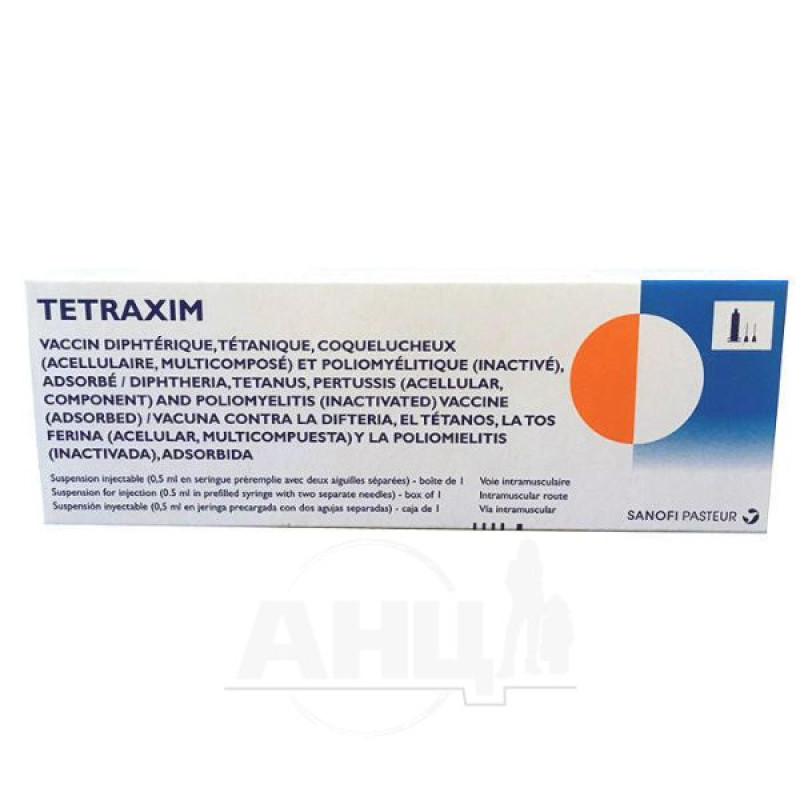
Instructions Tetraxim vaccine combined suspension for injection 1 dose syringe 0.5 ml No. 1
Composition
One immunizing dose of the vaccine (0.5 ml) contains:
active ingredients:
diphtheria toxoid(1) ≥ 30 IU(2)
tetanus toxoid(1) ≥ 40 IU(3)
Bordetella pertussis antigens:
pertussis toxoid(1) – 25 mcg
filamentous hemagglutinin (FGA) (1) – 25 μg
inactivated poliovirus(4)
type 1 (Mahoney strain) – 40 D-units(5) (6)
type 2 (MEF-1 strain) – 8 D-units(5) (6)
type 3 (Saukett strain) – 32 D-units(5) (6)
(1) adsorbed by aluminum hydroxide dihydrate – 0.3 mg Al3+
(2) as the average value
(3) as the lower limit of the confidence interval (p=0.95)
(4) obtained on Vero cells
(5) D – antigenic units
(6) or an equivalent amount of antigen determined using an appropriate immunochemical method
excipients: medium 199 with Hanks' salts without phenol red (a mixture of amino acids, including phenylalanine, mineral salts, vitamins and other components, including glucose), acetic acid and/or sodium hydroxide to adjust pH, formaldehyde, phenoxyethanol, ethanol, water for injection.
Dosage form
Suspension for injection.
Main physicochemical properties: sterile, cloudy with a whitish tint suspension of diphtheria and tetanus toxoids, acellular component of pertussis, inactivated polio virus, adsorbed on aluminum hydroxide dihydrate.
Pharmacotherapeutic group
Combined bacterial and viral vaccines. Vaccine for the prevention of diphtheria, tetanus, pertussis (acellular component) and poliomyelitis. ATX code J07C A02.
Pharmacological properties
Pharmacodynamics
Diphtheria and tetanus toxins are detoxified using formaldehyde, then purified.
The polio vaccine is produced from cultured poliovirus types 1, 2, and 3 on the Vero cell line, inactivation is performed using formaldehyde.
The acellular component of pertussis (pertussis toxin and PHA) is isolated from a culture of Bordetella pertussis and purified.
Pertussis toxin detoxified using glutaraldehyde corresponds to pertussis toxoid (PTxd).
PHA is native.
It has been established that pertussis toxoid and PHA are the two components that are of the greatest importance in protecting the body against pertussis.
As a result of immunogenicity studies conducted, it was established:
Immune response after primary vaccination
All infants (100%) vaccinated with three doses of the vaccine from 2 months of age developed seroprotective antibody titers (> 0.01 IU/ml) against diphtheria and tetanus antigens.
In over 87% of young children, one to two months after completing the primary immunization course, antibody titers against pertussis toxoid and PHA increased 4-fold.
At least 99.5% of children after primary vaccination had a protective antibody titer against poliovirus types 1, 2, and 3 (level ≥ 5 in the reciprocal of the dilution in the seroneutralization reaction) and were considered protected from polio.
After the first dose of booster vaccination (at 16–18 months of age), all young children had protective antibodies against diphtheria (> 0.1 IU/ml), tetanus (> 0.1 IU/ml) and 87.5% against polioviruses (level ≥ 5 inversely proportional to the dilution in the seroneutralization reaction).
The seroconversion rate in pertussis antibodies (titer 4 times higher than pre-vaccination titers) is 92.6% for pertussis toxoid and 89.7% for PHA.
Immune response after booster vaccination
After booster vaccination, all children aged 5 to 13 years had protective antibody titers against tetanus (> 0.1 IU/ml) and polioviruses. Of these, at least 99.6% had protective antibody titers against diphtheria (> 0.1 IU/ml). Seroconversion rates for pertussis antibodies (titres greater than 4 times the pre-vaccination titres) ranged from 89.1% to 98% for pertussis toxoid (determined by enzyme-linked immunosorbent assay (ELISA)) and from 78.7% to 91% for PHA (ELISA).
Pharmacokinetics
Not applicable.
Indication
For comprehensive prevention of diphtheria, tetanus, pertussis and poliomyelitis with Tetraxim® vaccine:
for the primary immunization course of infants at the age of 2 months and 4 months; for revaccination at the age of 11 months and 6 years; for revaccination of children aged 11 to 13 years who were not vaccinated at the age of 6 years with a vaccine containing a pertussis component at a concentration of 25 μg (aK).
When immunizing children in Ukraine, one should be guided by the current Orders of the Ministry of Health of Ukraine.
Contraindication
Increased sensitivity:
to any of the active substances of Tetraxim®, to any of the excipients (see section "Composition"), to glutaraldehyde, neomycin, streptomycin or polymyxin B (which are used in the manufacturing process and may be present in trace amounts), to pertussis vaccine (acellular or whole cell component). The occurrence of a severe allergic reaction after a previous administration of this vaccine or a vaccine containing the same substances. Vaccination should be postponed in case of fever or acute illness. Progressive encephalopathy. Encephalopathy occurring within 7 days after the administration of a previous dose of any vaccine containing pertussis antigens (acellular or whole cell pertussis vaccines).
Interaction with other medicinal products and other types of interactions
Tetraxim® can be administered simultaneously with the measles, mumps, and rubella vaccine or with the hepatitis B vaccine, but provided that it is administered into two different areas of the body.
Tetraxim® can be used to reconstitute a conjugate vaccine for the prevention of infections caused by Haemophilus influenzae type b (Act-Hib).
Before vaccination, you must inform your doctor about taking any medications or vaccines.
Application features
For syringes without an attached needle, the replacement needle must be firmly attached by rotating it a quarter turn relative to the syringe. Tetraxim® can be used to dilute the conjugate vaccine for the prevention of infections caused by Haemophilus influenzae type b (Act-HIB). Before use, the syringe with the suspension should be shaken until a homogeneous suspension of a cloudy white hue is obtained.
Syncope (fainting) may occur after or even before any vaccination as a psychogenic reaction to the needle insertion. Appropriate procedures should be followed to prevent injury from fainting and to manage syncopal reactions.
After use, all vaccine residues, syringes and vials must be disposed of safely in accordance with current requirements for the disposal of biological waste. Do not use the vaccine if it is discoloured or contains foreign matter.
The immunogenicity of Tetraxim® vaccine may be reduced by immunosuppressive treatment or immunodeficiency. Therefore, it is recommended to postpone vaccination until the end of treatment or until the disease is in remission. However, vaccination of individuals with chronic immunodeficiency, such as HIV infection, is recommended even when the immune response may be limited.
If Guillain-Barré syndrome or brachial neuritis has developed after previous administration of a tetanus toxoid-containing vaccine, the decision to use any tetanus toxoid-containing vaccine should be based on careful consideration of the potential benefits and possible risks of vaccination. Vaccination is usually justified for children who have incompletely completed their primary immunization series (e.g., fewer than three doses have been administered).
Do not administer intravascularly: ensure that the needle does not enter a blood vessel.
Do not administer intradermally.
As with all injectable vaccines, Tetraxim® should be administered with caution to individuals with thrombocytopenia or bleeding disorders, as bleeding may occur after intramuscular administration in these individuals.
Before vaccination, a complete medical history should be taken (with particular attention to immunization history and any adverse reactions) and a clinical examination should be performed.
If any of the following symptoms are known to have been associated in time with the receipt of a vaccine containing a pertussis component, further use of that vaccine should be reconsidered:
- temperature ≥ 40 °C for 48 hours, not associated with any other identified cause;
- collapse or shock-like state, hypotonic-hyporesponsive syndrome within 48 hours after vaccination;
- prolonged inconsolable crying for ≥ 3 hours occurring within 48 hours after vaccination;
- febrile or afebrile seizures within 3 days after vaccination.
A history of febrile seizures unrelated to previous vaccine administration is not a contraindication to vaccination. In this case, it is very important to measure body temperature within 48 hours after vaccination and regularly use antipyretics as prescribed by a doctor for 48 hours.
A history of afebrile seizures unrelated to previous vaccine administration should be evaluated by a specialist before deciding to vaccinate.
In case of lower limb edema after vaccination with a vaccine containing Haemophilus influenzae type b, both vaccines: the vaccine for the prevention of diphtheria, tetanus, pertussis, poliomyelitis and the vaccine for the prevention of infections caused by Haemophilus influenzae type b - should be administered in different areas of the body and on different days.
The potential risk of apnea and the need for respiratory function monitoring for 48–72 hours should be considered when administering primary immunization to very premature infants (born ≤ 28 weeks of gestation) and especially to infants with a history of respiratory immaturity. Since the benefit of vaccination is high in this group of infants, vaccination should not be canceled or postponed.
As with all injectable vaccines, adequate emergency medical treatment should be readily available in the unlikely event of an anaphylactic reaction and close supervision should be provided.
Patients should be under medical supervision for 30 minutes after vaccine administration.
This medicine contains:
less than 1 mmol (23 mg)/dose of sodium, i.e. practically sodium-free;
small amount of ethanol, less than 100 mg/dose;
Phenylalanine may be dangerous for patients with phenylketonuria (see the "Composition" section).
Ability to influence reaction speed when driving vehicles or other mechanisms
Not applicable. Tetraxim® is intended only for use in pediatrics.
Use during pregnancy or breastfeeding
Not applicable. The vaccine is intended for pediatric use only.
Method of administration and doses
When immunizing children in Ukraine, the current Orders of the Ministry of Health of Ukraine should be followed regarding contraindications, immunization schedules, and interactions with other medications.
Vaccination is carried out by medical personnel in preventive vaccination rooms of medical and preventive institutions.
Primary vaccination: 2 injections with an interval of two months, one at the age of 2 months, the second at the age of 4 months.
Revaccination: 1 injection at the age of 11 months.
During primary vaccination and during the 1st revaccination, Tetraxim® vaccine can be administered with the addition of the conjugate vaccine against Haemophilus influenzae type b (Act-Hib) or both vaccines can be administered simultaneously at different injection sites.
Revaccination at the age of 6 years: 1 injection.
Revaccination at the age of 11 to 13 years for children who were not vaccinated at the age of 6 years with a vaccine containing a pertussis component at a concentration of 25 mcg (aK).
The vaccine is administered intramuscularly.
The recommended vaccination site for infants is the anterolateral surface of the thigh (middle third), for older children - the deltoid muscle area.
Children
The vaccine is used in children from 2 months of age (see section “Method of administration and dosage”).
Overdose
Information is missing.
Adverse reactions
During clinical trials involving children receiving Tetraxim® as a primary vaccination, alone or in combination with Act-XIB vaccine, the most commonly reported adverse reactions were local injection site reactions, abnormal crying, loss of appetite, and irritability.
These signs and symptoms usually appear within 48 hours after vaccination and may last for 48–72 hours. They resolve spontaneously without requiring specific treatment.
The incidence of injection site reactions tends to increase with booster vaccination compared to primary immunization.
The safety profile of Tetraxim® does not differ significantly across age groups. However, some reactions (myalgia, malaise, headache) are more specific to children aged 2 years and older.
Adverse reactions are classified according to frequency:
very common: ≥ 1/10,
common: from ³ 1/100 to < 1/10,
uncommon: ≥ 1/1000 to < 1/100,
rare: from ³ 1/10000 to < 1/1000,
very rare: < 1/10,000,
unknown: cannot be estimated from available data.
Based on spontaneous reports, some adverse reactions have been identified that have been observed very rarely after the administration of Tetraxim® vaccine. Since the reporting was spontaneous and the sample size is unknown, it is not always possible to accurately calculate the incidence rate or establish a cause-and-effect relationship between the use of the vaccine and these reactions. Therefore, the frequency of these adverse reactions is stated as “not known”.
Blood and lymphatic system disorders
Not known: lymphadenopathy.
Immune system disorders
Not known: immediate-type hypersensitivity reactions such as facial edema, angioedema, Quincke's edema, anaphylactic reactions.
Metabolism and eating disorders
Very common: loss of appetite.
Mental disorders
Very common: nervousness, irritability, abnormal crying.
Common: insomnia, sleep disorders.
Uncommon: prolonged inconsolable crying.
Nervous system disorders
Very common: drowsiness, headache.
Not known: febrile or afebrile convulsions, syncope.
Gastrointestinal disorders
Very common: vomiting.
Common: diarrhea.
Skin and subcutaneous tissue disorders
Not known: rash, erythema, urticaria.
Musculoskeletal and connective tissue disorders
Very common: myalgia.
General disorders and administration site conditions
Very common: injection site erythema, injection site pain, injection site swelling, fever ≥ 38 °C, malaise.
Common: injection site induration.
Uncommon: injection site redness and swelling ≥ 5 cm, fever ≥ 39°C.
Rare: fever > 40 °C.
Unknown:
Potential adverse reactions (i.e. adverse events that have been reported with other vaccines containing one or more antigenic components similar to Tetraxim®):
After administration of a vaccine containing tetanus toxoid, cases of brachial neuritis and Guillain-Barré syndrome have been reported.
Additional information regarding specific populations of apnea in very premature infants (born ≤28 weeks of gestation) (see section 4.4).
Reporting of suspected adverse reactions
Reporting of suspected adverse reactions in the post-marketing period is an important measure. They allow for continued monitoring of the benefit/risk balance of this medicinal product. Healthcare professionals are asked to report any suspected adverse reactions via the national reporting system.
Expiration date
3 years.
Storage conditions
Store at 2 to 8°C (in a refrigerator). Do not freeze.
Protect from light. Keep out of the reach of children.
Packaging
1 pre-filled syringe of 0.5 ml (1 dose) with attached needle (2 separate needles) containing suspension for injection in a cardboard box containing standard export packaging and instructions for medical use.
Vacation category
According to the recipe.
Producer
Sanofi Pasteur, France.
Location of the manufacturer and its business address
1541 Avenue Marcel Mérieux, 69280 Marcy l'Étoile, France.