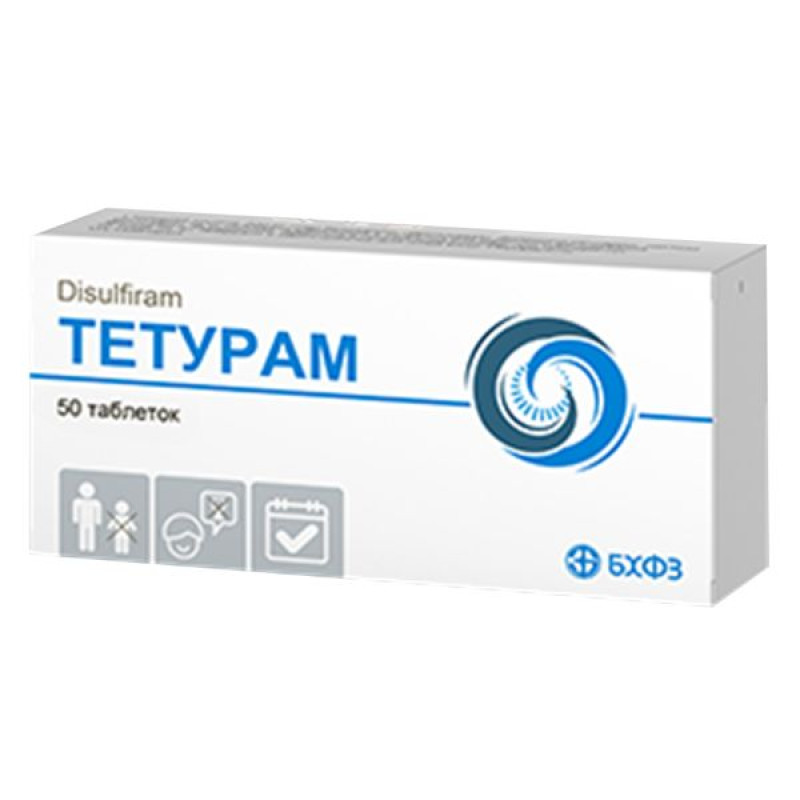
Instructions Teturam tablets 150 mg blister No. 50
Composition
active ingredient: disulfiram;
1 tablet contains disulfiram (calculated as 100% and dry matter) – 150 mg;
excipients: hypromellose, microcrystalline cellulose, croscarmellose sodium, magnesium stearate.
Dosage form
Pills.
Main physicochemical properties: tablets of white or white with a slightly yellowish-greenish tint, round in shape, with a flat surface with beveled edges (chamfer) and a score.
Pharmacotherapeutic group
N07B B01.
Pharmacological properties
Pharmacodynamics
Teturam is a specific drug for the treatment of chronic alcoholism. The action of disulfiram is due to its ability to disrupt alcohol metabolism. In the body, disulfiram is converted into N,N-diethyldithiocarbamic acid and other metabolites that block metal ions and sulfhydryl groups of enzymes involved in alcohol detoxification. Ethanol in the body undergoes oxidative transformations through the acetaldehyde and acetic acid phases. By blocking the enzymatic biotransformation of alcohol by alcohol dehydrogenase, disulfiram contributes to the accumulation of acetaldehyde in the blood after alcohol intake with the development of characteristic toxic effects (nausea, vomiting, skin hyperemia, a feeling of heat in the face and upper body, chest pain, difficulty breathing, noise in the head, palpitations, dizziness, a feeling of fear, chills, decreased blood pressure). The administration of alcohol against the background of the action of disulfiram allows you to develop a stable negative conditioned reflex to the taste and smell of alcohol and, with long-term treatment, achieve partial or complete alcohol intolerance.
Pharmacokinetics
After oral administration, it is rapidly but incompletely (70-90%) absorbed from the gastrointestinal tract. The duration of action is 48 hours. Disulfiram is rapidly metabolized by reduction to diethyldithiocarbamate, which is excreted as conjugates, or to diethylamine and carbon disulfide (from 4% to 53%). Carbon disulfide is excreted through the lungs.
Indication
Adjuvant therapy for preventing relapse of alcohol dependence.
Contraindication
Hypersensitivity to disulfiram or to any component of the drug and to thiuram compounds;
cardiovascular disorders;
diabetes;
Mental and behavioral disorders: severe personality disorders, suicidal risk, psychosis;
epilepsy and epileptiform syndromes (except alcoholic epilepsy);
severe respiratory failure;
severe hepatic and/or renal failure;
drinking beverages or using medications containing alcohol within the last 24 hours before taking disulfiram.
Interaction with other medicinal products and other types of interactions
Not recommended combinations of Teturam:
with alcohol (as a drink or an auxiliary substance) - development of a disulfiram-like reaction (feeling of heat, redness, vomiting, tachycardia). It is necessary to avoid alcoholic beverages or medicines, food products, perfumes and cosmetics containing alcohol until the drug is completely eliminated from the body. For this purpose, one should be guided by data on the half-life. It is also necessary to avoid the use of medicines containing a large amount of propylene glycol;
with isoniazid, paraldehyde – acute behavioral and motor coordination disorders are possible;
with nitroimidazoles (metronidazole, ornidazole, secnidazole, tinidazole, omeprazole) - acute toxic psychosis (delirium tremens), impaired consciousness, catatonia are possible, which are reversible after drug withdrawal; metronidazole should be avoided for 14 days after discontinuing treatment with disulfiram;
with hydantoins (phenytoin and, by extrapolation, fosphenytoin) - a significant and rapid increase in the level of hydantoins, including phenytoin, in the blood plasma (due to inhibition of metabolism) with toxic manifestations is possible; if the use of the combination cannot be avoided, clinical supervision and monitoring of the level of phenytoin in the blood plasma during and after discontinuation of disulfiram treatment are indicated;
with hepatotoxic drugs - the likelihood of toxic liver damage, therefore, their simultaneous use with disulfiram should be avoided.
Combinations requiring caution:
with vasodilators, alpha- and beta-blockers, sympathomimetics - pharmacodynamic interactions with possible serious clinical consequences should be expected;
with warfarin and other oral anticoagulants - due to reduced metabolism in the liver, an increase in plasma concentrations of anticoagulants and an increase in the anticoagulant effect (risk of bleeding) is possible. Prothrombin time or international normalized ratio (INR) should be monitored more frequently, and anticoagulant doses should be adjusted during disulfiram treatment and for 8 days after disulfiram discontinuation;
with benzodiazepines - possible potentiation of the sedative effect, adverse reactions from the CNS due to inhibition of the oxidative metabolism of benzodiazepines (especially chlordiazepoxide and diazepam). Under the influence of diazepam, a decrease in the intensity of the disulfiram-alcohol reaction is possible. Potentially increased toxicity of temazepam is possible. The dosage of benzodiazepines should be adjusted based on clinical signs;
with barbiturates, morphine, penthidine - the therapeutic effect and side effects of these substances are enhanced due to an increase in their concentrations in the blood plasma, toxic reactions develop;
with buspirone - potential occurrence of mental disorders (mania);
with tricyclic antidepressants (desipramine, imipramine, amitriptyline) - possible increased alcohol intolerance, potentiation of the Antabuse reaction, development of acute organic brain syndrome; monitoring of the patient's mental state is recommended;
with pimozide – possible potentiation of organic brain syndrome and choreoathetosis;
with phenothiazine derivatives (including perphenazine, chlorpromazine), MAO inhibitors - risk of developing serious adverse reactions (including psychotic reactions, increased arterial hypotension) associated with drug interaction.
with chlorzoxazone - the risk of developing its adverse reactions from the CNS increases;
with cocaine - disulfiram can inhibit its metabolism, which can lead to a significant increase in the concentration of cocaine in the blood and an increased risk of cardiovascular adverse reactions to cocaine, including prolongation of the QT interval;
with caffeine - the use of disulfiram and high doses of caffeine increases the risk of cardiovascular reactions and agitation. The use of caffeine-containing drugs and products should be monitored;
;with ascorbic acid – the use of high doses of ascorbic acid may interfere with the disulfiram-alcohol reaction;
;with rifampicin – disulfiram inhibits the oxidation and renal excretion of rifampicin.
Concomitant use of antacids containing divalent cations may reduce the absorption of disulfiram. Similarly, high doses of iron salts block absorption.
Impact on laboratory test results.
Disulfiram may interfere with the determination of blood cholesterol levels (increased values).
Disulfiram slightly reduces urinary excretion of vanillylmandelic acid, but not enough to interfere with the diagnosis of pheochromocytoma.
Disulfiram may increase the concentration of homovanillic acid in the urine due to inhibition of beta-dopamine hydroxylase.
Application features
Features of use related only to disulfiram.
Cases of severe hepatotoxicity leading to liver transplantation or death have been reported.
In the event of asthenia, anorexia, nausea, vomiting, abdominal pain or jaundice, darkening of urine, the drug should be discontinued immediately and the patient should be clinically examined, including assessment of laboratory parameters of liver function (see section "Adverse reactions").
Features of use associated with the combination of disulfiram-alcohol.
The patient should be warned about the risk of developing a disulfiram reaction of varying severity, in rare cases fatal, in case of simultaneous use of the drug and alcoholic beverages, even in small quantities, and in case of violation of the sobriety regimen for up to 2 weeks after the end of treatment (see sections "Interaction with other medicinal products and other types of interactions", "Adverse reactions").
Patients should be aware of the alcohol content in some other medications (especially oral solutions) or foods, as well as when using perfumes and cosmetics such as aftershave lotions, mouthwash, and perfumes.
Disulfiram reaction (symptoms: flushing, erythema, nausea, vomiting, general malaise, tachycardia, and hypotension) develops within 10 minutes after consuming alcohol-containing products and can last from 30 minutes to several hours.
Reactions to alcohol may occur within 2 weeks of disulfiram discontinuation. More severe reactions have been reported: cardiac arrhythmias, angina attacks, cardiovascular collapse, myocardial infarction, respiratory depression, neurological events (confusion, encephalopathy, convulsions), and sudden death.
The use of disulfiram with the following substances is not recommended:
alcoholic beverages and medicines containing alcohol;
isoniazid;
metronidazole;
phenytoin, fosphenytoin (see section "Interaction with other medicinal products and other types of interactions").
Precautions during use.
The use of the drug is possible only in a specialized institution (hospital, medical center, polyclinic) where there are qualified personnel with experience in working with the drug.
Disulfiram treatment should be carried out under the supervision of a physician only after a thorough medical examination of the patient (general medical examination and laboratory tests) and in the absence of contraindications to therapy. The patient should be explained the essence of the therapy and prohibited from drinking alcohol during the treatment period.
The drug should never be used on patients without their knowledge, on insufficiently informed patients, and on patients under the influence of alcohol.
Before using the drug, it is necessary to completely eliminate withdrawal symptoms, conduct a course of detoxification, general strengthening, symptomatic therapy. It is advisable to conduct rational psychotherapy.
It is recommended to completely discontinue taking sleeping pills, tranquilizers, antidepressants, and neuroleptics 1-3 days before administering the drug.
Liver function tests, including serum transaminase levels, should be performed before initiating disulfiram treatment (see Contraindications) and at regular intervals thereafter, at least monthly, especially during the first 3 months of treatment. Serum transaminase levels exceeding three times the upper limit of normal require immediate discontinuation of disulfiram treatment without further re-introduction. Patients should be closely monitored until liver function tests return to normal.
Disulfiram should be used with caution in patients with nickel dermatitis/eczema due to the increased risk of hepatitis.
When taking disulfiram, patients with arterial hypertension should carefully monitor blood pressure, and a dose reduction is recommended.
Disulfiram should be used with caution in patients with impaired renal function and hypothyroidism due to the possibility of developing an accidental disulfiram reaction.
The use of disulfiram is not recommended during pregnancy, regardless of stage, and in women of reproductive age not using contraception (see section “Use during pregnancy or breastfeeding”).
Use during pregnancy or breastfeeding
Animal studies have not been conclusive, and clinical data are insufficient. Therefore, disulfiram is not recommended for use during pregnancy, regardless of its duration, or in women of reproductive age not using contraception.
The development of a disulfiram reaction when the drug is taken with alcohol can have serious consequences for the fetus.
It is not recommended to use the drug during breastfeeding.
Ability to influence reaction speed when driving vehicles or other mechanisms
You should refrain from driving or operating machinery, given that visual disturbances, confusion, and drowsiness may occur during treatment.
Method of administration and doses
It is recommended that treatment be initiated after abstinence from alcohol for at least 24 hours in a specialized facility by physicians experienced in its use.
The drug is intended for oral administration. Adults should take it in the morning, during breakfast, in doses of 150-450 mg per day for 7-10 days.
After 7-10 days from the start of treatment, the first disulfiram-alcohol test should be performed: after taking the drug in the morning at a dose of 450-750 mg, the patient drinks 20-30 ml of a 40% solution of ethyl alcohol or vodka, or another suitable alcoholic beverage. If the reaction is weak, the dose of alcohol should be increased by 10-20 ml during subsequent tests, the maximum dose is 100-120 ml. Repeated tests should be performed in a hospital setting after 1-2 days, in an outpatient setting after 3-5 days.
The duration of the treatment course is determined by the doctor individually.
Children
There is no experience in using the drug to treat children.
Overdose
Symptoms: Overdose of disulfiram can lead to serious neurological complications such as encephalopathy, disorders of consciousness such as confusion, coma, convulsions, possible extrapyramidal symptoms.
Overdose of disulfiram in combination with alcohol can lead to coma or confusional state, cardiovascular failure, sometimes with neurological complications.
Treatment: symptomatic.
Side effects
Adverse reactions associated with disulfiram.
Nervous system and mental disorders: peripheral neuropathies, neuritis, including optic neuritis, polyneuritis, usually of the lower extremities; neuropsychiatric disorders (including memory impairment/loss, confusion, disorientation, paranoia), asthenia; headache, drowsiness, feeling of increased fatigue (usually at the beginning of treatment). Sometimes encephalopathy, convulsions/epileptiform seizures, catatonia may develop, usually reversible upon discontinuation of treatment.
Digestive tract: metallic or garlicky taste in the mouth, bad breath (halitosis), bad breath in patients with colostomy, loss of appetite, gastralgia, nausea, vomiting, diarrhea. These reactions usually occur within the first two weeks and disappear spontaneously with continued therapy or with dose reduction.
Hepatobiliary system: increased transaminases, bilirubin, jaundice, hepatitis (predominantly cytolytic), sometimes with eosinophilia, skin rash have been reported; severe cases have been associated with fulminant hepatitis, hepatic necrosis, hepatic failure, sometimes requiring liver transplantation or resulting in death. Some cases of hepatitis have occurred in patients with nickel eczema. Disulfiram should be discontinued immediately if liver function deteriorates (see section "Special warnings and precautions for use").
Skin and subcutaneous tissue: allergic dermatitis, itching, skin rashes, including acneiform, maculopapular. In patients with sensitization to tetramethylthiuram disulfide, present in rubber products, cross-sensitivity to disulfiram is possible. Cases of erythema multiforme, toxic epidermal necrolysis, Stevens-Johnson syndrome have been reported.
Reproductive system: decreased libido, potency, erectile dysfunction.
Immune system: hypersensitivity reactions.
Adverse reactions associated with the combination of disulfiram and alcohol (disulfiram-alcohol reactions).
May occur up to two weeks after disulfiram discontinuation and are characterized by:
intense vasodilation of the face and neck area, causing erythema, flushing, a feeling of pulsation in the head and neck; hyperthermia, sweating, nausea, vomiting, feeling of thirst, itching of the skin, urticaria, anxiety, feeling of malaise, dizziness, headache, blurred vision, dyspnea, palpitations, tachycardia, arterial hypotension, hyperventilation;
in more severe cases - respiratory depression, chest pain, QT interval prolongation, ST segment depression, arrhythmias, angina attacks, syncope, cyanosis of the lips, nails, myocardial infarction, cardiovascular failure, cardiovascular collapse, neurological complications (confusion, loss of consciousness, cerebral edema, hemorrhages in the meninges, hemorrhagic stroke, encephalopathy, convulsions/epileptiform seizures), coma, sudden death. Rare complications include arterial hypertension, bronchospasm, methemoglobinemia.
Expiration date
4 years.
Do not use after the expiry date stated on the packaging.
Storage conditions
In the original packaging at a temperature not exceeding 25 °C.
Keep out of reach of children.
Packaging
10 tablets in a blister, 1 or 5 blisters in a pack.
Leave category. By prescription.
Vacation category
According to the recipe.
Producer
Public Joint Stock Company "Research and Production Center "Borshchagov Chemical and Pharmaceutical Plant".
Address
Ukraine, 03134, Kyiv, Myru St., 17.