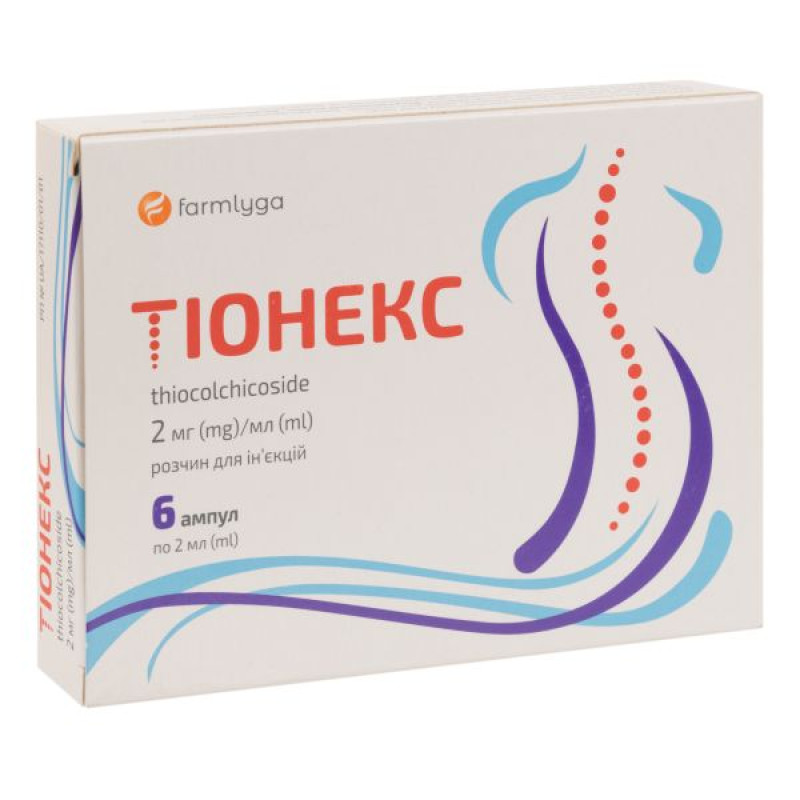
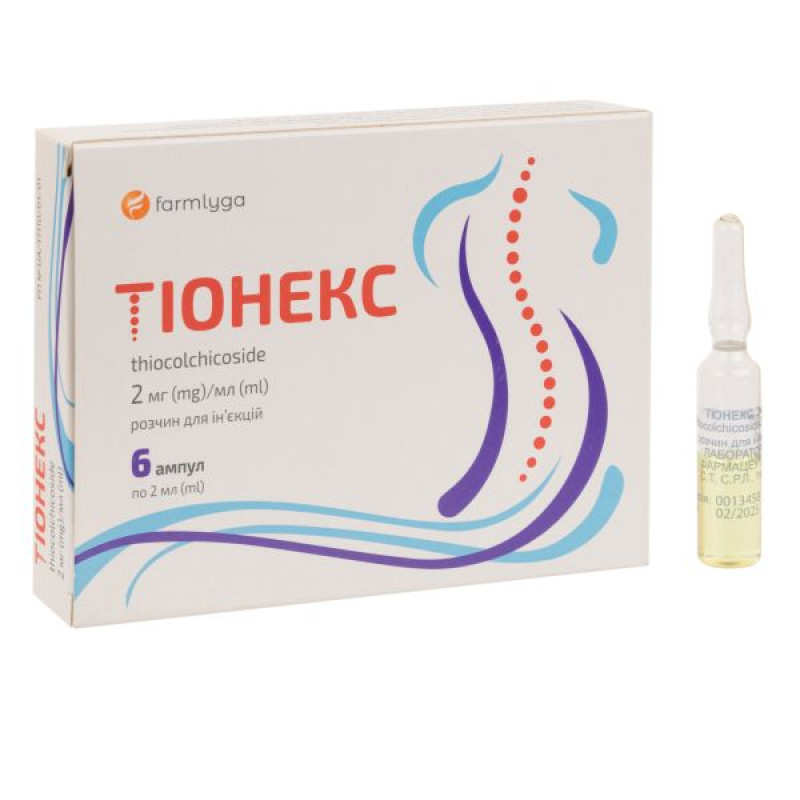
Instructions for Tionex solution for injection 2 mg/ml ampoule 2 ml No. 6
Composition
active ingredient: thiocolchicoside;
1 ampoule (2 ml) contains thiocolchicoside 4.0 mg;
Excipients: sodium chloride, water for injections.
Dosage form
Solution for injection.
Main physicochemical properties: clear, slightly yellowish solution.
Pharmacotherapeutic group
Muscle relaxants with a central mechanism of action. Thiocolchicoside. ATC code M03B X05.
Pharmacological properties
Pharmacodynamics.
Thiocolchicoside is a semisynthetic sulfide derivative of colchicoside, a natural glycoside of colchicum, which has a muscle relaxant effect, but does not exhibit the effect of curare-like agents. Some studies have revealed a selective agonist effect on GABAergic and glycinergic receptors. Such an effect may explain the effect of thiocolchicoside in cases of contractures of the reflex, rheumatic and traumatic types, as well as in cases of spastic contractures of central origin. Thiocolchicoside does not affect voluntary movements and does not affect the respiratory muscles. It does not affect the cardiovascular system.
Pharmacokinetics.
Absorption
After intramuscular administration, the maximum plasma concentration (Cmax) of thiocolchicoside is observed after 30 minutes, with values of 113 ng/ml being reached after a 4 mg dose and 175 ng/ml after a 8 mg dose. The corresponding area under the pharmacokinetic concentration-time curve (AUC) values are 283 ng∙g/ml and 417 ng∙g/ml.
The pharmacologically active metabolite SL18.0740 is also observed at lower concentrations, with a Cmax of 11.7 ng/mL, which is reached 5 hours after dosing, and an AUC of 83 ng∙g/mL.
There are no data on the inactive metabolite SL59.0955.
Distribution
The apparent volume of distribution of thiocolchicoside was estimated to be 42.7 L after intramuscular administration of 8 mg. Data are not available for either metabolite.
Breeding
After intramuscular administration, the expected half-life of thiocolchicoside is 1.5 hours and the plasma clearance is 19.2 l/h.
Indication
Adjuvant therapy of painful muscle contractures in cases of acute spinal pathologies in adults and adolescents aged 16 years and older.
Contraindication
Thiocolchicoside should not be used:
- patients with hypersensitivity to the active substance or to any of the excipients of the drug;
- throughout the entire period of pregnancy;
- during breastfeeding;
- women of reproductive age who do not use adequate contraception;
- patients suffering from flaccid paralysis, muscular hypotension.
Interaction with other medicinal products and other types of interactions
There is no information on interaction.
Application features
Thiocolchicoside may cause epileptic seizures in patients suffering from epilepsy or diseases associated with a risk of seizures (see section "Adverse reactions").
If a side effect occurs, the dosage is reduced accordingly (in particular, the dosage should be reduced in case of diarrhea).
Particular attention should be paid to patients suffering from renal and/or hepatic insufficiency.
The patient should be monitored if vasovagal syncope occurs after intramuscular administration of the drug (see section "Adverse reactions").
According to preclinical studies, one of the metabolites of thiocolchicoside, SL59.0955, causes aneuploidy (changes in the number of chromosomes in dividing cells) at concentrations close to 8 mg twice daily when administered orally, which had similar effects in humans.
Aneuploidy is considered a risk factor for teratogenicity, embryo/fetal toxicity, miscarriage, altered male fertility and a potential risk factor for cancer. For prevention, exceeding the recommended dose of the drug or prolonged use should be avoided (see section "Dosage and Administration").
Patients should be well informed about the potential risks to possible pregnancy and about effective contraceptive methods that should be used.
Postmarketing reports of liver injury have been reported in association with thiocolchicoside. Severe cases (e.g. fulminant hepatitis) of liver injury have been reported in patients receiving concomitant non-steroidal anti-inflammatory drugs (NSAIDs) or paracetamol. Patients should be advised to discontinue treatment and seek medical advice if signs of liver injury appear (see section 4.8).
This medicinal product contains less than 1 mmol (23 mg) sodium/dose, i.e. essentially 'sodium-free'.
Use during pregnancy or breastfeeding
Pregnancy
Information on the use of thiocolchicoside in pregnant women is limited, so the potential risk to the embryo and fetus is unknown.
Animal studies have shown teratogenic effects of this drug.
The drug Tionex is contraindicated during pregnancy and for women of reproductive age who are not using adequate contraception (see section "Contraindications").
The use of thiocolchicoside is contraindicated during breastfeeding, as it is excreted in breast milk (see section "Contraindications").
Fertility
Fertility studies in animals have shown no changes in fertility at doses up to 12 mg/kg, i.e. at doses that did not cause clinical effects. Thiocolchicoside and its metabolites are aneugenic at various concentrations, which is a risk factor for human fertility.
Ability to influence reaction speed when driving vehicles or other mechanisms
Studies of the effect of thiocolchicoside on the ability to drive vehicles or other mechanisms have not been conducted.
Despite the fact that drowsiness is considered a very rare manifestation, the possibility of its occurrence should be taken into account.
Method of administration and doses
The drug Tionex is administered intramuscularly.
The recommended maximum daily dose is 4 mg every 12 hours (8 mg per day). Treatment should not exceed 5 consecutive days.
Exceeding the recommended dose or duration of use should be avoided (see section "Special precautions for use").
Children.
The drug is contraindicated in children under 16 years of age.
Overdose
Cases of overdose are unknown or reported only in specialized literature.
In case of overdose, close medical supervision and symptomatic measures are recommended.
Adverse reactions
After intramuscular administration, infrequent cases of malaise, sometimes accompanied or not by a decrease in blood pressure and/or fainting, have been reported. In addition, infrequent cases of agitation or short-term confusion have been reported after parenteral administration. The following adverse reactions are listed by MedDRA system organ class and frequency: very common (≥1/10), common (≥1/100, <1/10), uncommon (≥1/1,000, <1/100), rare (≥1/10,000, <1/1,000), very rare (<1/10,000), not known (frequency cannot be estimated from the available data).
On the part of the immune system
Common: itching.
Rare: urticaria.
Very rare: decreased blood pressure.
Frequency unknown: angioedema and anaphylactic reactions, including anaphylactic shock following intramuscular administration.
From the nervous system
Common: drowsiness (see section "Ability to influence the reaction rate when driving vehicles or using other mechanisms").
Rare: agitation or short-term confusion.
Frequency unknown: malaise, with or without vasovagal syncope, within the first few minutes after intramuscular injection, convulsions (see section "Special warnings and precautions for use").
From the digestive system
Common: diarrhea, stomach pain.
Uncommon: nausea, vomiting.
Rare: heartburn.
Liver and biliary tract disorders
Frequency unknown: liver damage (see section "Special warnings and precautions for use").
Skin and subcutaneous tissue disorders
Uncommon: allergic skin reactions.
Reporting of suspected adverse reactions
Reporting adverse reactions after the registration of a medicinal product is important. This allows monitoring of the benefit/risk ratio when using this medicinal product. Medical and pharmaceutical professionals, as well as patients or their legal representatives, should report all cases of suspected adverse reactions and lack of efficacy of the medicinal product via the Automated Information System for Pharmacovigilance at the link: https://aisf.dec.gov.ua.
Expiration date
3 years.
Storage conditions
Store in original packaging at a temperature not exceeding 25 ° C. Keep out of the reach of children.
Incompatibility.
Data is missing.
Packaging
2 ml in ampoules; 6 ampoules in a contour blister pack. 1 contour blister pack in a pack.
Vacation category
According to the recipe.
Producer
LABORATORIO FARMACEUTICO S.T. SRL, Italy.
Location of the manufacturer and address of its place of business
VIA DANTE ALIGHIERI, 71 –18038 Sanremo (Empire), Italy.
Applicant
CJSC "Farmlyga"/UAB "Farmlyga".
Applicant's location
Antakalnio g. 48A-304, Vilnius, Republic of Lithuania.