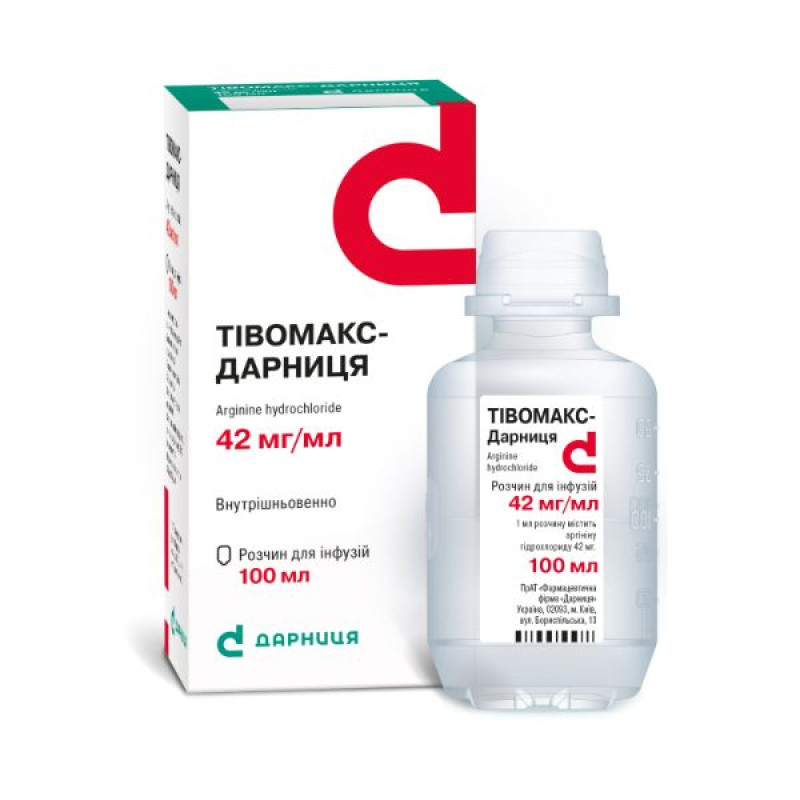
Instructions for use Tivomax-Darnitsa solution for infusion 42 mg/ml bottle 100 ml No. 1
Composition
active ingredient: arginine hydrochloride;
1 ml of solution contains arginine hydrochloride 42 mg;
excipient: water for injections.
Dosage form
Solution for infusion.
Main physicochemical properties: clear colorless or slightly yellowish-brown liquid.
Pharmacotherapeutic group
Blood substitutes and perfusion solutions. Additional solutions for intravenous administration. Amino acids. Arginine hydrochloride.
ATX code B05X B01.
Pharmacological properties
Pharmacodynamics.
Arginine is an amino acid that belongs to the class of conditionally essential amino acids and is an active and versatile cellular regulator of numerous vital functions of the body, exhibiting important protective effects in critical conditions of the body.
The drug exhibits antihypoxic, membrane-stabilizing, cytoprotective, antioxidant, antiradical, detoxification activity, manifests itself as an active regulator of intermediate metabolism and energy supply processes, plays a certain role in maintaining hormonal balance in the body. It is known that arginine increases the blood content of insulin, glucagon, somatotropic hormone and prolactin, participates in the synthesis of proline, polyamine, agmatine, is involved in the processes of fibrinolysis, spermatogenesis, and has a membrane depolarizing effect.
Arginine is one of the substrates in the urea synthesis cycle in the liver. The hypoammonemic effect of the drug is realized by activating the conversion of ammonia into urea. It has a hepatoprotective effect due to its antioxidant, antihypoxic and membrane-stabilizing activity, and has a positive effect on the energy supply processes in hepatocytes.
The drug is a substrate for NO synthase, an enzyme that catalyzes the synthesis of nitric oxide in endothelial cells. The drug activates guanylate cyclase and increases the level of cyclic guanidine monophosphate in the vascular endothelium, reduces the activation and adhesion of leukocytes and platelets to the vascular endothelium, inhibits the synthesis of adhesion proteins VCAM-1 and MCP-1, thus preventing the formation and development of atherosclerotic plaques, inhibits the synthesis of endothelin-1, which is a powerful vasoconstrictor and stimulator of proliferation and migration of smooth myocytes of the vascular wall. The drug also inhibits the synthesis of asymmetric dimethylarginine, a powerful endogenous stimulator of oxidative stress. The drug stimulates the thymus, which produces T-cells, regulates the content of glucose in the blood during physical exertion. It has an acid-forming effect and contributes to the correction of acid-base balance.
Pharmacokinetics.
With continuous intravenous infusion, the maximum concentration of arginine hydrochloride in the blood plasma is observed 20–30 minutes after the start of administration. The drug penetrates the placental barrier, is filtered in the renal glomeruli, but is almost completely reabsorbed in the renal tubules.
Indication
Metabolic alkalosis, hyperammonemia, atherosclerosis of the heart and brain vessels, atherosclerosis of peripheral vessels, including with manifestations of intermittent claudication, diabetic angiopathy, arterial hypertension, chronic heart failure, hypercholesterolemia, chronic obstructive pulmonary disease, pulmonary hypertension, fetal growth retardation and preeclampsia - as part of complex therapy.
Contraindication
Hypersensitivity to the drug.
History of allergic reactions.
Severe renal impairment, hypochloremic acidosis.
Use of potassium-sparing diuretics, spironolactone.
Myocardial infarction (including history).
Interaction with other medicinal products and other types of interactions
Potassium-sparing diuretics, spironolactone. When using the drug, it should be taken into account that it can cause severe and persistent hyperkalemia against the background of renal failure in patients who are taking or have taken spironolactone. Previous use of potassium-sparing diuretics can also contribute to an increase in the concentration of potassium in the blood.
Aminophylline. When used simultaneously with aminophylline, an increase in insulin levels in the blood is possible.
Arginine is incompatible with thiopental.
Application features
In patients with renal insufficiency, diuresis and plasma potassium levels should be checked before starting the infusion, as the drug may contribute to the development of hyperkalemia.
The drug should be used with caution in cases of endocrine gland dysfunction. The drug may stimulate the secretion of insulin and growth hormone. If dry mouth occurs, it is necessary to check the blood sugar level.
It should be used with caution in cases of electrolyte imbalance and kidney disease.
If symptoms of asthenia increase while taking the drug, treatment should be discontinued.
The drug should be used with caution in patients with angina pectoris.
Use during pregnancy or breastfeeding
There are no data on the use of the drug during breastfeeding.
Breastfeeding should be discontinued during treatment.
Ability to influence reaction speed when driving vehicles or other mechanisms
The medicine may cause dizziness, so caution should be exercised when driving or operating other machinery.
Method of administration and doses
The drug should be administered intravenously by drip at a rate of 10 drops per minute for the first 10–15 minutes, then the rate of administration can be increased to 30 drops per minute.
The daily dose of the drug is 100 ml of solution.
In case of severe circulatory disorders in the central and peripheral vessels, with pronounced symptoms of intoxication, hypoxia, asthenic conditions, the dose of the drug can be increased to 200 ml per day.
The maximum rate of infusion solution administration should not exceed 20 mmol/h.
For children under 12 years of age, the dose of the drug is 5–10 ml per 1 kg of body weight per day.
For the treatment of metabolic alkalosis, the dose can be calculated as follows:
arginine hydrochloride (mmol)
______________________________________ ´ 0.3 ´ body weight (kg)
alkali excess (Be) (mmol/l)
Administration should begin with half the calculated dose. Any additional correction should be made after receiving the results of an updated acid-base balance.
Method of application
Do not insert the needle(s) into any places on the polymer vial that are not intended for this purpose, but only into sterile ports!
To carry out infusion treatment, you must follow the following algorithm:
Remove the protective plastic cover with the first opening control (if any).
Tear off the safety valve(s) No. 1 as shown in Fig. 1 and 2 (the manufacturer may use different types and materials for safety valves).
Remove the cap from the needle and insert it into any of the special ports No. 2 of the infusion drug vial.
Another sterile port can be used to introduce other drugs into the infusion bottle or, in case of insufficient flow rate, for an air needle.
Hang the solution bottle using the special ring No. 3 located at the bottom of the bottle.
Children
The medicine can be used in children aged 3 years and over.
Overdose
Symptoms: renal failure, hypoglycemia, metabolic acidosis.
Treatment. In case of overdose, the infusion of the drug should be stopped. It is necessary to monitor physiological reactions and maintain vital functions of the body. If necessary, administer alkalizing agents and agents for establishing diuresis (saluretics), electrolyte solutions (0.9% sodium chloride solution, 5% glucose solution).
Side effects
Respiratory, thoracic and mediastinal disorders: dyspnea.
On the part of the digestive system: dry mouth, nausea, vomiting.
From the nervous system: headache, dizziness, feeling of fear, weakness, convulsions, tremor - more often when the rate of administration is exceeded.
Cardiovascular system: fluctuations in blood pressure, changes in heart rhythm, pain in the heart area.
Immune system disorders: hypersensitivity reactions, including rash, urticaria, angioedema, anaphylactic shock.
Musculoskeletal system: joint pain.
General disorders: hyperthermia, feeling hot, body aches.
Changes at the injection site: changes at the injection site, including hyperemia, itching, skin pallor, up to acrocyanosis.
Changes in laboratory parameters: hyperkalemia.
Expiration date
3 years.
Storage conditions
Store in the original packaging at a temperature not exceeding 25 ° C. Do not freeze.
Keep out of reach of children.
Incompatibility
The drug is incompatible with thiopental.
Packaging
100 ml in a bottle; 1 bottle in a pack; 100 ml in bottles.
Vacation category
According to the recipe.
Producer
PrJSC "Pharmaceutical Company "Darnitsa".
Location of the manufacturer and address of its place of business
Ukraine, 02093, Kyiv, Boryspilska St., 13.