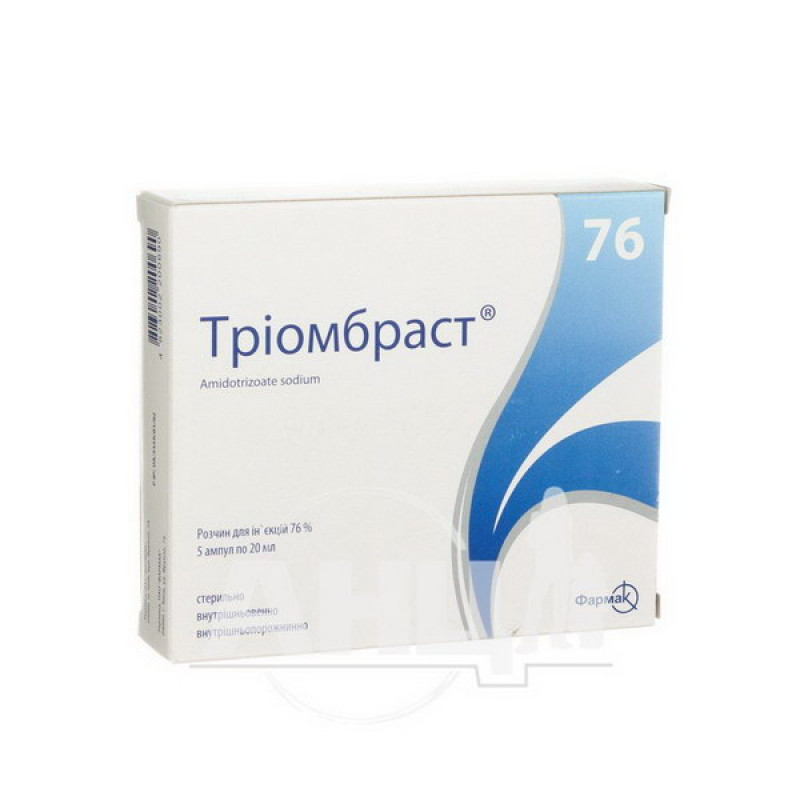
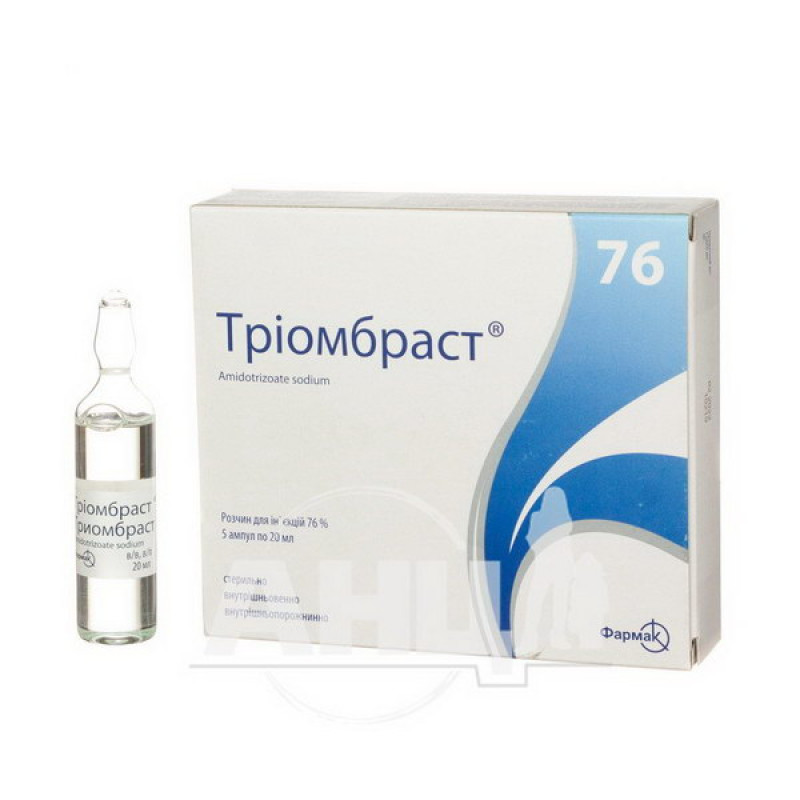
Instructions Triombrast solution for injection 76% ampoule 20 ml No. 5
Composition
active ingredients: 1 ml of 60% solution contains diatrizoic acid dihydrate calculated as 100% anhydrous substance 471.6 mg, meglumine (N-methylglucamine) calculated as 100% dry substance 125.7 mg;
1 ml of 76% solution contains diatrizoic acid dihydrate in terms of 100% anhydrous substance 597.3 mg, meglumine (N-methylglucamine) in terms of 100% dry substance 159 mg;
Excipients: sodium hydroxide, disodium edetate, water for injections.
Dosage form
Solution for injection.
Main physicochemical properties: transparent, colorless or light yellow, slightly viscous liquid.
Pharmacotherapeutic group
Iodine-containing radiopaque agents. ATX code V08A A01.
Pharmacological properties
Pharmacodynamics.
The radiopaque agent Triombrast® is a salt of amidotrizoic acid, which contains bound iodine that absorbs X-rays.
Pharmacokinetics.
Distribution. After intravenous administration, the amount of the drug bound to blood plasma proteins does not exceed 10%. 5 minutes after intravenous bolus administration of Triombrast®60% at a dose of 1 ml/kg body weight, a concentration of the drug in the blood plasma corresponding to 2-3 g of iodine per liter is achieved. Within 3 hours after administration, a relatively rapid decrease in the concentration of the drug is observed during the first 30 minutes, then a gradual decrease with a half-life of 1-2 hours. Amidotrizoic acid does not penetrate into erythrocytes, after intravascular administration it is very quickly distributed in the intercellular substance, but does not penetrate through an intact blood-brain barrier. The drug penetrates into breast milk only in minimal quantities.
Metabolism and elimination. When administered in diagnostic doses, amidotrizoic acid undergoes glomerular filtration in the kidneys. About 15% of the administered drug is excreted unchanged in the urine within 30 minutes after administration, and more than 50% within 3 hours, no metabolites have been detected.
The distribution and elimination kinetics of Triombrast® were dose-independent within the clinically relevant range. This means that when a double or half dose is administered, the blood levels of the drug and the amount of contrast medium excreted in grams/time will be doubled or decreased, respectively. However, due to the increased osmotic diuresis with a double dose, the concentration of contrast medium in the urine does not increase to the same extent.
Characteristics in patients. In patients with reduced renal function, amidotrizoate may also be eliminated extrarenal via the liver, although at a significantly reduced rate. Contrast agents eliminated by the kidneys can be readily removed from the body by extracorporeal hemodialysis. Regardless of the site of administration, complete elimination occurs within a short period of time, even from tissues.
Indication
Intravenous and retrograde urography.
In addition, angiography, as well as arthrography, intraoperative cholangiography, endoscopic retrograde cholangiopancreatography (ERCP), sialography, fistulography, hysterosalpingography, and other studies.
Contraindication
Known or suspected sensitivity to iodinated contrast media and to the components of the drug.
There is hyperthyroidism, decompensated heart failure.
Hysterosalpingography should not be performed during pregnancy, as well as in cases of acute inflammatory processes in the pelvic cavity.
ERCP is contraindicated in acute pancreatitis.
Triombrast® should not be used for myelography, ventriculography, and cisternography due to the possible provoking of neurotoxic phenomena (pain, convulsions, and coma, often fatal) during these studies.
Interaction with other medicinal products and other types of interactions
In patients who used interleukin, the prevalence of delayed reactions (e.g., fever, rash, flu-like symptoms, joint pain, and itching) is higher.
Interaction with diagnostic tests.
After intravascular administration of iodinated contrast agents, the ability of thyroid tissue to absorb radioisotopes for the diagnosis of thyroid diseases decreases for a period of up to 2 weeks, and in some cases even for a longer period.
Application features
General information for all indications.
The following warnings and precautions apply to any route of administration, however, the potential for the following risk situations to occur is higher with intravascular administration.
Triombrast®, solution for injection 60% contains 0.125 mmol (or 2.9 mg)/ml sodium. Caution should be exercised when administered to patients on a controlled sodium diet.
Triombrast®, solution for injection 76% contains 0.158 mmol (or 3.6 mg)/ml sodium. Caution should be exercised when administered to patients on a controlled sodium diet.
Allergic-like hypersensitivity reactions have occasionally been observed after the use of radiopaque contrast agents such as Triombrast® (see section "Adverse reactions"). They are usually expressed by non-serious respiratory or skin symptoms, such as mild respiratory distress, redness of the skin (erythema), urticaria, itching or swelling of the face. Serious adverse reactions such as angioedema, subchoroidal edema, bronchospasm and allergic shock are possible. Such reactions are usually observed within 1 hour after the administration of the contrast agent. However, in isolated cases, delayed reactions (several hours or days after administration) are possible.
Patients with hypersensitivity or previous reaction to iodine-containing radiopaque agents are at increased risk of developing a serious complication.
Before administering any contrast agent, the patient should be asked about a history of allergic reactions (e.g., seafood allergy, hay fever, urticaria), sensitivity to iodine or radiographic contrast agents, and bronchial asthma, as serious reactions to contrast agents have been reported to occur more frequently in patients with these conditions, and premedication with antihistamines and/or glucocorticoids may be considered.
Patients with bronchial asthma are at particular risk of developing bronchospasm or hypersensitivity reactions.
Hypersensitivity reactions may be exacerbated in patients taking beta-blockers, especially in the presence of bronchial asthma. In addition, it should be taken into account that patients taking beta-blockers may be insensitive to standard therapy for hypersensitivity reactions with beta-agonists.
If hypersensitivity reactions occur (see section "Adverse reactions"), the contrast medium should be discontinued immediately and, if necessary, specific intravenous therapy should be administered. Therefore, flexible indwelling cannulas (catheters) are recommended for intravenous administration of contrast medium. Emergency equipment (appropriate medications and equipment, including an endotracheal tube and a respirator) should always be available to enable immediate emergency measures to be taken.
Thyroid dysfunction: Small amounts of free inorganic iodide from iodinated contrast media may interfere with thyroid function. Therefore, special care should be taken when performing the study in patients with latent hyperthyroidism or goiter, given the potential risk.
Cardiovascular disease: There is an increased risk of serious reactions in individuals with severe cardiac disease, and especially in patients with heart failure and coronary artery disease.
Elderly patients. Vascular pathologies and neurological disorders, which are often observed in the elderly, pose an increased risk of serious reactions to iodinated contrast agents.
General poor health. Particular care should be taken when conducting the study in patients with very poor general health, given the potential risk.
Intravascular administration.
Renal failure. In rare cases, temporary renal failure may occur. Precautions to prevent acute renal failure after contrast medium administration include:
– identification of high-risk patients, for example, patients with a history of kidney disease, renal failure, renal failure after contrast medium administration, diabetes mellitus with nephropathy, decreased circulating blood volume, multiple myeloma, persons over 60 years of age; patients with advanced vascular disease, paraproteinemia, severe and chronic hypertension, gout; patients receiving large or repeated doses of the drug;
– ensuring adequate hydration in patients at risk before contrast medium administration, preferably by maintaining an intravenous infusion before and after the procedure and until the contrast medium is excreted by the kidneys;
– avoiding additional burden on the kidneys in the form of nephrotoxic drugs, oral cholecystographic agents, arterial clamping, renal arterial angioplasty, radical surgical intervention before the removal of the contrast medium;
– postponement of the new study with a contrast agent until kidney function indicators return to previous levels.
Dialysis patients may receive contrast agents for radiological procedures because iodine-containing substances are excreted during the dialysis process.
Metformin therapy: The use of intravenous radiopaque agents that are excreted by the kidneys may cause transient renal dysfunction. This may lead to the development of lactic acidosis in patients taking biguanides.
Cardiovascular Disease: In patients with valvular heart disease and pulmonary hypertension, administration of contrast media may result in marked hemodynamic changes. Reactions including ischemic ECG changes and severe arrhythmias are more common in the elderly and in patients with a history of cardiac disease.
Intravenous administration of contrast media may cause pulmonary edema in patients with heart failure.
CNS disorders: Particular caution should be exercised when administering intravenous contrast media to patients with acute ischemic stroke, acute intracranial hemorrhage, and other conditions involving blood-brain barrier disruption, cerebral edema, or acute demyelination. Intracranial tumors or metastases and a history of epilepsy may increase the incidence of seizures following administration of iodinated contrast media.
Neurological symptoms may be exacerbated by contrast media administration due to cerebrovascular disease, intracranial tumors or metastases, degenerative or inflammatory pathologies. Vasospasm and subsequent cerebral ischemia may be caused by intraarterial contrast media administration. Patients with symptomatic cerebrovascular disease, recent stroke, or frequent transient ischemic attacks are at increased risk for neurological complications.
Severe hepatic dysfunction: In the case of severe renal insufficiency, the concomitant presence of severe hepatic dysfunction may significantly delay the excretion of contrast medium, possibly necessitating hemodialysis.
Myeloma and paraproteinemia: Myeloma or paraproteinemia may predispose to renal failure following contrast medium administration. Adequate hydration is essential.
Pheochromocytoma: Patients with pheochromocytoma may develop severe (sometimes uncontrollable) hypertensive crisis following intravenous contrast media administration. Premedication with alpha-blockers is recommended.
Patients with autoimmune disorders: Cases of severe vasculitis or Stevens-Johnson-like syndrome have been reported in patients with a history of autoimmune disorders.
Bulbospinal paralysis (myasthenia gravis). Administration of iodinated contrast agents may exacerbate the symptoms of bulbospinal paralysis.
Alcoholism. Acute or chronic alcoholism can increase the permeability of the blood-brain barrier. This facilitates the passage of contrast media into brain tissue, which can lead to CNS reactions. Special attention should be paid to alcoholics and drug addicts because of the possibility of a lowered seizure threshold.
Coagulation. Ionic iodinated contrast agents have greater in vitro anticoagulant activity than nonionic contrast agents. However, healthcare professionals performing vascular catheterization should be aware that, in addition to the contrast agent, multiple factors may contribute to the development of thromboembolic events, including the duration of the procedure, the number of injections, the material from which the catheter and syringe are made, the underlying disease state, and concomitant medication. Therefore, during vascular catheterization, careful attention should be paid to angiographic technique, frequent flushing of the catheter with saline (if possible with heparin), and the duration of the procedure should be shortened to minimize the risk of procedure-related thrombosis and embolism.
It has been reported that the use of plastic syringes instead of glass ones reduces, but does not eliminate, the likelihood of blood clotting in vitro.
It is recommended to pay special attention to patients with homocystinuria due to the increased risk of thrombosis and embolism.
Introduction into body cavities.
Pregnancy must be ruled out before performing hysterosalpingography.
Inflammation of the bile ducts and fallopian tubes may increase the risk of reactions after cholangiography, ERCP, and hysterosalpingography procedures.
Instructions for use.
Triombrast® is a clear, colorless to pale yellow solution, ready for use. Contrast media should not be used if the color is significantly changed, if there are mechanical inclusions or if the container is damaged. The contrast media solution should be drawn into a syringe or infusion bottle attached to the infusion equipment only immediately before the start of the examination.
Contrast solution that has not been used in one procedure should be discarded.
Use during pregnancy or breastfeeding
The results of reproductive toxicity studies using meglumine or sodium amidotrizoate do not indicate the existence of a teratogenic or any other embryotoxic effect after inadvertent administration of Triombrast® during pregnancy.
The safety of contrast agents in pregnant women has not been sufficiently demonstrated. Since it is desirable for them to avoid any radiation exposure, it is necessary to carefully consider the possible risks when ordering an X-ray examination - with or without contrast.
There is limited data to suggest that the risk to the breast-fed infant from maternal administration of diatrizoic acid salts is low. Breast-feeding is probably safe.
Ability to influence reaction speed when driving vehicles or other mechanisms
After the administration of the contrast agent, as with all iodinated contrast agents, in rare cases there is a possibility of delayed reactions that may impair the ability to drive and use machines.
Method of administration and doses
General rules.
Dietary advice. To facilitate diagnosis, abdominal angiography and urography are recommended to be performed with an empty bowel. Therefore, for 2 days before the examination, foods that cause flatulence should be avoided, in particular, legumes, salads, fruits, black and fresh bread, as well as any raw vegetables. The last meal should be no later than 6 p.m. In addition, it is advisable to use a laxative in the evening. However, newborns and young children should not have a long interval between meals, and they should not be given laxatives.
Hydration. Adequate hydration should be ensured before and after intravascular and intrathecal administration of contrast media. This is especially true for patients with multiple myeloma, diabetes mellitus, polyuria, oliguria, hyperuricemia, as well as newborns, infants and young children and elderly patients. Any disturbances in water and electrolyte metabolism should be corrected.
Neonates and children under 2 years of age. Children under 1 year of age and especially neonates are susceptible to electrolyte imbalance and hemodynamic changes. Attention should be paid to the dose of contrast medium to be administered, the technical performance of the radiological procedure, and the patient's condition.
Anxiety. Severe states of agitation, anxiety, and pain may increase the risk of side effects and enhance the body's reactions to the contrast medium. A sedative may be prescribed for these patients.
Tolerance testing. Tolerance testing using a low dose of contrast medium is not recommended because it has no prognostic value. Furthermore, tolerance testing itself has occasionally resulted in severe hypersensitivity reactions, even fatal.
Dosage for intravascular administration. Intravascular administration of contrast media is preferably performed with the patient in the supine position. After administration, the patient should be observed for at least 30 minutes, as most complications occur during this period.
Dosage may vary depending on the age, body weight, cardiac output, and general condition of the patient.
For patients with severe renal or cardiovascular insufficiency and patients with a general serious condition, the lowest possible dose of contrast medium should be used. They are advised to monitor renal function for at least 3 days after the examination.
Between individual injections, the body must be given sufficient time for the outflow of interstitial fluid to compensate for the increase in plasma osmolality. To achieve this in adequately hydrated patients, the required period is 10-15 minutes. If it is necessary in individual cases to exceed the total dose of 300-350 ml of contrast medium per examination, additional water and possibly electrolytes should be administered in adults.
Recommended doses:
Intravenous urography.
Injection.
Triombrast® 76% and 60% are equally suitable for intravenous urography.
The rate of intravascular administration is usually 20 ml/min. For patients with heart failure who are prescribed a dose of 100 ml or more, an administration time of at least 20-30 minutes is recommended.
Dosage.
Adult:
dose of Triombrast® 76% – 20 ml, Triombrast® 60% – 50 ml. Increasing the dose of Triombrast® 76% to 50 ml significantly increases the likelihood of a more accurate diagnosis. Further increase is possible if necessary due to special indications.
For children:
Due to the reduced physiological concentrating ability of the immature nephron of the kidneys, children require relatively high doses of Triombrast® 76%:
children under 1 year old – 7-10 ml;
from 1 to 2 years – 10-12 ml;
from 2 to 6 years old – 12-15 ml;
from 6 to 12 years old – 15-20 ml;
from 12 years old - as for adults.
Time of execution of the snapshots.
The best contrast image of the renal parenchyma can be obtained if the image is taken immediately after the contrast medium is injected.
To visualize the renal pelvis and urinary tract, the first image should be taken 3-5 minutes and the second 10-12 minutes after the contrast medium is injected, with young patients aiming for the lower limit and elderly patients aiming for the upper limit of the specified time interval.
For newborns and infants and young children, it is recommended that the first image be taken within 2 minutes of contrast injection. If the images appear to be low contrast, later images may be necessary.
Triombrast® can also be used for angiographic studies. The use of the 76% solution is preferred in cases where a particularly high iodine concentration is important, for example, for aortography, angiocardiography or coronarography. The dose should be set depending on the diagnostic task, the examination technique, the nature and volume of the vascular area being examined.
Introduction into body cavities.
Retrograde urography.
Triombrast® 60% can be used. Despite its high concentration, irritation symptoms are extremely rare. In order to avoid the effect of a lower solution temperature causing ureteral spasms, it is recommended to warm the contrast medium to body temperature.
Children.
Due to the reduced physiological concentrating ability of the immature nephron of the kidneys, children require relatively high doses of Triombrast® 76%.
Overdose
In case of accidental overdose by intravascular administration, loss of water and electrolytes should be compensated by infusion. Renal function should be monitored for at least 3 days.
If necessary, hemodialysis can be used to remove the bulk of the contrast agent from the patient's circulatory system.
Adverse reactions
With intravascular administration.
Adverse reactions associated with intravascular administration of iodinated contrast media are usually mild to moderate in severity and transient in nature. However, severe, life-threatening and fatal reactions have been reported. The incidence of adverse reactions in patients receiving ionic contrast media has been reported to be >12% compared with >3% for non-ionic contrast media.
The most common reactions observed with intravascular administration are nausea, vomiting, pain, and a general feeling of heat.
Anaphylactic reactions/hypersensitivity:
mild angioedema, conjunctivitis, cough, itching, rhinitis, sneezing and urticaria. These reactions, which may occur regardless of the amount of the drug administered and the route of administration, may be the first signs of the initial stage of shock. The administration of the contrast medium should be stopped immediately and, if necessary, specific therapy should be carried out, preferably intravenously (see section "Special instructions").
Severe reactions requiring emergency treatment may include circulatory collapse with peripheral vasodilation and subsequent hypotension, reflex tachycardia, dyspnoea, agitation, confusion and cyanosis, which may lead to fainting.
Bronchospasm, laryngeal spasm or edema, or hypotension may occur.
Delayed reactions associated with the administration of contrast media occur in isolated cases (see section "Special warnings and precautions for use").
Body as a whole: feeling hot and headache, malaise, fever, sweating and vasovagal reactions, increased body temperature and swelling of the salivary glands.
On the part of the respiratory system: transient respiratory rate disturbance, shortness of breath and respiratory distress and cough, respiratory arrest and pulmonary edema.
Cardiovascular system: clinically pronounced transient disturbances of heart rate (HR), blood pressure, disturbances of cardiac rhythm or function or cardiac arrest. Severe reactions requiring emergency therapy may take the form of circulatory disorders accompanied by peripheral vasodilation and subsequent arterial hypotension, reflex tachycardia, shortness of breath, a state of excitement, confusion and cyanosis, which can lead to fainting.
Serious thromboembolic events leading to myocardial infarction have been reported.
Gastrointestinal: nausea, vomiting, abdominal pain.
On the part of the cerebral vascular system: cerebral angiography and other procedures during which the contrast agent enters the brain in high concentrations with arterial blood may be accompanied by such transient neurological complications as dizziness, headache, state of excitement or confusion of consciousness, amnesia, speech, vision, hearing disorders, seizures, tremors, paresis/paralysis, photophobia, temporary loss of vision, coma and drowsiness, severe, in some cases fatal thromboembolic phenomena leading to stroke.
Renal: renal dysfunction, renal failure.
Skin and subcutaneous tissue disorders: mild angioedema, flushing with vasodilation, urticaria, pruritus and erythema, toxic skin reactions such as mucocutaneous syndrome (e.g. Stevens-Johnson or Lyell syndrome).
Local irritation (at the injection site): pain at the injection site occurs mainly during peripheral angiography, bleeding of the contrast medium, including Triombrast®, increases injection site pain and swelling, which usually resolve without sequelae, inflammation and tissue necrosis, thrombophlebitis and venous thrombosis.
Adverse reactions following intra-body contrast media administration are rare. Most develop within a few hours of administration due to slow adsorption from the site of administration and distribution throughout the body, mainly by a controlled diffusion process.
After ERCP (endoscopic retrograde cholangiopancreatography), a slight increase in amylase levels is possible. It has been proven that acinar contrast imaging is associated with an increased risk of pancreatitis after ERCP. Cases of necrotizing pancreatitis and vasovagal reactions associated with hysterosalpingography have been described.
Anaphylactic reactions/hypersensitivity:.
Systemic hypersensitivity, mainly mild, usually occurs in the form of skin reactions, but the possibility of severe hypersensitivity reactions cannot be completely excluded. For a full description of anaphylactic reactions, see the relevant information in the section "Adverse reactions", "With intravascular administration".
Expiration date
3 years.
Do not use the drug after the expiration date indicated on the package.
Storage conditions
Store in the original packaging at a temperature not exceeding 25 ° C. Do not freeze.
Keep out of reach of children.
During storage of the drug, crystals may precipitate. In such cases, the ampoule must be heated in a boiling water bath. If the crystals disappear and the solution becomes transparent, and when cooled to 33-36 °C, the crystals do not precipitate again, the solution is suitable for use.
Packaging
20 ml in an ampoule. 5 ampoules in a pack.
20 ml in an ampoule. 5 ampoules in a blister, 1 blister in a pack.
Vacation category
According to the recipe.
Producer
PJSC "Farmak".
Location of the manufacturer and address of its place of business
Ukraine, 04080, Kyiv, Frunze St., 74.