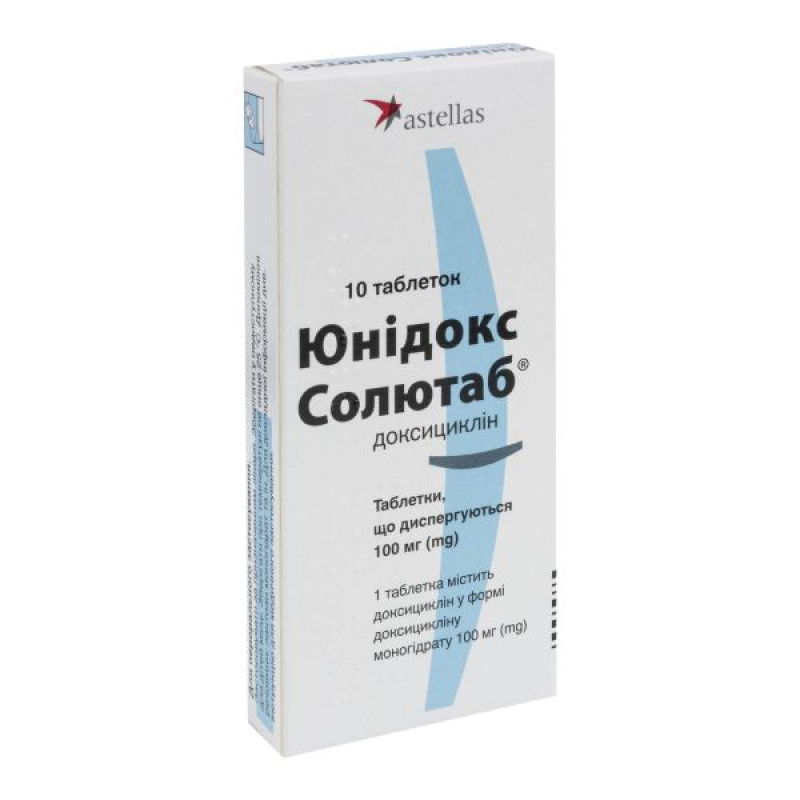
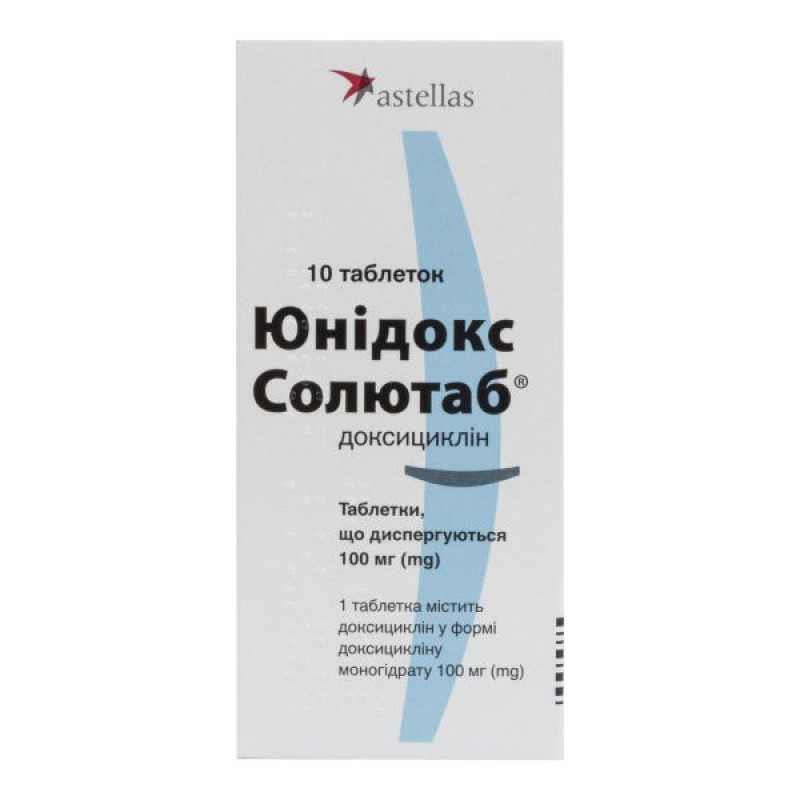
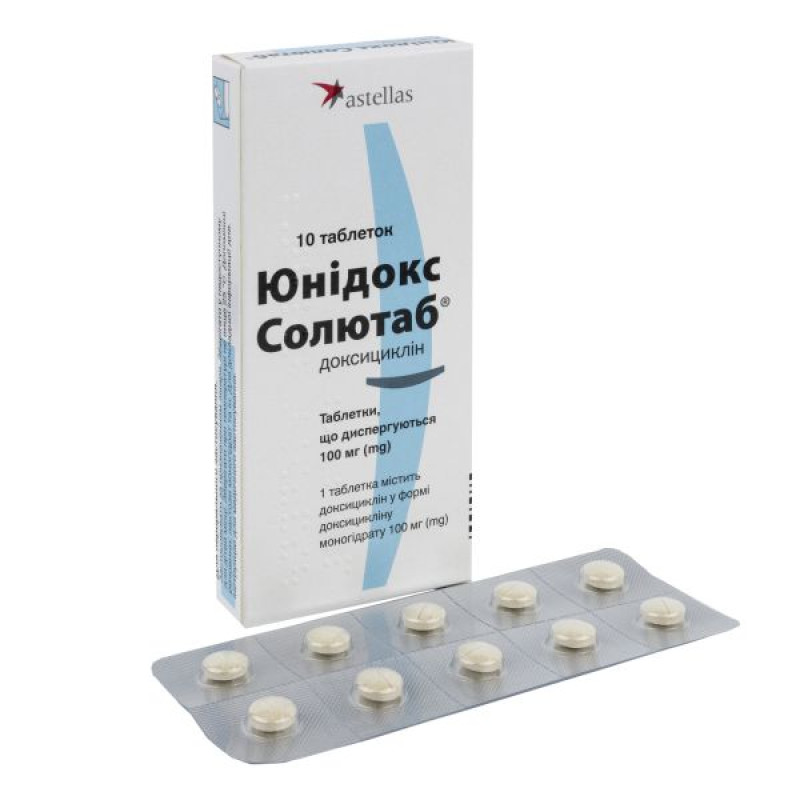
Instructions for use: Unidox Solutab dispersible tablets 100 mg blister No. 10
Composition
active ingredient: doxycycline;
1 tablet contains doxycycline in the form of doxycycline monohydrate 100 mg;
excipients: microcrystalline cellulose, saccharin, low-substituted hydroxypropylcellulose, hypromellose, colloidal anhydrous silicon dioxide, magnesium stearate, lactose monohydrate.
Dosage form
Dispersible tablets.
Main physicochemical properties: round, biconvex tablets from light yellow to gray-yellow to brown with inclusions, with an embossed inscription “173” on one side and a score on the other side.
Pharmacotherapeutic group
Antibacterials for systemic use. Tetracyclines. Doxycycline. ATX code J01A A02.
Pharmacological properties
Pharmacodynamics
Doxycycline has a bacteriostatic effect; its antimicrobial effect is realized by inhibiting protein synthesis. The drug is effective against a wide range of gram-positive and gram-negative bacteria and some other microorganisms.
Pharmacokinetics
Tetracyclines are readily absorbed and bind to plasma proteins. They are accumulated by the liver in bile and excreted in biologically active form in high concentrations in urine and feces.
Doxycycline is almost completely absorbed after oral administration. Studies show that the absorption of doxycycline differs from that of some other tetracyclines and is not affected by concomitant food intake (including milk).
After a 200 mg dose, the maximum serum concentration of doxycycline in healthy adult volunteers averaged 2.6 μg/ml after 2 hours and decreased to 1.45 μg/ml after 24 hours.
Doxycycline is a highly lipophilic substance and has a low affinity for calcium. It is highly stable in blood plasma. Doxycycline is not metabolized to the epi-anhydrous form.
Indication
Unidox Solutab® is used to treat infections caused by sensitive strains of gram-positive and gram-negative microorganisms, and some other microorganisms, namely:
Respiratory tract infections: pneumonia and other lower respiratory tract diseases caused by sensitive strains of Streptococcus pneumoniae, Haemophilus influenza, Klebsiella pneumonia, etc. Pneumonia caused by Mycoplasma pneumoniae. Treatment of chronic bronchitis, sinusitis.
Urinary tract infections: infections caused by sensitive strains of the species Klebsiella, Enterobacter, as well as Escherichia coli, Streptococcus faecalis, etc.
Sexually transmitted diseases: infections caused by Chlamydia trachomatis, including uncomplicated urethral and endocervical infections and rectal infections. Non-gonococcal urethritis caused by Ureaplasma urealyticum (T-mycoplasma). Soft chancre, inguinal granuloma, venereal granuloma. Unidox Solutab® is an alternative drug for the treatment of gonorrhea and syphilis.
Skin infections: acne if antibiotic therapy is necessary.
Since Unidox Solutab® belongs to the group of tetracycline antibiotics, it can be used for infections caused by microorganisms sensitive to tetracyclines, namely:
Ophthalmic infections: infections caused by sensitive bacteria gonococci, staphylococci and Haemophilus influenza. The infection causing trachoma is not always eliminated, which is confirmed by immunofluorescence analysis. For the treatment of paratrachoma, Unidox Solutab® can be used as monotherapy or in combination with other drugs.
Rickettsial infections: Rocky Mountain spotted fever, typhus group, Q fever, Coxiella endocarditis, tick-borne fever.
Other infections: ornithosis, brucellosis (when used in combination with streptomycin), cholera, bubonic plague, epidemic relapsing typhus; tick-borne relapsing fever; tularemia; melioidosis; tropical malaria resistant to chloroquine and acute intestinal amebiasis (when used in combination with an amebicide).
Unidox Solutab® is an alternative drug for the treatment of leptospirosis, gas gangrene, and tetanus.
Unidox Solutab® is indicated for the prevention of the following conditions: Japanese river fever, traveler's diarrhea (caused by enterotoxigenic Escherichia coli), leptospirosis, malaria. Malaria prophylaxis should be carried out in accordance with current practice due to the possibility of resistance development.
Contraindication
Hypersensitivity to doxycycline and tetracyclines or to any of the excipients of the drug. Combination of severe renal and/or hepatic insufficiency. Severe hepatic dysfunction. Pregnancy or breastfeeding. Children under 12 years of age.
Interaction with other medicinal products and other types of interactions
The absorption of doxycycline may be reduced by concomitant use of antacids containing aluminum, calcium, magnesium, or other drugs containing these cations, or by oral administration of zinc, iron, or bismuth salts. The use of doxycycline with such drugs should be separated as much as possible in time.
There have been reports of prolongation of prothrombin time in patients taking warfarin and doxycycline. Tetracyclines reduce plasma prothrombin activity, so a reduction in the dose of anticoagulants may be necessary.
The half-life of doxycycline may be reduced when administered concomitantly with barbiturates, carbamazepine and phenytoin. Therefore, an increase in the daily dose of Unidox Solutab® should be considered.
Alcohol can reduce the half-life of doxycycline.
Several cases of pregnancy and breakthrough bleeding have been reported with the concomitant use of doxycycline and oral contraceptives.
Doxycycline may increase plasma concentrations of cyclosporine. Concomitant use of these drugs should be accompanied by careful monitoring.
Fatal renal toxicity has been reported with the concomitant use of tetracyclines and methoxyflurane (see section 4.4).
Laboratory indicators.
Falsely elevated urinary catecholamine levels may occur due to interaction with the fluorescent test. Tetracyclines interfere with reactions with glucose in urine.
Application features
Cross-resistance and cross-sensitivity to other tetracycline antibiotics may occur.
Patients with impaired liver function. Tetracyclines can be hepatotoxic, especially when taken in high doses or when taken concomitantly with other hepatotoxic drugs or in the presence of pre-existing hepatic or renal insufficiency. Unidox Solutab® should be used with caution in patients with impaired liver function (see section "Contraindications"), as well as in those who are taking concomitant potentially hepatotoxic drugs. Liver function tests have been reported rarely with both oral and parenteral administration of tetracyclines, including doxycycline.
Patients with renal impairment. In patients with normal renal function, the renal excretion of doxycycline is approximately 40% per 72 hours. This figure may decrease to 1-5% per 72 hours in patients with severe renal insufficiency (creatinine clearance below 10 ml/min). Studies have shown that there is no significant difference in the serum half-life of doxycycline in patients with normal renal function and in patients with severe renal insufficiency. Hemodialysis does not affect the serum half-life of doxycycline.
The anti-anabolic effect of tetracyclines may increase blood urea levels. Studies have shown that this anti-anabolic effect does not occur when used in patients with renal insufficiency. However, worsening of azotemia may occur in patients with impaired renal function. Tetracyclines should be used with caution in patients with mild to moderate renal insufficiency under medical supervision.
Photosensitivity. This effect manifests itself as an increased reaction to sunlight and has been observed in some patients taking tetracyclines, including doxycycline. Patients who are expected to be exposed to sunlight or ultraviolet radiation should be informed of the possibility of this reaction and that treatment should be discontinued at the first appearance of erythema.
Overgrowth of microorganisms. The use of antibiotics can sometimes cause the growth of non-susceptible microorganisms, including Candida. If resistance occurs, the antibiotic should be discontinued and appropriate therapy should be instituted.
Pseudomembranous colitis has been reported in patients receiving antibacterial agents, including doxycycline. The severity of the disease has ranged from mild to life-threatening. It is important to consider the possibility of pseudomembranous colitis and staphylococcal enteritis in patients with diarrhea secondary to antibacterial therapy. Depending on the diagnosis, vancomycin and teicoplanin should be used to treat pseudomembranous colitis and cloxacillin to treat staphylococcal enteritis.
Clostridium difficile-associated diarrhea (CDAD) has been reported with the use of antibacterial agents, including doxycycline, and has ranged in severity from mild to fatal colitis. Antibacterial agents disrupt the normal intestinal flora and lead to overgrowth of C. difficile.
C. difficile produces toxins A and B, which in turn contribute to the development of CDAD.
Toxin-producing strains of C. difficile can increase morbidity and mortality because such infections are resistant to antibacterial therapy and may require colectomy. It is important to consider this diagnosis in patients with diarrhea secondary to antibacterial therapy. A careful history is necessary, as CDAD has been reported to develop as late as 2 months after completion of antibacterial therapy.
Fontanelle protrusion in neonates and benign intracranial hypertension in juveniles and adults have been reported with full therapeutic doses of tetracyclines. These conditions resolve rapidly upon discontinuation of the drug.
Porphyria: Rare reports of porphyria have been reported in patients receiving tetracyclines.
Venereal diseases. During treatment of venereal diseases, if concomitant syphilis is suspected, appropriate diagnostics should be performed, including dark-field microscopy. In such cases, serological tests should be performed monthly for at least 4 months.
Infections caused by β-hemolytic streptococci. For infections caused by group A β-hemolytic streptococci, treatment should be continued for at least 10 days.
Myasthenia gravis: Due to the possibility of mild neuromuscular blockade, the drug should be used with caution in patients with myasthenia gravis.
Systemic lupus erythematosus. The use of tetracyclines may lead to exacerbation of systemic lupus erythematosus.
Methoxyflurane: Methoxyflurane should be used with caution in combination with tetracyclines.
The use of tetracyclines may affect blood coagulation (prolongation of prothrombin time). Therefore, tetracyclines should be used with particular caution in patients with blood clotting disorders (see section "Interaction with other medicinal products and other types of interactions").
During long-term treatment, periodic laboratory monitoring of organ and system function should be performed, including hematopoietic, renal, and hepatic function. If abnormalities are detected, treatment should be discontinued.
Increased excretion of ascorbic and folic acids has been observed during treatment with tetracyclines, but this is usually of no clinical significance.
The drug contains lactose, therefore patients with rare hereditary forms of galactose intolerance, the Lapp lactase deficiency or glucose-galactose malabsorption syndrome should not use the drug.
Ability to influence reaction speed when driving vehicles or other mechanisms
The effect of doxycycline on the ability to drive or use machines has not been studied. If adverse reactions such as hypotension, tinnitus, blurred vision, scotoma, diplopia, or prolonged vision loss occur, you should refrain from driving or operating machinery.
Use during pregnancy or breastfeeding
The use of tetracyclines during the period of tooth development (during pregnancy) may cause permanent discoloration of the teeth (yellow-brown-gray). This adverse reaction is more common with long-term use, but may also occur with repeated short courses of treatment. Enamel hypoplasia has also been reported. In connection with the above, the drug is contraindicated for use during pregnancy.
Tetracyclines pass into breast milk, so the use of the drug is contraindicated during breastfeeding (see information above regarding the use of the drug during tooth development).
Method of administration and doses
Unidox Solutab® is intended for oral use only.
Add the tablet to a glass of water and stir well until evenly mixed. Drink the mixture immediately. The drug should be taken in a sitting or standing position, well before bedtime, to reduce the risk of esophagitis or esophageal ulcers. The mixture should preferably be taken with food.
The score is not intended to divide the tablet into equal doses, it is only aesthetic.
Adults. The usual dose of Unidox Solutab® for adults for the treatment of acute infections is 200 mg on the first day of treatment (as a single dose or 100 mg every 12 hours) and 100 mg per day on the following days. In the treatment of severe infections, the drug should be used at a dose of 200 mg per day throughout the entire treatment period.
Exceeding the recommended dose may lead to an increase in the frequency of adverse reactions. Therapy should be continued for 24-48 hours after the disappearance of symptoms of the disease and fever.
In case of streptococcal infections, the use of the drug should be continued for 10 days to prevent the development of rheumatic fever or glomerulonephritis.
Children. For children aged 12 years and over with a body weight of up to 45 kg, the recommended dose is 4.4 mg/kg body weight (on the first day of treatment, the recommended dose should be administered in 1 or 2 doses), on the following days the dose is 2.2 mg/kg body weight (in 1 or 2 doses); in more severe infectious diseases, up to 4.4 mg/kg body weight may be prescribed.
Children weighing more than 45 kg should be given the usual adult dose.
Use of the drug for the treatment of certain infections.
- Sexually transmitted diseases: for the treatment of diseases such as uncomplicated gonococcal infections (exception - anorectal infections in men), uncomplicated urethral and endocervical infections, rectal infections caused by Chlamydia trachomatis, non-gonococcal urethritis caused by Ureaplasma urealyticum, the recommended dose is 100 mg twice a day for 7 days.
For the treatment of acute epididymo-orchitis caused by Chlamydia trachomatis or Neisseria gonorrhea, the drug should be administered at 100 mg twice daily for 10 days.
For the treatment of primary and secondary syphilis, the recommended dose for patients without confirmed pregnancy and with a penicillin allergy is 200 mg orally twice a day for 2 weeks (as an alternative to penicillin therapy).
- Epidemic relapsing typhus, tick-borne relapsing typhus: the recommended dose of the drug is 100-200 mg once, depending on the severity of the disease.
- Tropical malaria resistant to chloroquine: the recommended dose is 200 mg per day for at least 7 days due to the potential for severe infectious disease.
A fast-acting schizonticide (e.g. quinine) should always be used as an adjunctive therapy to Unidox Solutab®, the dose of which varies depending on the case, due to the potential severe course of the infectious disease.
Malaria prevention: The recommended dose for adults is 100 mg per day. For children aged 12 years and over, the recommended dose is 2 mg/kg per day up to a total dose of 100 mg per day. Prophylaxis can be started 1-2 days before travel to a malaria-endemic area. Prophylaxis should be continued daily during travel to a malaria-endemic area and for 4 weeks after leaving the malaria-endemic area. Current standards for the treatment of malaria should also be considered.
Prevention of Japanese river fever: the recommended dose of the drug is 200 mg once.
Prevention of traveler's diarrhea in adults: The recommended dose is 200 mg on the first day of travel (administered as a single dose of 200 mg or 100 mg every 12 hours) and 100 mg daily for the following days of travel. There is no information on the use of the drug for longer than 21 days for the purpose of prevention.
Leptospirosis prevention: The recommended dose is 200 mg once a week during the entire stay in the leptospirosis-prone area and 200 mg at the end of the trip. There is no information on the use of the drug for longer than 21 days for the purpose of prevention.
Use of the drug in elderly patients: the drug can be used in normal doses without special precautions. There is no need for dose adjustment in case of impaired renal function. Unidox Solutab® may be the drug of choice for elderly patients, as its use is less associated with the development of irritation and ulcers of the esophagus.
Use of the drug in patients with impaired liver function – see the section “Special instructions for use”.
Use of the drug in patients with impaired renal function - studies have shown that the use of the drug in recommended doses does not lead to accumulation of the antibiotic in this category of patients (see the section "Peculiarities of use").
Children
The drug Unidox Solutab® is contraindicated for use in children under 12 years of age. Like other tetracyclines, Unidox Solutab® forms stable calcium complexes in any bone-forming tissue. A decrease in the growth rate of the tibia was observed in premature children who received tetracyclines orally at a dose of 25 mg/kg every 6 hours. This adverse reaction is reversible upon discontinuation of the drug. The use of tetracyclines during the period of tooth development (in children under 12 years of age) may cause a permanent change in the color of the teeth (yellow-brown-gray). This adverse reaction is more common during long-term use, but can also be observed during repeated short courses of treatment. There have also been reports of enamel hypoplasia.
Overdose
Acute antibiotic overdose is rare. Symptoms of intoxication may include liver damage, accompanied by symptoms such as vomiting, fever, jaundice, hematomas, melena, azotemia, increased transaminase levels, and increased prothrombin time.
Treatment of intoxication
Drink plenty of fluids. Induce vomiting. In case of ingestion of a large amount of the drug: gastric lavage, followed by administration of activated charcoal and an osmotic laxative (sodium sulfate).
Hemodialysis and peritoneal dialysis should not be performed because they do not affect the serum half-life of the drug and are therefore not effective in overdose.
Adverse reactions
The following adverse reactions have been observed in patients taking tetracyclines, including doxycycline.
From the nervous system. Hot flashes.
Central and peripheral nervous system: Headache. Fontanelle protrusion in neonates and benign intracranial hypertension in adolescents and adults have been reported with full therapeutic doses of tetracyclines. Benign elevated intracranial pressure has also been reported in older children and adults. Symptoms of benign intracranial hypertension may include headache, nausea, tinnitus, dizziness, blurred vision, hallucinations, scotomata, and diplopia. These symptoms are reversible and resolve within days to weeks after discontinuation of use. Long-term vision loss has been reported.
Gastrointestinal side effects. Gastrointestinal side effects are usually mild and do not require discontinuation of treatment. Abdominal pain, anorexia, decreased appetite, nausea, vomiting, diarrhea, dyspepsia, stomatitis, blackening of the tongue, rarely dysphagia. Inhibition of the growth of bacteria that synthesize vitamin B. The development of esophagitis and esophageal ulcers has been reported.
From the side of the organs of hearing and vestibular apparatus: ringing in the ears, vertigo.
Hematopoietic system: Adverse reactions such as hemolytic anemia, thrombocytopenia, neutropenia, decreased prothrombin levels, porphyria, and eosinophilia have been reported with the use of tetracyclines.
Hepatobiliary system: Hepatotoxicity with transient elevations in liver function tests, hepatitis, jaundice, hepatic failure and pancreatitis have been reported rarely.
Musculoskeletal system: Arthralgia, myalgia. Bone and tooth development may be impaired (bones become brittle and teeth irreversibly discolored).
Skin and subcutaneous tissue disorders: Rashes, including maculopapular and erythematous rashes, exfoliative dermatitis, erythema multiforme, Stevens-Johnson syndrome, toxic epidermal necrolysis, skin photosensitivity reactions, photoonycholysis.
Development of superinfection. As with all antibiotics, the use of the drug Unidox Solutab® may increase the number of insensitive microorganisms, which can cause candidiasis, glossitis, enterocolitis, staphylococcal enterocolitis, pseudomembranous colitis (with overgrowth of Clostridium difficile) and inflammatory lesions (with overgrowth of Candida bacteria) of the anogenital area, itching in the anal area. There have also been reports of the development of stomatitis and vaginitis.
Urinary system: Increased blood urea nitrogen. Increased azotemia in patients with renal failure. Tetracyclines stored after their expiration date have been associated with the development of a Fanconi-like syndrome: albuminuria, glucosuria, aminoaciduria, hypophosphatemia, hypokalemia, and renal tubular acidosis.
Other disorders. Brown-black microscopic staining of thyroid tissue has been observed with prolonged use of tetracyclines. No thyroid pathology has been identified. Tetracyclines can cause tooth discoloration and enamel hypoplasia, which has been more common with prolonged use.
Expiration date
5 years.
Storage conditions
Keep out of the reach of children. Store at a temperature not exceeding 25 ºС.
Packaging
10 tablets in a blister, 1 blister in a cardboard box.
Vacation category
According to the recipe.
Producer
Astellas Pharma Europe BV, the Netherlands.
Location of the manufacturer and its business address
Hogemaat 2, 7942 JG Meppel, the Netherlands.