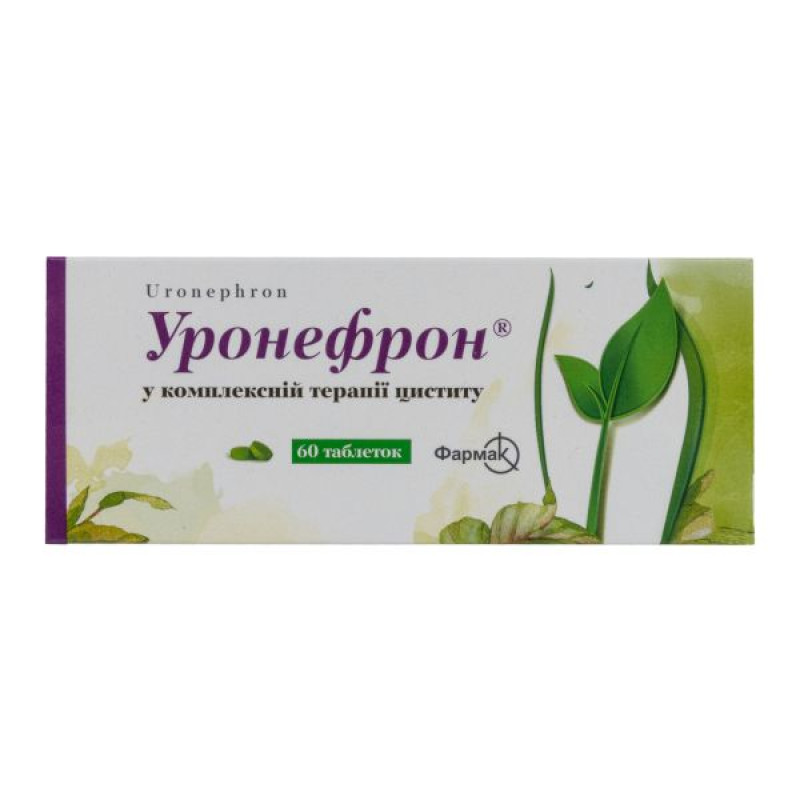
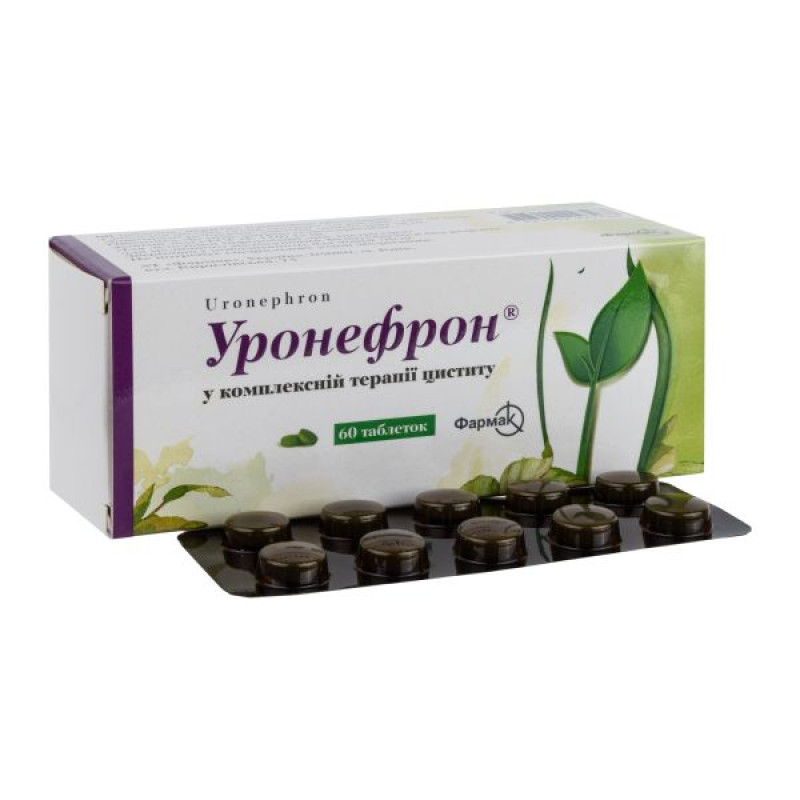
Instructions for use Uronefron film-coated tablets blister pack No. 60
Composition
active ingredients: 1 tablet contains 188 mg of dry extract from 9 plants: onion husk (Allium cepa), white birch (Betula alba), creeping wheatgrass rhizome (Agropyron repens), curly parsley root (Petroselium sativum), fenugreek seed (Trigonella foenum graecum), goldenrod (Solidago virgaurea), field horsetail (Equisetum arvense), common knotweed (Polygonum aviculare), lovage root (Levisticum officinale);
excipients: lactose monohydrate, magnesium stearate, microcrystalline cellulose, colloidal anhydrous silicon dioxide;
shell: Opadry 200 Green 200F210013 (polyvinyl alcohol, talc, macrogol, titanium dioxide (E 171), quinoline yellow (E 104), indigo carmine (E 132), methacrylic acid copolymer type C, sodium bicarbonate, sunset yellow FCF (E 110)).
Dosage form
Film-coated tablets.
Main physicochemical properties: round tablets with a biconvex surface, film-coated, dark green in color.
Pharmacotherapeutic group
Means that help dissolve urinary stones.
ATX code G04B C.
Pharmacological properties
Pharmacodynamics
Uronefron® is a combined preparation of plant origin. It has anti-inflammatory, diuretic, antispasmodic and antimicrobial effects. The diuretic effect is due to flavone derivatives, inositol, saponins and silicates. The latter also enhance the excretion of uric acid in case of urate deposits in the kidneys. The preparation prevents the crystallization of mineral components in the urinary tract, has a beneficial effect on maintaining the balance between colloids and crystalloids of urine. Saponins reduce surface tension, form protective colloids and emulsify pathogenic components of urine, prevent the formation of sand and stones in the kidneys. Promotes the washing out of sand and small concrements, prevents the enlargement of concrements and the appearance of new ones. The effect of Uronefron on the tubular and glomerular system of the kidneys leads to a decrease in protein excretion in proteinuria.
Onion husk contains essential oil (up to 0.15%), vitamin C, riboflavin, thiamine, carotenoids, phytic, citric and malic acids, sugars (glucose, fructose, sucrose), flavonoids, potassium, iron, manganese, zinc and cobalt compounds. It has an anti-inflammatory effect.
Creeping wheatgrass. The rhizome contains polysaccharides, sugars, alcohols, glycosides, vitamins, essential and fatty oils, organic acids. The main action is diuretic, regulating metabolism.
Birch leaves contain essential oils, saponins, tannins, resins, ascorbic and nicotinic acids. The main action is diuretic, choleretic, antispasmodic, and anti-inflammatory.
The seeds of the senna plant contain trigonelline, nicotinic acid, rutin, steroidal saponins and phytosterols, flavonoids, essential oils. The main effect is anti-inflammatory, tonic, and wound healing.
Curly parsley roots contain aponyl, myristicin, and flavonoids. The main action is diuretic, anti-inflammatory, and litholytic.
Common goldenrod herb contains flavonoids: kaempferol, quercetin and their glycosides – astragalin, rutin. The main action is diuretic, antibacterial, anti-inflammatory.
Horsetail contains flavonoids: derivatives of apigenin, luteolin, kaempferol, quercetin, also contains phenolcarboxylic acids, tannins, saponins. The main action is diuretic, anti-inflammatory, litholytic, detoxification.
Common knotweed herb contains flavonoids, phenolic acids, carotene, ascorbic acid, and tannins. The main action is diuretic and hemostatic.
Lovage officinalis. The aerial mass and roots of lovage contain essential oil (in fresh roots – 0.1-0.2%, in dry – 0.6-1.0%), sugars, organic acids, minerals, resins, starch. The composition of the essential oil includes terpineol, cineole, acetic, isovaleric and benzoic acids. The main action is diuretic, anti-inflammatory.
The components that make up the herbal medicine Uronefron® exhibit complex activity, which is manifested in anti-inflammatory action and elimination of spasm of the urinary tract, diuretic, vasodilating effects, and also determine the effectiveness of the antimicrobial action of the drug.
Pharmacokinetics
Not studied.
Indication
In the complex therapy of infectious and inflammatory diseases of the urinary system:
- acute and chronic cystitis;
- acute and chronic pyelonephritis;
- chronic urethritis;
- chronic prostatitis.
Treatment and prevention of urolithiasis, including after surgical removal of urinary stones.
Contraindication
Increased individual sensitivity to the components of the drug, acute glomerulonephritis, acute interstitial nephritis, nephrosis, phosphate lithiasis, renal and heart failure. Urinary tract obstruction. Conditions accompanied by increased blood clotting.
Interaction with other medicinal products and other types of interactions
Reduces the absorption of beta-carotene, alpha-tocopherol, and cholesterol in the small intestine.
Application features
When using the drug, glycemic control is necessary in patients with diabetes due to the possible hypoglycemic effect of fenugreek.
If you experience pain, difficulty urinating, blood in the urine, worsening symptoms, or a fever, you should seek immediate medical attention.
It is recommended to drink plenty of fluids while using the drug.
The drug should not be used in case of edema caused by heart or kidney failure.
If you have been told by your doctor that you have an intolerance to some sugars, contact your doctor before taking this medicinal product, as it contains lactose monohydrate.
Use during pregnancy or breastfeeding
It is not recommended to take the drug during pregnancy or breastfeeding.
Ability to influence reaction speed when driving vehicles or other mechanisms
If dizziness occurs during treatment with the drug, you should refrain from driving vehicles and operating machinery.
Method of administration and doses
It is used internally for adults. Take 1 tablet 3-4 times a day after meals.
The course of treatment is from 2 to 6 weeks. The duration of the course of treatment is determined by the doctor. If necessary, the course of treatment can be repeated.
Children
There is no experience with the use of the drug in children (under 18 years of age), therefore it should not be prescribed to patients in this age category.
Overdose
In case of overdose, the manifestations of adverse reactions may be increased.
Treatment is symptomatic.
Adverse reactions
Allergic reactions are possible (rash, hives, itching, allergic rhinitis).
With increased sensitivity to ultraviolet rays, photosensitization is possible, in some cases - gastrointestinal disorders, nausea, taste disturbances, vomiting, diarrhea, bloating, renal colic, dizziness.
Expiration date
2 years.
Do not use the drug after the expiration date indicated on the package.
Storage conditions
Does not require special storage conditions. Keep out of the reach of children.
Packaging
10 tablets in a blister. 3 or 6 blisters in a pack.
Vacation category
Without a prescription.
Producer
PJSC "Farmak".
Location of the manufacturer and its business address
Ukraine, 04080, Kyiv, Frunze St., 74.