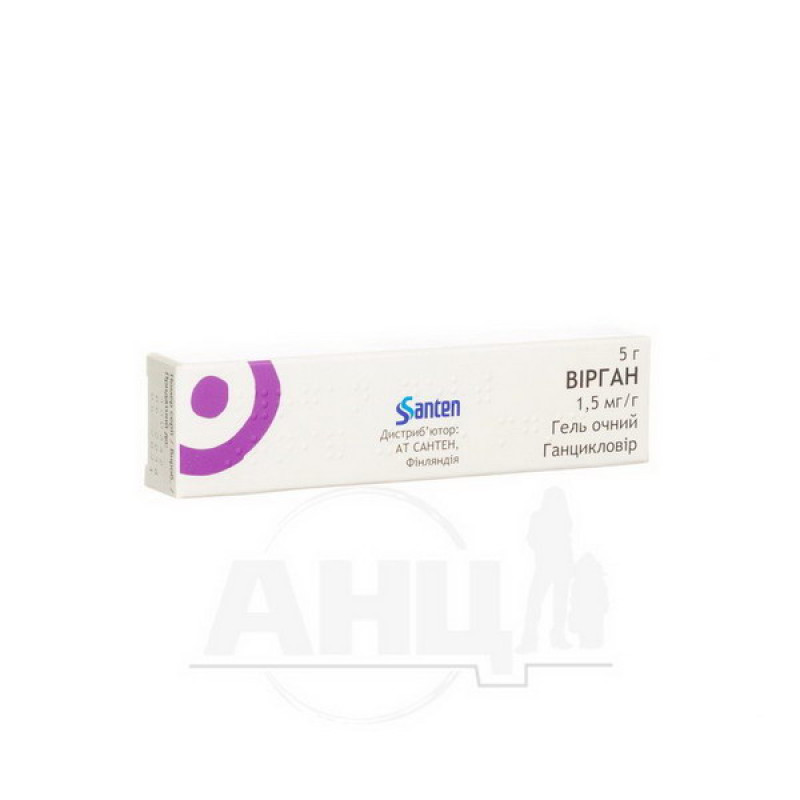
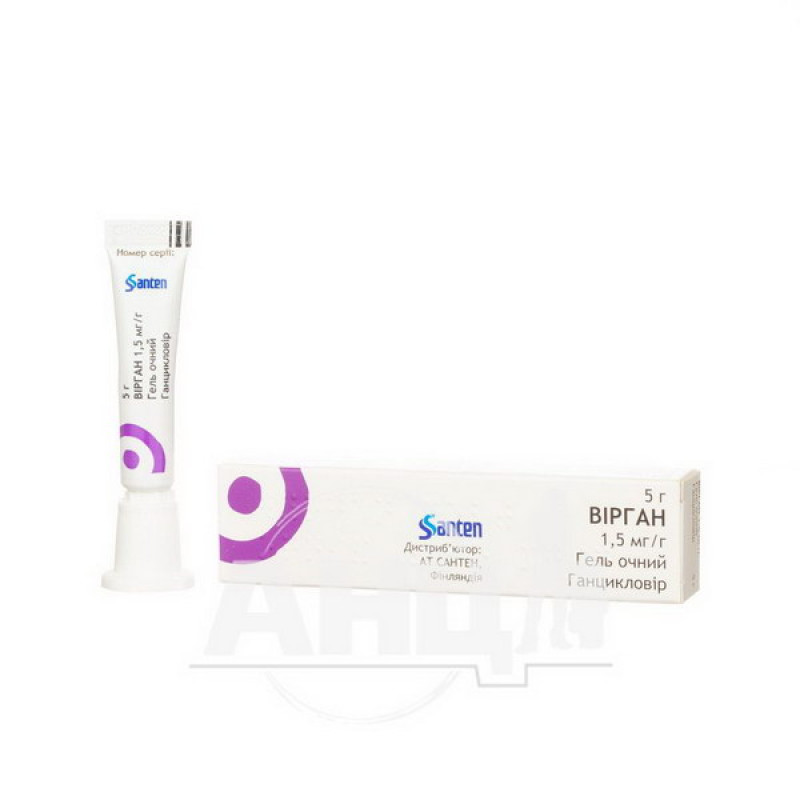
Instructions for Virgan eye gel 1.5 mg/g tube 5 g
Composition
active ingredient: ganciclovir;
1 g of gel contains ganciclovir 1.5 mg;
Excipients: benzalkonium chloride, carbomer, sorbitol (E 420), sodium hydroxide, purified water.
Dosage form
Eye gel.
Main physicochemical properties: colorless gel.
Pharmacotherapeutic group
Drugs used in ophthalmology. Antiviral drugs. Ganciclovir. ATX code S01A D09.
Pharmacological properties
Pharmacodynamics.
Ganciclovir, 9-[(1,3-dihydroxy-2-propoxy)]guanine, or DHPG, is a nucleoside that inhibits in vitro replication of human herpesviruses (Herpes simplex types 1 and 2, cytomegalovirus) and adenoviruses serotypes 1, 2, 4, 6, 8, 10, 19, 22, 28.
In infected cells, ganciclovir is converted to ganciclovir triphosphate, the active form of the active substance.
Phosphorylation occurs predominantly in infected cells, with ganciclovir triphosphate concentrations being 10-fold lower in uninfected cells.
The antiviral activity of ganciclovir triphosphate consists in inhibiting viral DNA synthesis using two mechanisms: competitive inhibition of viral DNA polymerases and direct incorporation into viral DNA, which blocks its elongation.
Pharmacokinetics.
In humans, after instillation of the drug into the eyes 5 times a day for 11-15 days for the treatment of superficial herpetic keratitis, its levels in blood plasma, determined using a sensitive analytical method (limit of quantification - 0.005 μg/ml), were very low: an average of 0.013 μg/ml (0-0.037 μg/ml).
Ophthalmic pharmacokinetic studies in rabbits confirmed rapid and extensive penetration of ganciclovir into the cornea and anterior segment of the eye, with concentrations higher than the median effective dose (ED50) maintained for several hours.
Indication
Treatment of acute superficial keratitis caused by the herpes simplex virus.
Contraindication
Hypersensitivity to ganciclovir, acyclovir or any component of the drug.
Interaction with other medicinal products and other types of interactions
When used with any other ophthalmic drugs, it is recommended to wait at least 15 minutes between the two medications. Virgan should be used last.
Although the amount of ganciclovir that enters the systemic circulation after intraocular administration is negligible, the risk of drug-drug interactions cannot be excluded.
The interactions listed below have been observed with systemic use of ganciclovir.
The binding of ganciclovir to plasma proteins is about 1–2%, so interactions with drugs that involve displacement from the active site are unlikely.
In the case of concomitant administration of drugs that inhibit replication in rapidly dividing cell populations such as bone marrow, spermatogonial cells, skin germ layers and gastrointestinal mucosa, a combined additive toxic effect is possible when they are used simultaneously, before or after ganciclovir. Because of the potential for additive toxicity with drugs such as dapsone, pentamidine, flucystis zoster, vincristine, vinblastine, adriamycin, amphotericin B, trimethoprim/sulfanilamide combinations or other nucleoside analogues, concomitant use of ganciclovir drugs is possible only if the potential benefit outweighs the risks.
Because zidovudine, like ganciclovir, can cause neutropenia, concomitant use of these drugs during ganciclovir induction therapy is not recommended. Studies have shown that concomitant use of maintenance doses of ganciclovir and zidovudine at recommended doses causes severe neutropenia in the majority of patients.
Cases of generalized seizures have been observed in patients receiving ganciclovir and imipenem-cilastatin concomitantly.
It is also possible that probenecid, like other drugs that inhibit renal tubular secretion or reabsorption, may reduce the renal clearance of ganciclovir and increase its plasma half-life.
Application features
This medicine is not intended for the treatment of cytomegalovirus (CMV) infection of the retina.
Efficacy against keratoconjunctivitis caused by other types of viruses has not been established.
No specific clinical studies have been conducted in patients with immunodeficiency states.
Benzalkonium chloride may cause eye irritation. It is known that the drug may discolor soft contact lenses, so contact with soft contact lenses should be avoided. Contact lenses should be removed before using the drug and reinserted no earlier than 15 minutes after instillation.
Use during pregnancy and breastfeeding
In animal studies, ganciclovir has been shown to be teratogenic and to impair fertility (ability to conceive and reproduce) following oral or intravenous administration. In addition, ganciclovir has shown potential genotoxicity with a low safety profile.
Therefore, the use of this medicinal product during pregnancy or breastfeeding is not recommended, unless there are no alternative treatments.
Women of reproductive age should use contraception during treatment with Virgan.
Due to genotoxicity identified in animal studies, men using Virgan are advised to use contraception (condom) during treatment and for three months after its completion.
Ability to influence reaction speed when driving vehicles or other mechanisms
It is necessary to refrain from driving a car or operating other mechanisms in case of any visual impairment during treatment.
Method of administration and doses
The drug is instilled into the lower conjunctival sac of the affected eye.
1 drop 5 times a day until complete corneal re-epithelialization, then 1 drop 3 times a day for 7 days. The duration of treatment usually does not exceed 21 days.
Children
The use of the drug in children under 18 years of age is not recommended, as special studies have not been conducted.
Overdose
Not detected.
Side effects
Visual impairment
Very common:
Temporary burning or tingling sensation, eye irritation, blurred vision.
Frequent:
Superficial punctate keratitis, conjunctival hyperemia.
Allergic reactions, visual disturbances, and eye irritation have been reported.
Notification of possible adverse reactions
Reporting of suspected adverse reactions after the marketing authorisation of a medicinal product is essential. This allows for continuous monitoring of the risk/benefit balance of the medicinal product. Any suspected adverse reactions should be reported to qualified healthcare professionals.
Information should be sent to the following address: info@regata.in.ua or by phone: (044) 467-57-70 (24 hours a day), 585-04-60.
Expiration date
3 years.
The shelf life after opening the tube is 4 weeks.
Storage conditions
Store at a temperature not exceeding 25 ° C. Keep out of the reach of children.
Packaging
5 g in a tube with a screw-on tip, 1 tube in a cardboard box.
Vacation category
According to the recipe.
Producer
Farmila - Thea Farmaceutici S.p.A. / Farmila - Thea Farmaceutici S.p.A.
Location of the manufacturer and its business address
Via Enrico Fermi 50, Settimo Milanese, 20019, Italy.
Applicant
THEA LABORATORY / LABORATOIRES THEA
Location of the applicant and/or applicant's representative
12 rue Louis Bleriot 63100 Clermont-Ferrand Cedex 2, France / 12 rue Louis Bleriot 63100 Clermont-Ferrand Cedex 2, France.