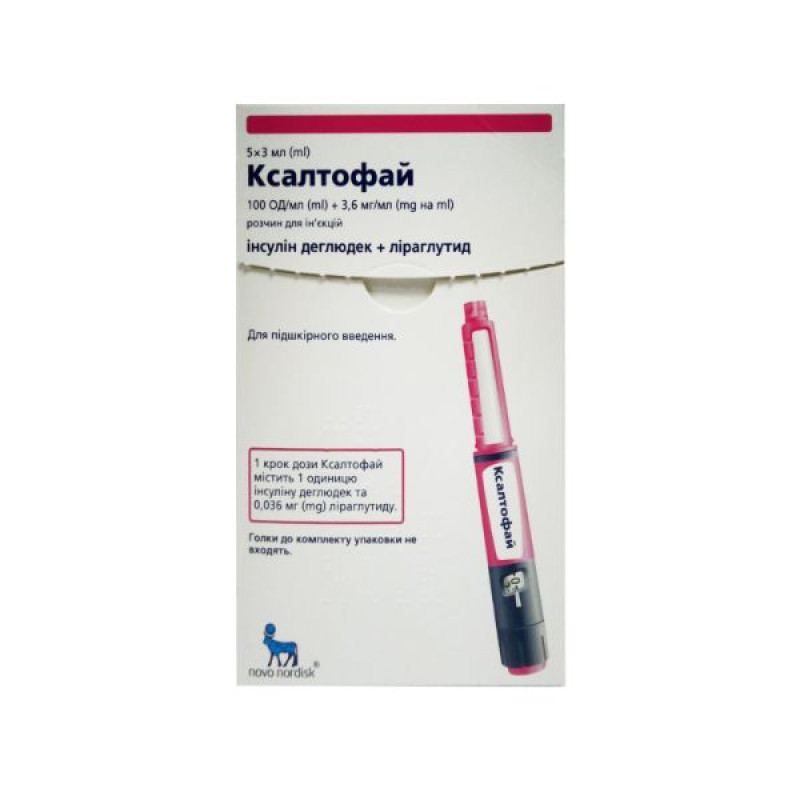
Instructions for use Xaltofay solution for injection 100 IU/ml + 3.6mg 3 ml cartridge in syringe pen No. 5
Composition
active ingredients: insulin degludec, liraglutide;
1 ml of solution contains 100 U of insulin degludec* and 3.6 mg of liraglutide*.
1 pre-filled pen contains 3 ml, equivalent to 300 U of insulin degludec and 10.8 mg of liraglutide;
Excipients: glycerin, phenol, zinc acetate, hydrochloric acid (for pH adjustment), sodium hydroxide (for pH adjustment), water for injections.
* - Produced by recombinant DNA technology in Saccharomyces cerevisiae.
Dosage form
Solution for injection.
Main physicochemical properties: transparent, colorless, isotonic solution.
Pharmacotherapeutic group
Drugs used in diabetes. Insulins and long-acting analogues for injection.
ATX code A10A E56.
Pharmacological properties
Pharmacodynamics
Mechanism of action
Xaltophagy is a combination medicine consisting of insulin degludec and liraglutide, whose mechanisms of action complement each other, improving glycemic control.
Insulin degludec is a basal insulin that forms a soluble multihexamer after subcutaneous injection. This results in a depot from which insulin degludec is continuously and slowly absorbed into the bloodstream, resulting in a smooth and sustained blood glucose-lowering effect with low daily variability in insulin action.
Insulin degludec specifically binds to the human insulin receptor, providing the same pharmacological effect as human insulin.
The blood sugar-lowering effect of insulin degludec is to promote glucose absorption after insulin binds to receptors in muscle and fat cells, as well as to simultaneously inhibit glucose release from the liver.
Liraglutide is an analogue of glucagon-like peptide-1 (GLP-1) with an amino acid sequence that is 97% homologous to human GLP-1, it binds to and activates the GLP-1 receptor (GLP-1R). The prolonged action of subcutaneously administered liraglutide is due to three mechanisms: self-association, which slows absorption, binding to blood albumin, and increased resistance to the enzymes dipeptidyl peptidase 4 (DPP-4) and neutral endopeptidase (NEP), which provides a long half-life of the drug from plasma.
Liraglutide acts through its specific interaction with GLP-1 receptors and contributes to improved glycemic control by reducing fasting and postprandial blood glucose levels. Liraglutide stimulates insulin secretion and reduces excessive glucagon secretion in a glucose-dependent manner. Thus, when blood glucose levels are high, insulin secretion is stimulated and glucagon secretion is suppressed. Conversely, in hypoglycemia, liraglutide attenuates insulin secretion and does not inhibit glucagon secretion. In addition, the mechanism of blood glucose reduction is also due to a slight delay in gastric emptying. Liraglutide reduces body weight and reduces adipose tissue mass through mechanisms that include a decrease in hunger and a decrease in energy expenditure.
GLP-1 is a physiological regulator of appetite and food intake, but the exact mechanism of its action is not yet fully understood. In animal studies, peripheral administration of liraglutide resulted in the uptake of the drug by specific brain regions involved in appetite regulation, in which liraglutide, through specific activation of GLP-1R, enhanced satiety signals and attenuated hunger signals, thereby causing a decrease in body weight.
GLP-1 receptors are also expressed in specific areas of the heart, blood vessels, immune system and kidneys. In experimental models of atherosclerosis in mice, liraglutide prevented further development of aortic plaque and reduced the degree of inflammation in the plaque. In addition, liraglutide had a beneficial effect on plasma lipids. Liraglutide did not reduce the size of existing plaques.
Pharmacodynamic effects
Xaltophagy has a stable pharmacodynamic profile with a prolonged duration of action resulting from the combined action of insulin degludec and liraglutide, allowing Xaltophagy to be administered once daily at any time of day, regardless of mealtime. Xaltophagy improves glycemic control by consistently reducing fasting and postprandial blood glucose levels.
The reduction in postprandial glucose was confirmed in a 4-hour follow-up study after a standardized meal in patients inadequately controlled on metformin alone or in combination with pioglitazone. Xaltofay produced a greater reduction in postprandial plasma glucose (mean 4-hour) than insulin degludec. The results were similar for Xaltofay and liraglutide.
The safety and efficacy of Xaltofay were evaluated in 6 randomised, controlled, phase 3 parallel-group studies in different populations of patients with type 2 diabetes, depending on their previous antidiabetic therapy. The comparator therapies included basal insulin, GLP-1 receptor agonists, placebo and basal-bolus regimens. The trials lasted 26 weeks, with 199 to 833 patients randomised to Xaltofay. One study was further extended to 52 weeks. In all studies, the starting dose of the drug was determined according to the instructions for use; and the dose of Xaltofay was titrated twice weekly (see Table 1). The same dose titration algorithm was used for the comparators - basal insulins. In 5 studies, Xaltofay demonstrated clinically and statistically significant improvements in glycemic control versus comparators in glycosylated hemoglobin A1c (HbA1c), while one study demonstrated similar reductions in HbA1c in both treatment groups.
Table 1. Dose titration of Xaltofay.
Plasma glucose level before breakfast*,
Dose adjustment (twice a week)
Xaltophagy (dose steps)
mmol/l
mg/dL
< 4.0
< 72
˗2
4.0-5.0
72-90
0
> 5.0
> 90
+2
* - Self-measured glucose levels. In the study of Xaltofay added to sulfonylureas, the target level was 4.0–6.0 mmol/L.
Glycemic control
Addition to oral hypoglycemic drugs.
The addition of Xaltofay to metformin or to the combination of metformin and pioglitazone in a 26-week, randomised, open-label controlled trial enabled 60.4% of patients treated with Xaltofay to achieve a target HbA1c < 7% without a confirmed episode of hypoglycaemia after 26 weeks of treatment. This proportion was significantly higher than with insulin degludec (40.9%; odds ratio (OR): 2.28; p < 0.0001) and similar to that of liraglutide (57.7%; OR: 1.13; p = 0.3184).
The key results of the study are presented in Table 2.
The incidence of confirmed hypoglycemia was lower with Xaltophagy than with insulin degludec, regardless of the degree of glycemic control.
The incidence of severe hypoglycemia (defined as an episode requiring assistance from another person) per patient-year of exposure (percentage of patients) was 0.01 (2 of 825 patients) with Xaltofay, 0.01 (2 of 412 patients) with insulin degludec, and 0.00 (none of 412 patients) with liraglutide. The incidence of nocturnal hypoglycemia was similar between Xaltofay and insulin degludec.
In general, patients taking Xaltofay had fewer gastrointestinal side effects than those taking liraglutide. This may be due to the slower dose escalation of liraglutide as a component of Xaltofay during the initiation period compared to liraglutide monotherapy.
The efficacy and safety of Xaltofay remained stable through 52 weeks of treatment. The reduction in HbA1c from baseline to week 52 was 1.84% with Xaltofay, with an estimated treatment difference of 0.65% compared to liraglutide (p < 0.0001) and 0.46% compared to insulin degludec (p < 0.0001). Body weight decreased by 0.4 kg with an estimated treatment difference of 2.80 kg between Xaltofay and insulin degludec (p < 0.0001), and the rate of confirmed hypoglycemia remained at 1.8 events per patient-year of exposure, indicating a significant reduction in the overall risk of confirmed hypoglycemia compared to insulin degludec.
The use of Xaltofay in combination with a sulfonylurea or with a combination of a sulfonylurea and metformin was studied in a randomized, placebo-controlled, double-blind study of 26 weeks duration.
The key results of the study are presented in Table 2.
The incidence of severe hypoglycemia per patient-year of exposure (percentage of patients) was 0.02 (2 of 288 patients) with Xaltofay and 0.00 (none of 146 patients) with placebo.
Table 2. Results after 26 weeks. Addition to oral hypoglycemic drugs.
Add-on to metformin ± pioglitazone
Addition to sulfonylurea ± metformin
Xaltofay
Insulin degludec
Liraglutide
Xaltofay
Placebo
N
833
413
414
289
146
HbA1c, %
Start → end of study
Average change
Calculated difference
8.3→6.4
˗ 1.91
8.3→6.9
˗ 1.44
˗ 0.47AB
[˗ 0.58; ˗ 0.36]
8.3→7.0
˗ 1.28
˗ 0.64AB
[˗ 0.75; ˗ 0.53]
7.9→6.4
˗ 1.45
7.9→7.4
˗ 0.46
˗ 1.02AB
[˗ 1.18; ˗ 0.87]
Patients (%) who achieved HbA1c < 7%
All patients
Calculated odds ratio
80.6
65.1
2.38B
[1.78; 3.18]
60.4
3.26B
[2.45; 4.33]
79.2
28.8
11.95B
Patients (%) who achieved HbA1c £ 6.5%
All patients
Calculated odds ratio
69.7
47.5
2.82B
[2.17; 3.67]
41.1
3.98B
[3.05; 5.18]
64.0
12.3
16.36B
[9.05; 29.56]
Incidence of confirmed hypoglycemia* per patient-year of exposure (%)
Calculated ratio
1.80 (31.9%)
2.57 (38.6%)
0.68AC
[0.53; 0.87]
0.22 (6.8%)
7.61B
[5.17; 11.21]
3.52 (41.7%)
1.35 (17.1%)
3.74B [2.28; 6.13]
Body weight, kg
Start → end of study
Average change
Calculated difference
87.2→86.7
˗ 0.5
87.4→89.0
1.6
˗ 2.22AB
[˗ 2.64; ˗ 1.80]
87.4→84.4
˗ 3.0
2.44B
[2.02; 2.86]
87.2→87.7
0.5
89.3→88.3
˗ 1.0
1.48B [0.90; 2.06]
GPN, mmol/l
Start → end of study
Average change
Calculated difference
9.2→5.6
˗ 3.62
9.4→5.8
˗ 3.61
˗ 0.17
[˗ 0.41; 0.07]
9.0→7.3
˗ 1.75
˗ 1.76B
[˗ 2.0; ˗ 1.53]
9.1→6.5
˗ 2.60
9.1→8.8
˗ 0.31
- 2.30B
[˗ 2.72; ˗ 1.89]
Dose at the end of the study
Insulin degludec, units
Liraglutide, mg
Calculated difference, insulin degludec dose
38
1.4
53
-
˗ 14.90AB
[˗ 17.14;
˗ 12.66]
-
1.8
28
1.0
-
-
The values recorded before the start, at the end of treatment and their change. The last recorded values are carried forward. The 95% confidence interval is indicated in square brackets ([ ]).
* - Confirmed hypoglycemia is defined as severe hypoglycemia (an episode requiring assistance from another person) and/or mild hypoglycemia (plasma glucose level < 3.1 mmol/L, regardless of symptoms).
A - Endpoints with confirmed superiority of Xaltofay compared to the comparator;
B - p < 0.0001;
C - p < 0.05.
FPG – fasting plasma glucose level.
Switching from GLP-1 receptor agonist therapy
A 26-week, randomized, open-label study examined switching from GLP-1 receptor agonist therapy to Xaltofa compared with unchanged GLP-1 receptor agonist therapy (dosage according to the instructions for medical use) in patients with type 2 diabetes inadequately controlled on a GLP-1 receptor agonist and metformin (74.2%) or its combination with pioglitazone (2.5%), a sulfonylurea (21.2%), or both (2.1%).
The key results of the study are presented in Table 3.
The incidence of severe hypoglycemia per patient-year of exposure (percentage of patients) was 0.01 (1 out of 291 patients) with Xaltofay and 0.00 (none out of 199 patients) with GLP-1 receptor agonists.
Table 3. Results after 26 weeks. Switching from GLP-1 receptor agonist therapy.
Switching from GLP-1 receptor agonist therapy
Xaltofay
GLP-1 receptor agonist
N
292
146
HbA1c, %
Start → end of study
Average change
Calculated difference
7.8→6.4
˗1.3
7.7→7.4
˗0.3
˗0.94AB[˗1.11; ˗0.78]
Patients (%) who achieved HbA1c < 7%
All patients
Calculated odds ratio
75.3
35.6
6.84B [4.28; 10.94]
Patients (%) who achieved HbA1c £ 6.5%
All patients
Calculated odds ratio
63.0
22.6
7.53B [4.58; 12.38]
Incidence of confirmed hypoglycemia* per patient-year of exposure (%)
Calculated ratio
2.82 (32.0%)
0.12 (2.8%)
25.36B [10.63; 60.51]
Body weight, kg
Start → end of study
Average change
Calculated difference
95.6→97.5
2.0
95.5→94.7
˗0.8
2.89B [2.17; 3.62]
GPN, mmol/l
Start → end of study
Average change
Calculated difference
9.0→6.0
˗2.98
9.4→8.8
˗0.60
˗2.64B [˗3.03; ˗2.25]
Dose at the end of the study
The dose of GLP-1 receptor agonist was to remain unchanged from the start of the study.
Insulin degludec, units
Liraglutide, mg
43
1.6
Calculated difference, insulin degludec dose
The values recorded before the start, at the end of treatment and their change. The last recorded values are carried forward. The 95% confidence interval is indicated in square brackets ([ ]).
* Confirmed hypoglycemia is defined as severe hypoglycemia (an episode requiring assistance from another person) and/or mild hypoglycemia (plasma glucose level < 3.1 mmol/L, regardless of symptoms).
A - Endpoints with confirmed superiority of Xaltofay over the comparator; B p < 0.001.
Transition from basal insulin therapy
A 26-week study examined switching from insulin glargine (100 U/mL) to Xaltophagy versus intensification of insulin glargine in patients inadequately controlled on insulin glargine (20–50 units) and metformin. The maximum dose of Xaltophagy used in this study was 50 dose steps, and the maximum dose of insulin glargine was not defined. 54.3% of patients receiving Xaltophagy achieved the target HbA1c < 7% without confirmed hypoglycemic episodes, compared with 29.4% of patients receiving insulin glargine (odds ratio: 3.24; p < 0.001).
The incidence of severe hypoglycemia per patient-year of exposure (percentage of patients) was 0.00 (none of 278 patients) with Xaltofay and 0.01 (1 of 279 patients) with insulin glargine. The incidence of nocturnal hypoglycemia was significantly lower with Xaltofay compared to insulin glargine (estimated treatment-adjusted ratio: 0.17; p < 0.001).
The second study, a 26-week, randomized, double-blind study, examined switching from basal insulin to Xaltofay or insulin degludec in patients inadequately controlled on basal insulin (20–40 units) and metformin alone or in combination with a sulfonylurea/glinide. Basal insulin and sulfonylurea/glinide were discontinued at randomization. The maximum dose allowed was 50 dose steps for Xaltofay and 50 units for insulin degludec. 48.7% of patients treated with Xaltofay achieved a target HbA1c of <7% without documented hypoglycemic episodes. This proportion was significantly higher than with insulin degludec (15.6%; odds ratio: 5.57; p < 0.0001).
The incidence of severe hypoglycemia per patient-year of exposure (percentage of patients) was 0.01 (1 of 199 patients) with Xaltofay and 0.00 (none of 199 patients) with insulin degludec. The incidence of nocturnal hypoglycemia was similar between Xaltofay and insulin degludec.
Table 4. Results after 26 weeks. Transition from basal insulin therapy.
Switching from insulin glargine therapy (100 U/mL)
Switching from basal insulin therapy [NPH insulin (neutral protamine Hagedorn), insulin detemir, insulin glargine]
Xaltofay
Insulin glargine, without dose limitation
Xaltofay
Insulin degludec, maximum allowed dose – 50 units
N
278
279
199
199
HbA1c, %
Start → end of study
Average change
Calculated difference
8.4→6.6
˗1.81
8.2→7.1
-1.13
-0.59AB [-0.74; -0.45]
8.7→6.9
-1.90
8.8→8.0
-0.89
-1.05AB [-1.25; -0.84]
Patients (%) who achieved HbA1c < 7%
All patients
Calculated odds ratio
71.6
47.0
3.45B [2.36; 5.05]
60.3
23.1
5.44B [3.42; 8.66]
Patients (%) who achieved HbA1c ≤ 6.5%
All patients
Calculated odds ratio
55.4
30.8
3.29B [2.27; 4.75]
45.2
13.1
5.66B [3.37; 9.51]
Incidence of confirmed hypoglycemia* per patient-year of exposure (%)
Calculated ratio
2.23 (28.4%)
5.05 (49.1%)
0.43AB [0.30; 0.61]
1.53 (24.1%)
2.63 (24.6%)
0.66 [0.39; 1.13]
Body weight, kg
Start → end of study
Average change
Calculated difference
88.3→86.9
-1.4
87.3→89.1
1.8
-3.20AB [-3.77; -2.64]
95.4→92.7
-2.7
93.5→93.5
0.0
-2.51B [-3.21; -1.82]
GPN, mmol/l
Start → end of study
Average change
Calculated difference
8.9→6.1
-2.83
8.9→6.1
-2.77
-0.01 [-0.35; 0.33]
9.7→6.2
-3.46
9.6→7.0
-2.58
-0.73C [-1.19; -0.27]
Dose at the end of the study
Insulin, units
Liraglutide, mg
Calculated difference, basal insulin dose
41
1.5
66D
-
-25.47B [-28.90; 22.05]
45
1.7
45
-
-0.02 [-1.88; 1.84]
The values recorded before the start, at the end of treatment and their change. The last recorded values are carried forward. The 95% confidence interval is indicated in square brackets ([ ]).
* - Confirmed hypoglycemia is defined as severe hypoglycemia (an episode requiring assistance from another person) and/or mild hypoglycemia (plasma glucose level < 3.1 mmol/L, regardless of symptoms).
A - Endpoints with confirmed superiority of Xaltofay compared to the comparator;
B - p < 0.0001; C p < 0.05;
Results of a 26-week study comparing Xaltophagy with a basal-bolus insulin regimen consisting of basal insulin (insulin glargine 100 U/mL) plus bolus insulin (insulin aspart) in patients with type 2 diabetes inadequately controlled on insulin glargine and metformin showed similar reductions in HbA1c in both treatment groups (mean from 8.2% to 6.7%). In both groups, 66-67% of patients achieved an HbA1c < 7%. Compared to baseline, there was a mean weight loss of 0.9 kg with Xaltofay and a gain of 2.6 kg in patients receiving basal-bolus insulin therapy, with an estimated treatment difference of ₋3.57 kg (95% confidence interval: ₋4.19; ₋2.95). The percentage of patients experiencing severe hypoglycemia or confirmed symptomatic hypoglycemia was 19.8% in the Xaltofay group and 52.6% in the basal-bolus insulin therapy group, with an estimated rate ratio of 0.11 (95% CI: 0.08-0.17). The total daily insulin dose at the end of the study was 40 units in patients using Xaltofay and 84 units (52 units of basal insulin and 32 units of bolus insulin) ⸻ in patients receiving basal-bolus insulin therapy.
Cardiovascular safety
Studies on the cardiovascular effects of Xaltofay have not been conducted.
Liraglutide
The Cardiovascular Outcomes and Effects of Liraglutide in Diabetes Study was a multicenter, placebo-controlled, double-blind clinical trial. 9340 patients were randomized to liraglutide (4668 patients) or placebo (4672 patients), both added to standard therapy that affected HbA1c and cardiovascular (CV) risk factors. Information on the primary outcome or health status at the end of the study was obtained for 99.7% and 99.6% of the study participants randomized to liraglutide or placebo, respectively. The duration of the follow-up period was at least 3.5 years and at most 5 years. The study cohort included patients ≥ 65 years of age (n = 4329) and ≥ 75 years of age (n = 836) and patients with mild (n = 3907), moderate (n = 1934), or severe (n = 224) renal impairment. The mean age of the patients was 64 years and the mean BMI (body mass index) was ⸻ 32.5 kg/m². The mean duration of diabetes was 12.8 years.
The primary endpoint of the study was the time from randomization to the first occurrence of a serious adverse cardiovascular event (SACE), namely: death from CV disease, non-fatal myocardial infarction, or non-fatal stroke. Liraglutide was superior to placebo in preventing SACE.
Liraglutide compared with placebo when added to standard therapy resulted in a reduction in HbA1c from baseline to month 36 of treatment [-1.16% vs. 0.77%; estimated treatment difference -0.40% (-0.45; -0.34)].
Insulin degludec
The DEVOTE study was a 2-year, randomized, double-blind, event-based clinical trial to compare the cardiovascular safety of insulin degludec and insulin glargine (100 U/mL) in 7,637 patients with type 2 diabetes at high risk for cardiovascular events.
The primary endpoint of the study was the time from randomization to the first occurrence of any of three major adverse cardiovascular events (MACEs), defined as cardiovascular death, nonfatal myocardial infarction, or nonfatal stroke. This study was designed to demonstrate no greater risk of MACEs with insulin degludec compared with insulin glargine, using a prespecified hazard ratio (HR) threshold of 1.3. The cardiovascular safety of insulin degludec compared with insulin glargine was confirmed [HR: 0.91 (0.78, 1.06)].
In both treatment groups, HbA1c levels were 8.4% at baseline and 7.5% after 2 years with both insulin degludec and insulin glargine.
Insulin secretion/beta cell function
Compared with insulin degludec, Xaltophagy improves beta-cell function as measured by a homeostasis model assessment of beta-cell function. Improved insulin secretion compared with insulin degludec was demonstrated after 52 weeks of treatment in 260 patients with type 2 diabetes in a study with a standardized meal. Data beyond 52 weeks of treatment are not available.
In patients inadequately controlled on metformin monotherapy or in combination with pioglitazone, Xaltofay reduced mean systolic blood pressure by 1.8 mmHg compared with 0.7 mmHg for insulin degludec and 2.7 mmHg for liraglutide. In patients inadequately controlled on sulfonylurea monotherapy or in combination with metformin, the reduction was 3.5 mmHg for Xaltofay and 3.2 mmHg for placebo. The difference was not statistically significant. In three studies in patients inadequately controlled on basal insulin, systolic blood pressure was reduced by 5.4 mmHg for Xaltofay and 1.7 mmHg for placebo. - with insulin degludec, with a statistically significant calculated difference between treatment groups of 3.71 mm Hg (p = 0.0028); blood pressure decreased by 3.7 mm Hg with Xaltofay compared to 0.2 mm Hg with insulin glargine, with a statistically significant calculated difference between treatment groups of 3.57 mm Hg (p < 0.001) and by 4.5 mm Hg with Xaltofay compared to 1.16 mm Hg with insulin glargine 100 U/ml plus insulin aspart, with a statistically significant calculated difference between treatment groups of 3.70 mm Hg (p = 0.0003).
Pharmacokinetics
Overall, the pharmacokinetics of insulin degludec and liraglutide when administered as Xaltophagy were not clinically meaningfully different compared to separate injections of insulin degludec and liraglutide.
The following information is provided on the pharmacokinetic properties of Xaltophagy, unless otherwise stated, that the data presented were obtained with insulin degludec alone or liraglutide alone.
Absorption
Total exposure to insulin degludec was similar after administration of Xaltofay and insulin degludec alone, while Cmax was 12% higher. Total exposure to liraglutide was similar after administration of Xaltofay and liraglutide alone, while Cmax was 23% lower. This difference is considered clinically insignificant, since the starting dose of Xaltofay and its adjustment are selected individually according to the target blood glucose level of each individual patient.
Based on the results of a population pharmacokinetic analysis, exposure to insulin degludec and liraglutide increased proportionally with the dose of Xaltophagy across the dose range.
The pharmacokinetic profile of Xaltophagy allows it to be administered once daily, and steady-state concentrations of insulin degludec and liraglutide are achieved after 2-3 days of daily administration.
Distribution
Insulin degludec and liraglutide are extensively bound to plasma proteins (> 99% and > 98%, respectively).
Metabolism
Insulin degludec.
The breakdown of insulin degludec occurs similarly to the degradation of human insulin; all metabolites formed are inactive.
Liraglutide
Within 24 hours after administration of a single dose of [3H]-labeled liraglutide to healthy volunteers, unchanged liraglutide remained the major component of the drug in plasma. Two minor metabolites were detected in plasma (≤ 9% and ≤ 5% of the total radiolabeled dose in plasma). Liraglutide is metabolized in a similar manner to large proteins, and no specific organ is the major route of elimination.
Breeding
The half-life of insulin degludec from the body is approximately 25 hours, and that of liraglutide is approximately 13 hours.
Special patient groups
Elderly patients
Based on the results of a population pharmacokinetic analysis that included data from adult patients up to 83 years of age who used Xaltofay, age did not have a clinically meaningful effect on the pharmacokinetics of Xaltofay.
Sex
Based on the results of a population pharmacokinetic analysis of data, gender did not have a clinically significant effect on the pharmacokinetics of Xaltofay.
Ethnic origin.
According to the results of a population pharmacokinetic analysis that included data from patients of Caucasian, Negroid, Indian, Asian and Hispanic ethnic groups, ethnicity did not have a clinically significant effect on the pharmacokinetics of Xaltofay.
Kidney dysfunction
Insulin degludec.
No differences in the pharmacokinetics of insulin degludec were found between healthy volunteers and patients with renal impairment.
Liraglutide
Also, in a 26-week clinical study in patients with type 2 diabetes and moderate renal impairment (CrCL: 30-59 mL/min), liraglutide exposure was 26% lower than in patients with type 2 diabetes with normal renal function or mild renal impairment enrolled in another study.
Liver dysfunction
Insulin degludec.
No differences in the pharmacokinetics of insulin degludec were found between healthy volunteers and patients with hepatic impairment.
Liraglutide
The pharmacokinetics of liraglutide were evaluated in patients with varying degrees of hepatic impairment in a single-dose study. In patients with mild to moderate hepatic impairment, liraglutide exposure was 13-23% lower than in healthy subjects. In patients with severe hepatic impairment (> 9 Child-Pugh score), exposure was significantly lower (44%).
Children
Studies of the use of Xaltofay in children and adolescents under the age of 18 have not been conducted.
Preclinical safety data
The preclinical development program for insulin degludec/liraglutide included pivotal combined toxicity studies of up to 90 days duration in a single appropriate animal species (Wistar rats) to provide data to support the clinical development program. Local tolerability was evaluated in rabbits and pigs.
Based on the results of repeated dose toxicity studies, nonclinical safety data indicated no safety concerns for humans.
Tissue reactions at the injection site, recorded in two studies in rabbits and pigs respectively, were limited to mild inflammatory reactions.
Studies to evaluate carcinogenicity, mutagenicity, or impairment of fertility have not been conducted with the combination of insulin degludec and liraglutide. The data presented below are from studies with insulin degludec and liraglutide alone.
Insulin degludec
Based on the results of non-clinical studies of pharmacological safety, repeated dose toxicity, potential carcinogenicity and reproductive toxicity, no threat to human safety was identified.
The ratio of mitogenic and metabolic activity of insulin degludec does not differ from that of human insulin.
Liraglutide
Preclinical safety pharmacology, repeated dose toxicity or genotoxicity studies revealed no safety concern for humans. In 2-year carcinogenicity studies in rats and mice, non-lethal thyroid C-cell tumors were observed. No no-observable adverse effect levels were identified in rats. No such tumors were observed in monkeys treated for 20 months. These findings in rodents are due to a non-genotoxic specific mechanism involving GLP-1 receptors, to which rodents are particularly sensitive. The relevance of these effects to humans appears to be low, but cannot be completely excluded. No other treatment-related tumors were observed.
Animal studies have not shown any direct harmful effects on fertility, but a slight increase in early embryonic mortality was observed at the highest doses. Administration of liraglutide during mid-gestation resulted in reduced maternal body weight and delayed fetal development with unclear effects on ribs in rats and skeletal abnormalities in rabbits. At the highest dose of liraglutide, growth retardation in rats was observed in neonates, which persisted through the post-weaning period. It is not known whether this growth retardation in rat pups is due to reduced milk intake as a direct effect of GLP-1 or to reduced milk production in mothers as a result of reduced caloric intake.
Indication
The drug Xaltofay is used in adults with insufficiently controlled type 2 diabetes mellitus to improve glycemic control as an adjunct to diet, exercise, and other oral diabetes medications.
Contraindication
Hypersensitivity to active substances or other components specified in the list of auxiliary substances.
Special safety measures
The pre-filled syringe pen is intended for use with disposable NovoTwist or NovoFine needles up to 8 mm long, caliber 32G.
The pre-filled pen is for individual use only.
Xaltofay cannot be used if the solution is not transparent and colorless.
Xaltofay cannot be used if it has been frozen.
A new needle must always be used for each injection. Used needles cannot be reused. After each injection, the patient must throw away the used needle.
In case of needle blockage, the patient should follow the recommendations below.
Unused medicinal product or waste should be disposed of in accordance with local requirements.
See section detailed instructions for using the syringe-pen of the medicinal product accompanying the medicinal product.
Interaction with other medicinal products and other types of interactions
Pharmacodynamic interaction
Studies on the interaction of the drug Xaltofay with other drugs have not been conducted.
A number of substances disrupt glucose metabolism and may require dose correction of Xaltofa.
Substances capable of reducing the need for the drug Xaltofa: antidiabetic drugs, in