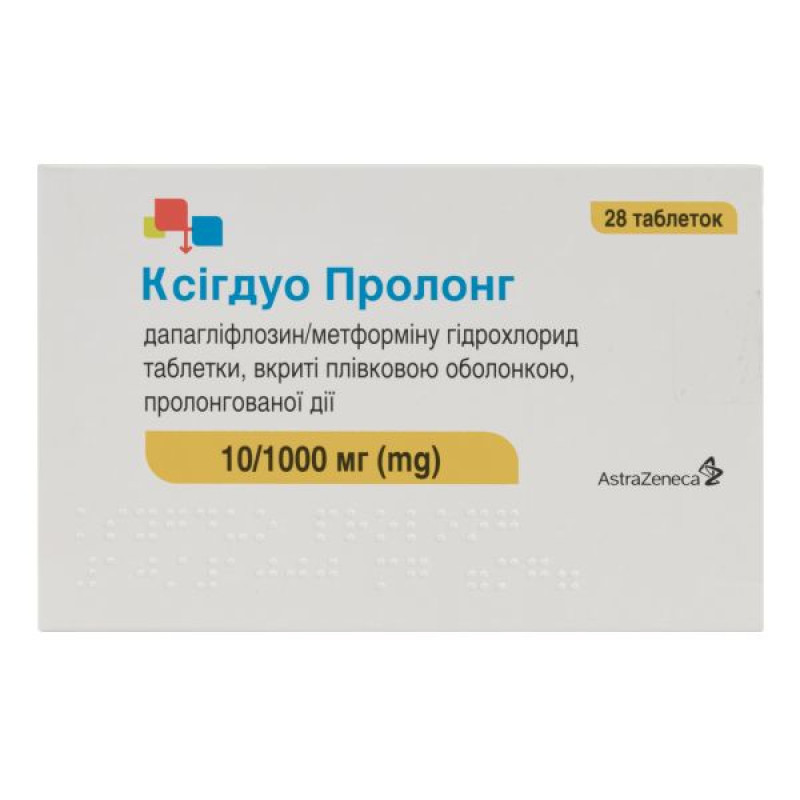
Instructions for Xigduo Prolong prolonged-release film-coated tablets 10 mg/1000 mg blister No. 28
Composition
active ingredients: dapagliflozin propanediol; metformin hydrochloride;
5/1000 mg: 1 prolonged-release film-coated tablet contains 6.15 mg of dapagliflozin propanediol, equivalent to 5 mg of dapagliflozin and 1005.04 mg of metformin hydrochloride;
10/1000 mg: 1 prolonged-release film-coated tablet contains dapagliflozin propanediol 12.30 mg, equivalent to 10 mg dapagliflozin and 1005.04 mg metformin hydrochloride;
10/500 mg: 1 prolonged-release film-coated tablet contains 12.30 mg of dapagliflozin propanediol, equivalent to 10 mg of dapagliflozin and 502.61 mg of metformin hydrochloride;
excipients: sodium carboxymethylcellulose, hypromellose 2208, hypromellose 2910 (for 10/500 mg), microcrystalline cellulose PH102 (for 10/500 mg), silicon dioxide, magnesium stearate, microcrystalline cellulose PH302, anhydrous lactose, crospovidone, Opadry® dye
II Yellow 85F12372 (for 10/1000 mg), Opadry® II Pink dye 85F94333 (for 10/500 mg), Opadry® II Pink dye 85F94592 (for 5/1000 mg).
Dosage form
Film-coated tablets, prolonged-release.
Main physicochemical properties:
5/1000 mg: film-coated tablet, pink to dark pink, biconvex, oval, engraved with ″1071″ and ″5/1000″ on one side and plain on the other side.
10/500 mg: film-coated tablet, pink, biconvex, capsule-shaped, engraved with ″1072″ and ″10/500″ on one side and plain on the other side.
10/1000 mg: film-coated tablet, yellow to dark yellow, biconvex, oval, engraved with ″1073″ and ″10/1000″ on one side and plain on the other side.
Pharmacotherapeutic group
Drugs for the treatment of diabetes. Metformin in combination with dapagliflozin. ATX code A10B D15.
Pharmacological properties
KSIGDUO Prolong combines two hypoglycemic agents with complementary mechanisms of action to improve glycemic control in patients with type 2 diabetes: dapagliflozin, a selective and reversible inhibitor of sodium-dependent glucose cotransporter type 2 (SGCT-2), and metformin hydrochloride, a biguanide.
Dapagliflozin
Sodium-glucose cotransporter type 2 (SGLT2), which is expressed in the proximal renal tubules, is responsible for the reabsorption of most filtered glucose from the tubular lumen. Dapagliflozin is a selective and reversible inhibitor of SGLT2. By inhibiting SGLT2, dapagliflozin reduces the reabsorption of filtered glucose and lowers the renal threshold for glucose, thereby increasing urinary glucose excretion.
Metformin hydrochloride
Metformin improves glucose tolerance in patients with type 2 diabetes by reducing basal and postprandial plasma glucose levels. Metformin reduces hepatic glucose production, reduces intestinal glucose absorption, and increases insulin sensitivity by increasing peripheral glucose uptake and utilization. Metformin does not cause hypoglycemia in patients with type 2 diabetes or in healthy volunteers, except in unusual circumstances, and does not cause hyperinsulinemia. Insulin secretion is not altered during metformin treatment, but fasting insulin levels and daily plasma insulin levels may actually decrease.
Pharmacodynamics.
Dapagliflozin
In healthy subjects and patients with type 2 diabetes, an increase in the amount of glucose excreted in the urine was observed after the use of dapagliflozin. Approximately 70 g of glucose was excreted in the urine per day when dapagliflozin was administered at a dose of 5 or 10 mg per day in patients with type 2 diabetes for 12 weeks. Similar maximum glucose excretion was observed when dapagliflozin was administered at a daily dose of 20 mg. This urinary glucose excretion with dapagliflozin also leads to an increase in urine volume.
Cardioelectrophysiology
Dapagliflozin was not associated with clinically significant prolongation of the QTc interval at daily doses up to 150 mg (15 times the recommended dose) in a study in healthy volunteers. In addition, no clinically significant effect on the QTc interval was observed after single doses of dapagliflozin up to 500 mg (50 times the recommended dose) were administered to healthy volunteers.
Pharmacokinetics.
Administration of XYGDUO Prolong to healthy volunteers after a standard meal and in the fasting state provides similar exposure to dapagliflozin and metformin extended-release. Compared to administration in the fasting state, administration with a standard meal results in a 35% decrease and a 1-2 hour delay in reaching maximum plasma concentrations of dapagliflozin. This effect of food intake is not considered clinically significant. Food intake does not significantly affect the pharmacokinetics of metformin when used as part of XYGDUO Prolong.
Absorption
Dapagliflozin
After oral administration of dapagliflozin, maximum plasma concentrations (Cmax) are generally achieved within 2 hours of administration in the fasted state. Cmax and AUC increase proportionally with increasing dapagliflozin dose over the therapeutic dose range. The absolute bioavailability of dapagliflozin after oral administration of 10 mg is 78%. Administration with a high-fat meal reduces dapagliflozin Cmax by 50% and delays Tmax by approximately 1 hour, but does not alter AUC compared to administration in the fasted state. These changes are not considered clinically significant and dapagliflozin can be administered without regard to food intake.
Metformin hydrochloride
After a single oral dose of metformin extended-release, the median time to Cmax is 7 hours and ranges from 4 to 8 hours. The extent of metformin absorption (as measured by AUC) from metformin extended-release tablets is increased by approximately 50% when administered with food.
No effect of food on metformin Cmax and Tmax was observed.
Distribution
Dapagliflozin
Dapagliflozin is approximately 91% protein bound. In patients with renal or hepatic impairment, protein binding is not altered.
Metformin hydrochloride
Distribution studies of metformin extended-release have not been performed; however, the apparent volume of distribution (V/F) of metformin after a single oral dose of 850 mg immediate-release metformin was on average 654 ± 358 L. Metformin is poorly bound to plasma proteins, in contrast to sulfonylureas, which are more than 90% protein bound. Metformin penetrates into erythrocytes.
Metabolism
Dapagliflozin
The metabolism of dapagliflozin is primarily mediated by UGT1A9; CYP-mediated metabolism is negligible in humans. Dapagliflozin is extensively metabolized, primarily to form dapagliflozin 3-O-glucuronide, an inactive metabolite. Dapagliflozin 3-O-glucuronide accounts for 61% of a 50 mg [14C]-dapagliflozin dose and is the predominant drug-related component in human plasma.
Metformin hydrochloride
Studies with single intravenous doses in healthy volunteers have shown that metformin is excreted unchanged in the urine and is not metabolized in the liver (no metabolites have been identified in humans) or excreted in the bile.
Metabolism studies of metformin extended-release tablets have not been conducted.
Breeding
Dapagliflozin
Dapagliflozin and its related metabolites are primarily excreted via urinary excretion. Following a single 50 mg dose of [14C]-dapagliflozin, 75% and 21% of the total radioactivity was excreted in urine and feces, respectively. Less than 2% of the dose was excreted unchanged in urine. Approximately 15% of the dose was excreted unchanged in feces.
The mean terminal plasma elimination half-life (t1/2) of dapagliflozin is approximately 12.9 hours following a single oral dose of dapagliflozin 10 mg.
Metformin hydrochloride
Renal clearance of metformin is approximately 3.5 times greater than creatinine clearance, indicating tubular secretion as the major route of metformin elimination. After oral administration of metformin, approximately 90% of the absorbed drug is excreted renally within the first 24 hours. The plasma half-life is approximately 6.2 hours. The elimination half-life is approximately 17.6 hours, indicating the possible role of erythrocytes as a depot for drug distribution.
Certain patient groups
Kidney dysfunction
At steady-state (20 mg dapagliflozin once daily for 7 days), patients with type 2 diabetes mellitus and mild, moderate, or severe renal impairment (as determined by estimated glomerular filtration rate (eGFR)) had geometric mean systemic exposures to dapagliflozin that were 45% higher, 2.04-fold and 3.03-fold, respectively, than those in type 2 diabetes mellitus patients with normal renal function. The higher systemic exposure to dapagliflozin in patients with type 2 diabetes mellitus and renal impairment did not translate into higher daily glucose excretion. The daily urinary glucose excretion at steady-state in patients with type 2 diabetes mellitus and mild, moderate, or severe renal impairment was 42%, 80%, and 90% lower, respectively, than in patients with type 2 diabetes mellitus and normal renal function. The effect of hemodialysis on dapagliflozin exposure is unknown.
Metformin hydrochloride
In patients with reduced renal function (eGFR), the half-life of metformin from plasma and blood is prolonged, and renal clearance is reduced in proportion to the decrease in eGFR.
Dapagliflozin
In patients with mild to moderate hepatic impairment (Child-Pugh Class A and B), mean Cmax and AUC of dapagliflozin were 12% and 36% higher, respectively, compared with matched healthy control subjects after a single dose of 10 mg dapagliflozin. These differences were not considered clinically significant. In patients with severe hepatic impairment (Child-Pugh Class C), mean Cmax and AUC of dapagliflozin were 40% and 67% higher, respectively, compared with matched healthy control subjects.
Metformin hydrochloride
Pharmacokinetic studies of metformin in patients with hepatic impairment have not been conducted.
Elderly patients
Dapagliflozin
Based on population pharmacokinetic analysis, age has no clinically significant effect on the systemic exposure of dapagliflozin; therefore, no dose adjustment is required.
Metformin hydrochloride
Some data from controlled pharmacokinetic studies of metformin in healthy elderly subjects suggest that the total plasma clearance of metformin is reduced, the half-life is prolonged, and Cmax is increased compared to healthy younger subjects.
Thus, the change in metformin pharmacokinetics with age is primarily explained by changes in renal function.
Pediatric population
The pharmacokinetics of KSIGDUO Prolong in the pediatric population have not been studied.
Sex
Dapagliflozin
Based on population pharmacokinetic analysis, gender has no clinically significant effect on the systemic exposure of dapagliflozin; therefore, no dose adjustment is required.
Metformin hydrochloride
The pharmacokinetic parameters of metformin in healthy subjects and patients with type 2 diabetes did not differ significantly when analyzed by gender (males = 19, females = 16). In addition, in controlled clinical trials in patients with type 2 diabetes, the hypoglycemic effect of metformin was comparable in men and women.
Racial affiliation
Dapagliflozin
Based on population pharmacokinetic analysis, race (Caucasian, Negroid, or Mongoloid) has no clinically significant effect on the systemic exposure of dapagliflozin; therefore, no dose adjustment is required.
Metformin hydrochloride
Studies of the pharmacokinetic parameters of metformin depending on race have not been conducted. In controlled clinical trials of metformin in patients with type 2 diabetes, the hypoglycemic effect was comparable in Caucasians (n = 249), Negroids (n = 51), and Hispanics (n = 24).
Body weight
Dapagliflozin
Based on population pharmacokinetic analysis, body weight has no clinically significant effect on the systemic exposure of dapagliflozin; therefore, no dose adjustment is required.
Drug interactions
Separate pharmacokinetic drug interaction studies with the drug KSIGDUO Prolong have not been conducted, although such studies have been conducted with the individual components of the drug, dapagliflozin and metformin.
In vitro drug interaction assessment
Dapagliflozin
In in vitro studies, dapagliflozin and dapagliflozin 3-O-glucuronide did not inhibit CYP 1A2, 2C9, 2C19, 2D6, 3A4 activity and did not induce CYP 1A2, 2B6 or 3A4 activity. Dapagliflozin is a weak substrate for the active transporter P-glycoprotein (P-gp), and dapagliflozin 3-O-glucuronide is a substrate for the active transporter OAT3. Dapagliflozin or dapagliflozin 3-O-glucuronide did not significantly inhibit the active transporters P-gp, OCT2, OAT1 or OAT3. In general, dapagliflozin is unlikely to affect the pharmacokinetics of concomitantly administered medicinal products that are substrates for P-gp, OCT2, OAT1 or OAT3.
The table below presents the effects of other concomitant medications on metformin.
Effect of concomitant medications on plasma systemic exposure of metformin
Concomitant drug (dosage regimen)* | Metformin (dosage regimen)* | Metformin | |
| Change in AUC† | Change in Cmax† | | |
| No dose adjustment was required for the following drugs: | | | |
| Glyburide (5 mg) | 850 mg | ↓9 %§ | ↓7%§ |
| Furosemide (40 mg) | 850 mg | ↑15%§ | ↑22 %§ |
| Nifedipine (10 mg) | 850 mg | ↑9% | ↑20% |
| Propranolol (40 mg) | 850 mg | ↓10% | ↓6% |
| Ibuprofen (400 mg) | 850 mg | ↑5%§ | ↑7%§ |
| Drugs that are excreted by the kidneys via tubular secretion may increase the accumulation of metformin. | | | |
| Cimetidine (400 mg) | 850 mg | ↑40% | ↑60% |
*Metformin and all concomitant medications were administered as single doses.
† Percent change (with/without co-administration and no change = 0%); ↑ and ↓ indicate increased and decreased exposure, respectively.
‡ AUC = AUC(INF) (area under the concentration-time curve from zero to infinity).
§ Ratio of arithmetic mean values.
The effect of metformin on other drugs
The table below presents the effects of metformin on other concomitant medications.
Effect of metformin on the systemic exposure of concomitant medications
| Concomitant drug (dosage regimen)* | Metformin (dosage regimen)* | Concomitant drug | |
| Change in AUC† | Change in Cmax† | | |
| No dose adjustment was required for the following drugs: | | | |
| Glyburide (5 mg) | 850 mg | ↓22 %§ | ↓37 %§ |
| Furosemide (40 mg) | 850 mg | ↓12 %§ | ↓31 %§ |
| Nifedipine (10 mg) | 850 mg | ↑10%¶ | ↑8% |
| Propranolol (40 mg) | 850 mg | ↑1 %¶ | ↑2% |
| Ibuprofen (400 mg) | 850 mg | ↓3 %# | ↑1 %# |
| Cimetidine (400 mg) | 850 mg | ↓5%¶ | ↑1% |
*Metformin and all concomitant medications were administered as single doses.
† Percent change (with/without co-administration and no change = 0%); ↑ and ↓ indicate increased and decreased exposure, respectively.
‡ AUC = AUC(INF) (area under the concentration-time curve from zero to infinity), unless otherwise stated.
§ Ratio of arithmetic means, p-value of difference < 0.05.
¶ AUC (0-24h) values (area under the concentration-time curve from zero to 24h) reported.
# Ratio of arithmetic mean values.
Effects of other drugs on dapagliflozin
The table below shows the effects of concomitant medications on dapagliflozin. No dose adjustment of dapagliflozin is required.
Effect of concomitant medications on systemic exposure to dapagliflozin
| Concomitant drug (dosage regimen)* | Dapagliflozin (dosage regimen)* | Dapagliflozin | |
| Change in AUC† | Change in Cmax† | | |
| No dose adjustment was required for the following drugs: | | | |
| Oral hypoglycemic drugs | | | |
| Metformin (1000 mg) | 20 mg | ↓1% | ↓7% |
| Pioglitazone (45 mg) | 50 mg | 0 % | ↑9% |
| Sitagliptin (100 mg) | 20 mg | ↑8% | ↓4% |
| Glimepiride (4 mg) | 20 mg | ↓1% | ↑1% |
| Voglibose (0.2 mg three times a day) | 10 mg | ↑1% | ↑4% |
| Cardiovascular drugs | | | |
| Hydrochlorothiazide (25 mg) | 50 mg | ↑7% | ↓1% |
| Bumetanide (1 mg) | 10 mg once daily for 7 days | ↑5% | ↑8% |
| Valsartan (320 mg) | 20 mg | ↑2% | ↓12% |
| Simvastatin (40 mg) | 20 mg | ↓1% | ↓2% |
| Antibacterial drug | | | |
| Rifampin (600 mg once daily for 6 days) | 10 mg | ↓22% | ↓7% |
| Nonsteroidal anti-inflammatory drug | | | |
| Mefenamic acid (loading dose of 500 mg followed by 14 doses of 250 mg every 6 hours) | 10 mg | ↑51% | ↑13% |
*Single dose unless otherwise stated.
†Percent change (with/without co-administration and no change = 0%); ↑ and ↓ indicate increased and decreased exposure, respectively.
‡ AUC = AUC(INF) (area under the concentration-time curve from zero to infinity) for drugs administered as single doses, and AUC = AUC(TAU) (area under the concentration-time curve with the minimum concentration at the end of the first dose interval) for drugs administered as multiple doses.
The table below presents the effects of dapagliflozin on other concomitant medications. Dapagliflozin did not significantly affect the pharmacokinetics of concomitant medications.
Effect of dapagliflozin on the systemic exposure of concomitant medications
| Concomitant drug (dosage regimen)* | Dapagliflozin (dosage regimen)* | Concomitant drug | |
| Change in AUC† | Change in Cmax† | | |
| No dose adjustment was required for the following drugs: | | | |
| Oral hypoglycemic drugs | | | |
| Metformin (1000 mg) | 20 mg | 0 % | ↓5% |
| Pioglitazone (45 mg) | 50 mg | 0 % | ↓7% |
| Sitagliptin (100 mg) | 20 mg | ↑1% | ↓11% |
| Glimepiride (4 mg) | 20 mg | ↑13% | ↑4% |
| Cardiovascular drugs | | | |
| Hydrochlorothiazide (25 mg) | 50 mg | ↓1% | ↓5% |
| Bumetanide (1 mg) | 10 mg once daily for 7 days | ↑13% | ↑13% |
| Valsartan (320 mg) | 20 mg | ↑5% | ↓6% |
| Simvastatin (40 mg) | 20 mg | ↑19% | ↓6% |
| Digoxin (0.25 mg) | 20 mg loading dose, then 10 mg once daily for 7 days | 0 % | ↓1% |
Warfarin (25 mg) S-warfarin R-warfarin | 20 mg loading dose, then 10 mg once daily for 7 days | ↑3% ↑6% | ↑7% ↑8% |
*Single dose unless otherwise stated.
† Percent change (with/without co-administration and no change = 0%); ↑ and ↓ indicate increased and decreased exposure, respectively.
‡ AUC = AUC(INF) (area under the concentration-time curve from zero to infinity) for drugs administered as single doses, and AUC = AUC(TAU) (area under the concentration-time curve with the minimum concentration at the end of the first dose interval) for drugs administered as multiple doses.
Indication
XYGDUO Prolong is indicated as an adjunct to diet and exercise to improve glycaemic control in adults with type 2 diabetes mellitus for whom treatment with dapagliflozin and metformin is considered appropriate.
Contraindication
KSIGDUO Prolong is contraindicated in patients with:
- hypersensitivity to the active substances or to any of the excipients;
- any type of acute metabolic acidosis (such as lactic acidosis, diabetic ketoacidosis);
- diabetic precoma;
- severe renal insufficiency (GFR < 30 ml/min) (see section "Special precautions for use");
- acute conditions that may affect kidney function, such as:
- dehydration,
- severe infection,
- shock;
- acute or chronic disease that can cause tissue hypoxia, such as:
- heart or respiratory failure,
- recent myocardial infarction,
- shock;
- liver dysfunction
- acute alcohol intoxication, alcoholism.
Interaction with other medicinal products and other types of interactions
Positive test for glucose in urine
Dapagliflozin
Monitoring of glycemic control with urine glucose testing is not recommended for patients taking SGLT2 inhibitors because SGLT2 inhibitors increase urinary glucose excretion and will result in positive urine glucose results. Alternative methods of testing should be used for glycemic monitoring.
Interference with 1,5-anhydroglucitol (1,5-AG)
Dapagliflozin
Monitoring glycemic control with 1,5-AG assays is not recommended because 1,5-AG measurements are unreliable in assessing glycemic status in patients taking SGLT2 inhibitors. Alternative methods should be used for glycemic monitoring.
Carbonic anhydrase inhibitors
Topiramate or other carbonic anhydrase inhibitors (e.g. zonisamide, acetazolamide or dichlorphenamide) often cause a decrease in serum bicarbonate levels and lead to hyperchloraemic metabolic acidosis without changes in the anion gap, hyperchloraemic metabolic acidosis. The combined use of these drugs with the drug KSIGDUO Prolong increases the risk of developing lactic acidosis. More frequent monitoring of the condition of such patients may be advisable.
Drugs that reduce metformin clearance
Drugs that are excreted by the kidneys by tubular secretion (e.g. cationic drugs such as cimetidine) that may interact with metformin by competing for the common renal tubular transport system may increase metformin accumulation and increase the risk of lactic acidosis. More frequent monitoring of these patients may be appropriate.
Alcohol
Alcohol may potentiate the effect of metformin on lactate metabolism. Patients should be cautioned against excessive alcohol consumption while taking XYGDUO Prolong.
Use with other drugs
Some drugs can cause hyperglycemia and may lead to loss of glycemic control. These drugs include thiazides and other diuretics, corticosteroids, phenothiazines, thyroid hormones, estrogens, oral contraceptives, phenytoin, nicotinic acid, sympathomimetics, calcium channel blockers, and isoniazid. When such drugs are prescribed to a patient taking XYGDUO Prolong, the patient should be closely monitored to maintain the necessary level of glycemic control. When such drugs are discontinued in a patient taking XYGDUO Prolong, the patient should be closely monitored for the development of hypoglycemia.
In single-dose interaction studies in healthy volunteers, the pharmacokinetics of metformin and propranolol, as well as metformin and ibuprofen, were unchanged.
Application features
Lactic acidosis
In the post-marketing period, cases of lactic acidosis associated with metformin have been reported, including fatalities. In these cases, the onset of lactic acidosis was almost insidious and was accompanied by nonspecific symptoms such as malaise, myalgia, abdominal pain, respiratory distress, or increased somnolence; however, severe acidosis has been associated with hypothermia, hypotension, and resistant bradyarrhythmia. Lactic acidosis associated with metformin has been characterized by elevated blood lactate concentrations (> 5 mmol/L), anion gap acidosis (without evidence of ketonuria or ketonemia), and an increased lactate:pyruvate ratio; plasma metformin levels were usually > 5 μg/mL. Metformin reduces the uptake of lactate by the liver, increasing blood lactate levels, which increases the risk of lactic acidosis, especially in patients at risk.
If metformin-associated lactic acidosis is suspected, immediate supportive measures should be instituted in a hospital setting and XYGDUO Prolong should be discontinued immediately. If lactic acidosis is diagnosed or strongly suspected in patients treated with XYGDUO Prolong, immediate hemodialysis is recommended to correct the acidosis and remove accumulated metformin (metformin hydrochloride is dialyzable with a clearance of up to 170 mL/min under adequate hemodynamic conditions). Hemodialysis has often resulted in resolution of symptoms and recovery.
Patients and their families should be informed about the symptoms of lactic acidosis and instructed to discontinue use of XYGDUO Prolong and report these symptoms to their physician if they develop these symptoms.
Recommendations for reducing the risk and correcting lactic acidosis associated with metformin use, in the presence of risk factors, are given below.
Renal impairment: Post-marketing reports of metformin-associated lactic acidosis have occurred predominantly in patients with significant renal impairment. The risk of metformin accumulation and metformin-associated lactic acidosis increases with increasing severity of renal impairment, as metformin is largely excreted by the kidneys.
Before starting therapy with KSIGDUO Prolong, it is necessary to calculate the glomerular filtration rate (eGFR). KSIGDUO Prolong is not recommended for patients with moderate renal insufficiency (eGFR less than 60 ml/min/1.73 m2), as the efficacy of dapagliflozin depends on renal function and is reduced in patients with moderate renal impairment and absent in patients with severe renal insufficiency (eGFR < 30 ml/min/1.73 m2). contraindicated in patients with eGFR less than 60 ml/min/1.73 m2. eGFR should be determined at least annually in all patients receiving KSIGDUO Prolong. In patients at increased risk of renal impairment (e.g. elderly patients), renal function should be assessed more frequently.
Drug interactions: Concomitant use of KSIGDUO Prolong with certain drugs increases the risk of metformin-associated lactic acidosis; these drugs include drugs that impair renal function, cause significant hemodynamic changes, affect acid-base balance, or increase metformin accumulation (e.g., cationic drugs). Therefore, more frequent monitoring of these patients may be appropriate.
Radiological studies using contrast agents: Intravascular administration of iodinated contrast agents in patients receiving metformin has resulted in acute deterioration of renal function and the development of lactic acidosis. Patients with a history of liver dysfunction, alcoholism or heart failure and patients who will be administered iodinated contrast agents intraarterially should discontinue the use of the drug KSIGDUO Prolong for the duration of the examination procedure involving the administration of iodinated contrast agents or before it. 48 hours after the procedure, eGFR should be re-evaluated, and if renal function is stable, the use of the drug KSIGDUO Prolong can be resumed.
Surgery and other procedures: Withholding food and fluids during surgery or other procedures increases the risk of hypovolemia, hypotension, and renal impairment. Use of XYGDUO Prolong should be temporarily discontinued while patients' food and fluid intake is restricted.
Hypoxic conditions: Several cases of lactic acidosis associated with metformin have been reported in post-marketing experience in patients with acute congestive heart failure (particularly those with hypoperfusion and hypoxemia). Cardiovascular collapse (shock), acute myocardial infarction, sepsis, and other conditions with hypoxemia have been associated with lactic acidosis and may also lead to prerenal azotemia. If such events occur, XYGDUO Prolong should be discontinued.
Excessive alcohol consumption: Alcohol potentiates the effect of metformin on lactate metabolism, which increases the risk of metformin-associated lactic acidosis. Patients should be cautioned against excessive alcohol consumption while taking KSIGDUO Prolong.
Hepatic impairment: Lactic acidosis has been reported with metformin in patients with hepatic impairment. This may be due to impaired lactate clearance, leading to higher blood lactate levels. Therefore, patients with clinical or laboratory evidence of liver disease should avoid the use of XYGDUO Prolong.
Arterial hypotension
Dapagliflozin causes intravascular volume depletion. Symptomatic hypotension may occur after initiation of dapagliflozin treatment, especially in patients with impaired renal function (eGFR less than 60 mL/min/1.73 m2), in elderly patients, or in patients receiving loop diuretics. Before initiating treatment with KSIGDUO Prolong, the degree of dehydration in such patients should be assessed and corrected. After initiation of therapy, monitoring for symptoms of hypotension is recommended.
Ketoacidosis
Cases of ketoacidosis, a serious, life-threatening condition requiring immediate hospitalization, have been reported in post-marketing experience in patients with type 1 and type 2 diabetes mellitus who were treated with sodium-dependent glucose cotransporter 2 (SGCT2) inhibitors, including dapagliflozin. Fatal cases of ketoacidosis have been reported in patients treated with dapagliflozin. KSIGDUO Prolong is not indicated for use in patients with type 1 diabetes mellitus.
Patients who develop symptoms of severe metabolic acidosis while taking XYGDUO Prolong should be evaluated for ketoacidosis, regardless of blood glucose levels, as ketoacidosis may occur with XYGDUO Prolong even when blood glucose levels are below 250 mg/dL. If ketoacidosis is suspected, the drug should be discontinued, the patient should be evaluated, and treatment should be initiated promptly. Treatment of ketoacidosis may require insulin, fluid replacement, and carbohydrate replacement.
Post-marketing reports have shown that in many cases, particularly in patients with type 1 diabetes, the presence of ketoacidosis was not immediately recognized and treatment was delayed because blood glucose concentrations were below the levels normally expected for diabetic ketoacidosis (often less than 250 mg/dL). Symptoms at the time of examination were consistent with dehydration and severe metabolic acidosis and included nausea, vomiting, abdominal pain, malaise, and dyspnea. In some cases, predisposing factors for ketoacidosis were identified, such as reduced insulin dose, acute febrile illness, reduced caloric intake due to illness or surgery, or pancreatic disorders suggesting insulin deficiency (e.g., type 1 diabetes, history of pancreatitis or surgery).