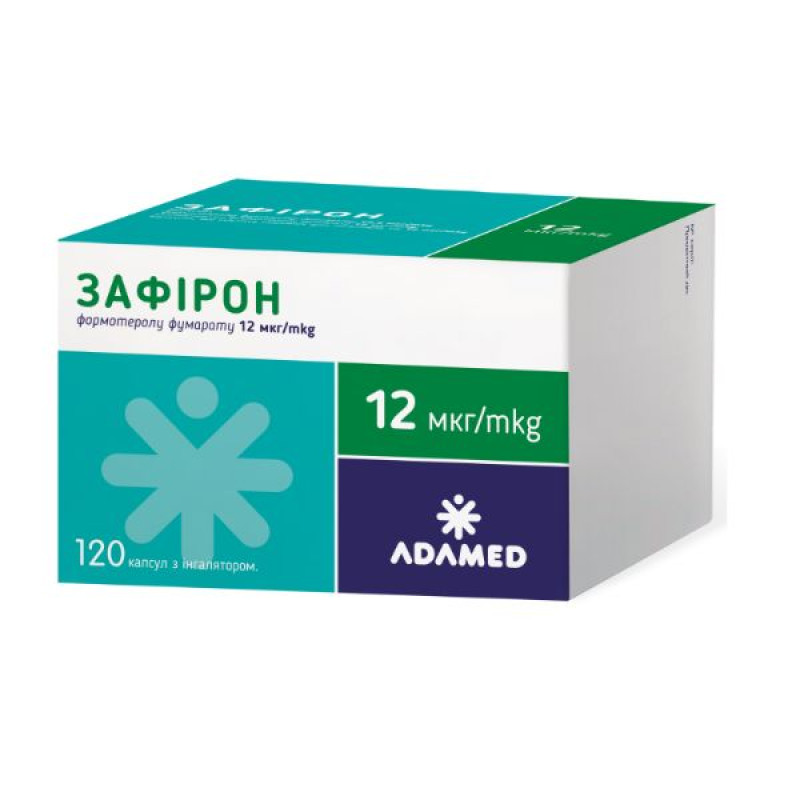
Instructions Zafiron powder for inhalation in capsules 12 mcg blister with inhaler No. 120
Composition
active ingredient: formoterol;
1 capsule contains formoterol fumarate dihydrate 12.5 mcg equivalent to formoterol fumarate 12 mcg;
excipients: semi-micronized lactose monohydrate, micronized lactose monohydrate, gelatin.
Dosage form
Capsules containing powder for inhalation.
Main physicochemical properties: hard transparent capsules with 2 cylindrical sections of size "3" containing white powder.
Pharmacotherapeutic group
Adrenergic drugs for inhalation use. Selective beta2-adrenoceptor agonists. ATC code R03A C13.
Pharmacological properties
Pharmacodynamics.
Formoterol fumarate is a selective beta2-adrenergic agonist. It has a bronchodilating effect in patients with reversible airway obstruction. The drug acts quickly (onset of action within 1–3 minutes), its effect persists for 12 hours after inhalation. When using the drug in therapeutic doses, the effect on the cardiovascular system is minimal and is observed only in isolated cases.
Formoterol inhibits the release of histamine and leukotrienes from passively sensitized human lungs. Formoterol effectively prevents bronchospasm caused by allergens, exercise, cold air, histamine or methacholine. Since the bronchodilator effect of the drug is pronounced within 12 hours after inhalation, maintenance therapy, in which formoterol is administered 2 times a day, allows in most cases to provide the necessary control of bronchospasm in chronic lung diseases both during the day and at night.
Pharmacokinetics.
The therapeutic dose of Zafiron is 12 to 24 mcg twice daily. Data on the pharmacokinetic properties of formoterol are obtained from studies involving healthy volunteers after inhalation of doses greater than therapeutic and in COPD patients after inhalation of therapeutic doses. The amount of formoterol excreted in the urine unchanged is used as an indirect indicator of the overall effect of the drug on the body and correlates with data on the removal of the drug from the blood plasma. The elimination half-lives in the elimination phase, calculated for urine and plasma, are similar.
Absorption.
When using formoterol in a dose exceeding the therapeutic (single dose of 120 μg), the maximum concentration (Cmax) in the blood plasma (266 pmol/l) was observed 5 minutes after inhalation. In patients with COPD who received formoterol in doses of 12 or 24 μg 2 times a day for 12 weeks, plasma concentrations of formoterol measured 10 minutes, 2 hours and 6 hours after inhalation were in the ranges of 11.5 - 25.7 pmol/l and 23.3 - 50.3 pmol/l, respectively.
Determination of the total excretion of formoterol and (or) its (R,R)- and (S,S)-enantiomers showed that the amount of formoterol in the bloodstream increases proportionally to the volume of the applied dose (12 - 96 μg).
After inhalation of 12 or 24 mcg of formoterol fumarate twice daily for 12 weeks, urinary excretion of unchanged formoterol increased from 63% to 73% (last dose compared to first dose) in asthmatic patients and from 19% to 38% in COPD patients. These data indicate limited accumulation of formoterol in plasma after multiple dosing. There was no relative greater accumulation of one enantiomer compared to the other after multiple dosing.
As with other drugs administered by inhaler, it is expected that the majority of the dose of formoterol from the inhaler will be swallowed by the patient and will then be absorbed from the gastrointestinal tract. After oral administration of 80 micrograms of formoterol fumarate 3H to two healthy volunteers, at least 65% of the dose was absorbed.
Dissemination.
The binding of formoterol to plasma proteins is 61–64% (primarily binding to albumin — 34%). Regarding the concentration achieved after taking therapeutic doses, saturation of binding sites does not occur.
Metabolism.
The main route of metabolism of formoterol is direct glucuronidation. Another metabolic route is O-demethylation followed by glucuronidation. Other metabolic processes include conjugation of formoterol with sulfate and deformylation followed by conjugation of formoterol with sulfate. O-demethylation and glucuronidation are catalyzed by multiple isoenzymes (UGT1A1, 1A3, 1A6, 1A7, 1A8, 1A9, 1A10, 2B7, 2B15 and CYP2D6, 2C19, 2A6, respectively), indicating a low likelihood of interactions with other drugs due to inhibition of specific isoenzymes involved in the metabolism of formoterol. Formoterol at therapeutic concentrations does not inhibit cytochrome P450 isoenzymes.
Breeding.
In patients with asthma or COPD treated with doses of 12 or 24 micrograms of formoterol fumarate twice daily for 12 weeks, approximately 10% and 7% of the dose was excreted unchanged in the urine, respectively. The (R,R) and (S,S) enantiomers accounted for 40% and 60% of the amount of unchanged formoterol in the urine, respectively, after a single dose (12 to
The active substance and its metabolites are completely eliminated from the body; about 2/3 of the dose administered orally is excreted in the urine and 1/3 in the feces. Renal clearance of formoterol is 150 ml/min.
In healthy volunteers, the plasma half-life of formoterol after inhalation of a single dose of 120 micrograms of formoterol fumarate is 10 hours, while the half-lives of the (R,R) and (S,S) enantiomers, calculated from urinary excretion, are 13.9 and 12.3 hours, respectively.
The pharmacokinetic properties of formoterol in elderly patients and in patients with impaired hepatic or renal function have not been studied.
Indication
Prevention and treatment of bronchospasm in patients with bronchial asthma; prevention of bronchospasm caused by allergens, cold air or physical exertion; prevention and treatment of bronchial patency disorders in patients with chronic obstructive pulmonary disease (COPD), including chronic bronchitis and emphysema.
Contraindication
Hypersensitivity to formoterol or to any of the other ingredients of the drug.
Interaction with other medicinal products and other types of interactions
The simultaneous use of Zafiron and such drugs as quinidine, disopyramide, procainamide, phenothiazines, antihistamines and tricyclic antidepressants, MAO inhibitors, macrolides or drugs that prolong the QT interval requires caution, as their effect on the cardiovascular system may be enhanced (for example, drugs that increase the QT interval increase the risk of ventricular arrhythmias).
Concomitant use of other sympathomimetic agents may enhance the side effects of Zafiron.
Concomitant use of xanthine derivatives, steroids or diuretics may enhance the potential hypokalemic effect of beta2-adrenergic agonists.
Hypokalemia may increase the susceptibility to cardiac arrhythmias in patients treated with digitalis glycosides.
Patients who are simultaneously taking analgesics in the form of halogenated hydrocarbons are at risk of developing heart rhythm disturbances.
Beta-blockers may weaken or block the effect of Zafiron. Therefore, Zafiron should not be used concomitantly with beta-blockers (including eye drops) unless there is no other alternative.
Application features
The lowest possible dose of Zafiron that provides a therapeutic effect should be selected according to the individual needs of the patient. The maximum recommended dose should not be exceeded (see "Method of administration and dosage").
Anti-inflammatory treatment.
When treating patients with asthma, Zafiron, a long-acting beta2-adrenostimulator (LABA), should be used only as an adjunct to inhaled corticosteroids in patients whose asthma is not adequately controlled with inhaled corticosteroids or in patients whose exacerbation of the disease warrants initiation of treatment with inhaled corticosteroids and a long-acting beta2-adrenostimulator.
In children aged 6 to 12 years, the use of a combination product containing inhaled corticosteroids and a long-acting beta2-adrenostimulator is recommended, except in cases where the use of separate inhaled corticosteroids and a long-acting beta2-adrenostimulator is required.
Zafiron should not be used concomitantly with other long-acting beta2-adrenergic stimulators. In the treatment of asthma, Zafiron should be used as an add-on in patients whose asthma is not adequately controlled by other agents (e.g. low- and medium-dose inhaled corticosteroids) or in patients whose exacerbation of the disease warrants the initiation of treatment with two maintenance agents, including Zafiron.
For patients not receiving anti-inflammatory treatment, it should be started at the same time as the start of Zafiron. Patients should be advised to continue anti-inflammatory therapy after starting Zafiron, even if improvement is noted.
If asthma symptoms improve, a gradual reduction in the dose of Zafiron may be considered. It is important to monitor patients regularly during the dose reduction period. The lowest effective dose of Zafiron should be used.
Exacerbation of asthma.
Clinical trials with Zafiron have shown a higher incidence of severe asthma exacerbations in patients taking Zafiron than in patients taking placebo, particularly in children aged 5 to 12 years. These studies do not allow for a precise determination of the difference in the number of asthma exacerbations between the study groups.
If symptoms persist or the number of doses of Zafiron required to control symptoms increases, this usually indicates a worsening of the underlying disease and the need for a doctor to review basic asthma therapy.
You should not start treatment with Zafiron, nor increase the dosage, during an asthma exacerbation.
In the event of an asthma attack, a fast-acting beta2-adrenergic agonist should be used. The patient should be informed of the need for urgent medical attention in the event of a sudden exacerbation of asthma.
The need for frequent medication (i.e., prophylactic treatment, such as corticosteroids and long-acting beta2-adrenergic agonists) to prevent exercise-induced bronchospasm several times a week, despite maintenance therapy, may be a symptom of inadequate asthma control and may be a reason to review asthma treatment and assess the patient's compliance with the doctor's recommendations.
Concomitant diseases.
Zafiron should be used with extreme caution and under the supervision of a physician, especially in terms of compliance with the recommended dose: ischemic heart disease; cardiac rhythm and conduction disorders, especially with third-degree AV block; severe heart failure or severe uncompensated heart failure, idiopathic subvalvular aortic stenosis, severe hypertension, aneurysm, pheochromocytoma, hypertrophic obstructive cardiomyopathy; thyrotoxicosis; known or suspected prolongation of the QT interval (corrected QT > 0.44 sec).
Due to the hyperglycemic effect inherent in β2-adrenergic stimulators, additional blood glucose monitoring is recommended in patients with diabetes.
Hypokalemia.
Treatment with β2-adrenergic agonists may result in the development of potentially serious hypokalemia. Since this effect of the drug may be potentiated by hypoxia and concomitant therapy, special caution should be exercised in patients with severe bronchial asthma. In these cases, regular monitoring of serum potassium is recommended.
Paradoxical bronchospasm.
As with other inhalation therapy, the possibility of paradoxical bronchospasm should be considered when using Zafiron. In this case, the drug should be immediately discontinued and alternative treatment should be prescribed.
The drug contains lactose, therefore patients with rare hereditary forms of galactose intolerance, lactase deficiency or glucose-galactose malabsorption syndrome should not use the drug.
Use during pregnancy or breastfeeding
The safety of using Zafiron during pregnancy and breastfeeding has not yet been established.
In animal studies, formoterol caused miscarriages and also reduced early postnatal survival and birth weight.
The drug should be avoided during pregnancy unless there is no safer alternative. Formoterol, like other beta2-adrenergic agonists, may slow the process of labor due to its tocolytic action.
It is not known whether formoterol passes into breast milk. The substance has been found in the milk of lactating rats. Women should stop breastfeeding during treatment.
Ability to influence reaction speed when driving vehicles or other mechanisms
If dizziness, tremors, or seizures occur during treatment, you should not drive or operate complex machinery.
Method of administration and doses
Zafiron is intended for inhalation use in adults and children aged 6 years and over.
Adults.
Bronchial asthma.
1–2 inhalation capsules (12–24 mcg) 2 times a day. The maximum recommended daily dose for maintenance therapy is 48 mcg per day. If necessary, an additional 1–2 capsules per day can be used to reduce symptoms. If the need for additional doses of the drug occurs more often than 2 days a week, treatment should be reviewed, as this may indicate a worsening of the underlying disease.
Chronic obstructive pulmonary disease.
1–2 inhalation capsules (12–24 mcg) 2 times a day.
The maximum daily dose for maintenance therapy is 48 mcg per day.
Prevention of bronchospasm caused by physical exertion, allergens or cold air.
Inhale the contents of 1 capsule (12 mcg) 15 minutes before exercise or anticipated allergen exposure. Patients with severe bronchial asthma may require 2 inhalation capsules (24 mcg) per day.
Children aged 6 and over.
Bronchial asthma.
1 capsule for inhalation (12 mcg) 2 times a day.
The maximum recommended daily dose is 24 mcg per day.
Prevention of bronchospasm caused by physical exertion, allergens or cold air.
The contents of 1 capsule (12 mcg) should be inhaled 15 minutes before exercise or anticipated contact with the allergen.
How to use the inhaler
1. Remove the cap-nozzle from the inhaler.
2. Holding the inhaler by the bottom, open it by turning the tip (top) in the direction of the arrow.
3. Place the capsule into the capsule-shaped chamber at the bottom of the inhaler. The capsule should be removed from the packaging immediately before use.
4. Turn the tip to the closed position.
WARNING! At this point, the capsule may break and small pieces of gelatin may enter the mouth or throat. The capsule is made of food-grade gelatin. The likelihood of the capsule breaking will be minimal if it is pierced no more than once, storage conditions are observed, and if the capsule is unpacked immediately before use.
6. Take a deep breath.
7. Take the tip into your mouth and tilt your head back slightly, close your mouth around the tip and take a few quick, even and deep breaths. At this moment, the capsule begins to rotate in the inhaler chamber, and the powder begins to disperse, accompanied by a characteristic sound. If this sound does not appear, the capsule is stuck in the chamber. In this case, you must open the inhaler and release the capsule. Do not try to release the capsule by repeatedly pressing the buttons.
8. When you hear a characteristic sound (buzzing), hold your breath for as long as you can without feeling discomfort and remove the inhaler from your mouth. Exhale. Then open the inhaler and check if there is any powder left in the capsule. If there is any powder left, repeat steps 6–8.
9. Open the inhaler, remove the empty used capsule, return the tip to the closed position and put on the cap-nozzle.
Cleaning the inhaler: To remove powder residue, wipe the tip and capsule chamber with a dry cloth or a clean, soft brush.
Children.
Formoterol should not be used in children under 6 years of age due to the lack of sufficient clinical experience in this patient group.
Overdose
Symptoms: overdose of Zafiron can lead to phenomena characteristic of excessive action of other β2-adrenostimulants, such as nausea, vomiting, headache, tremor, drowsiness, palpitations, tachycardia, ventricular arrhythmias, metabolic acidosis, hypokalemia, hyperglycemia, prolongation of the QT interval on the cardiogram, arterial hypertension.
Treatment: supportive and symptomatic therapy is indicated. In serious cases, hospitalization is necessary.
Beta-blockers may be considered, but only with extreme caution, as their use may cause bronchospasm.
In case of severe intoxication, it is necessary to monitor the concentration of electrolytes (e.g. potassium) in the blood serum and the acid-base balance.
Side effects
Severe asthma exacerbation.
Placebo-controlled clinical trials in which formoterol was used for at least 4 weeks indicated a higher incidence of severe asthma exacerbations in patients taking formoterol (0.9% for the 10–12 mcg twice daily dose, 1.9% for the 10–12 mcg twice daily dose).
24 mcg twice daily) than in patients receiving placebo (0.3%), particularly in children aged 6 to 12 years.
Experience in young and adult patients with asthma
In two large-scale controlled studies conducted over
In a 12-week study to register a formoterol-containing product in the US market, which included 1095 patients aged 12 years and older, severe asthma exacerbations (asthma exacerbations requiring hospitalization) occurred more frequently with formoterol 24 mcg twice daily (9/271, 3.3%) than with formoterol 12 mcg twice daily (1/275, 0.4%), placebo (2/277, 0.7%), or albuterol (2/277, 0.7%).
A subsequent clinical trial, which addressed the above observations, enrolled 2085 patients. The incidence of severe asthma-related adverse events was compared between the higher and lower dose groups. The results of this 16-week study did not reveal a clear relationship between the occurrence of these events and the dose of formoterol. The percentage of patients with severe asthma exacerbations in this study was slightly higher with formoterol than with placebo (in the three double-blind groups: formoterol 24 mcg twice daily (2/527, 0.4%), formoterol 12 mcg twice daily (3/527, 0.6%) and placebo (1/514, 0.2%) and in the known agent group: formoterol 12 mcg twice daily and up to two additional doses per day (1/517, 0.2%).
Experience in children aged 6 to 12 years with asthma
The safety of a 12 mcg twice daily formoterol preparation, a 24 mcg twice daily preparation, and placebo was compared in one large study.
A multicenter, randomized, double-blind clinical trial conducted over 52 weeks in 518 children (aged 6 to 12 years) with asthma who required daily bronchodilator and anti-inflammatory medication. Severe asthma exacerbations occurred more frequently in children receiving formoterol 24 mcg twice daily (11/171, 6.4%) or formoterol 12 mcg twice daily (8/171, 4.7%) than in children receiving placebo (0/176, 0.0%).
The frequency of occurrence is defined as follows: very common (>1/10), common (>1/100, <1/10), uncommon (>1/1000, <1/100), rare (>1/10000, <1/1000) and very rare (<1/10000).
On the part of the immune system | Rare: hypersensitivity reactions (including hypotension, bronchospasm, urticaria, angioedema, pruritus, exanthema) |
| Metabolic and nutritional disorders | Rare: hypokalemia Very rare: hyperkalemia |
| From the CNS | Sometimes: agitation, feeling of anxiety, nervousness, insomnia, dizziness Very rare: change in taste |
Cardiovascular system | Common: palpitations Sometimes: tachycardia Rare: arrhythmia, e.g. atrial fibrillation, supraventricular tachycardia, extrasystole Very rare: angina pectoris, prolonged QT interval on cardiogram, peripheral edema |
Respiratory and thoracic disorders | Sometimes: paradoxical bronchospasm, cough, rash, increased blood pressure (including hypertension), allergic reactions, throat irritation. |
| Gastrointestinal tract | Very rare: nausea |
| Musculoskeletal system | Sometimes: cramps, myalgia |
Expiration date
2 years.
Storage conditions
Store in the original packaging, out of the reach of children at a temperature not exceeding 25 ºС.
Packaging
10 capsules in a Pa-Al-PVC blister; 6 or 12 blisters together with an inhaler and instructions for medical use in a cardboard box.
Vacation category
According to the recipe.
Producer
(responsible for the release of the series).
Adamed Pharma JSC, Poland.
Location of the manufacturer and address of its place of business.
St. Marsh. J. Pilsudskiego 5, 95-200, Pabianice, Poland.