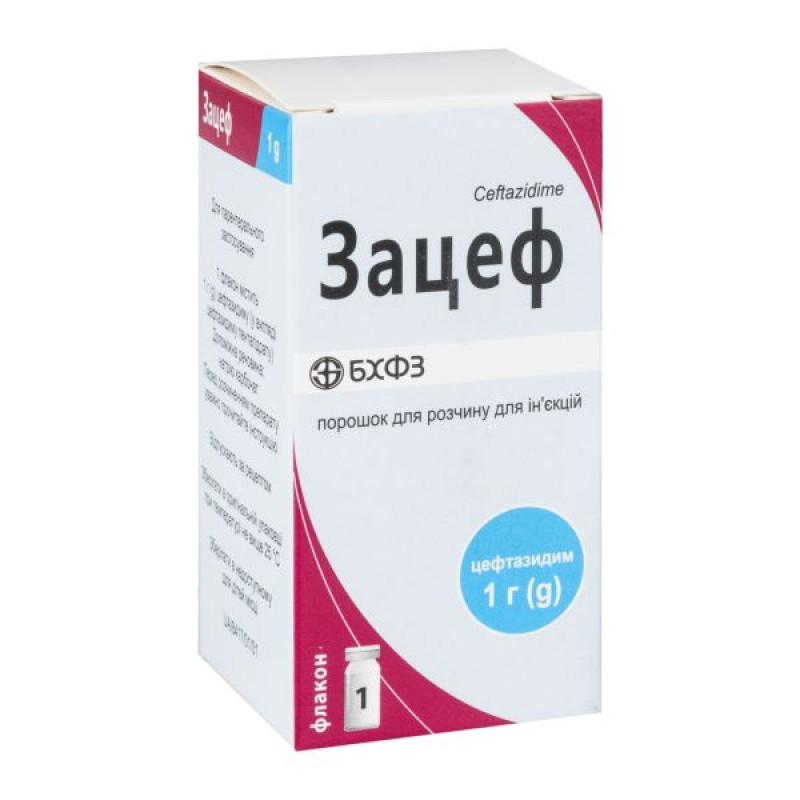
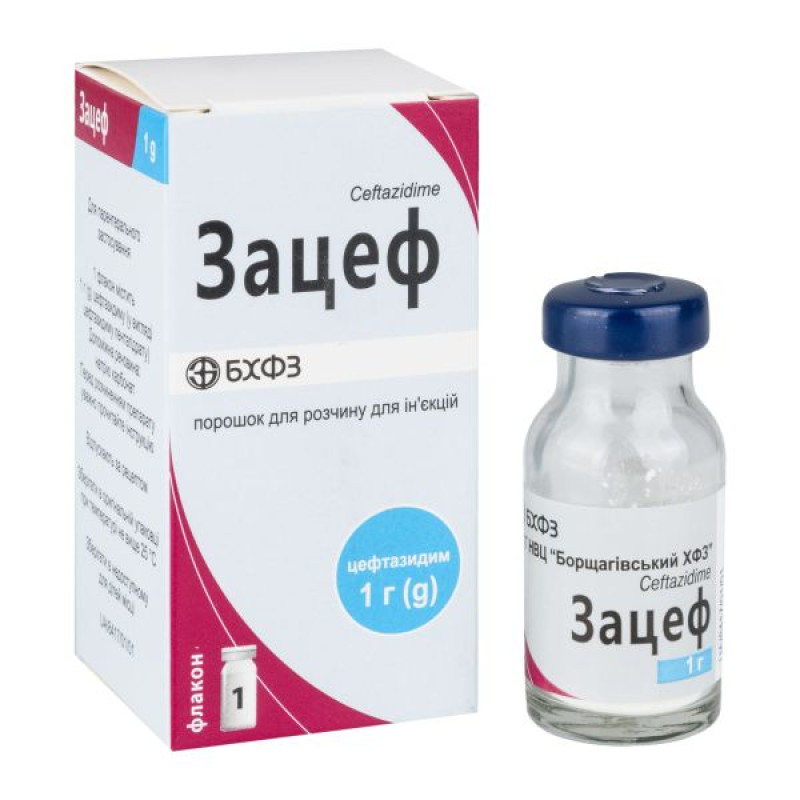
Instructions Zatsef powder for solution for injection 1 g bottle No. 1
Composition
active ingredient: ceftazidime;
1 vial contains 1 g of ceftazidime (as ceftazidime pentahydrate sterile, calculated as 100% dry ceftazidime);
excipient: sodium carbonate.
Dosage form
Powder for solution for injection.
Main physicochemical properties: white or white with a creamy tint crystalline powder.
Pharmacotherapeutic group
Antibacterials for systemic use. Other β-lactam antibiotics. Third generation cephalosporins. Ceftazidime. ATX code J01D D02.
Pharmacological properties
Pharmacodynamics
Ceftazidime is a bactericidal cephalosporin antibiotic, the mechanism of action of which is associated with a violation of the synthesis of bacterial cell walls. It has high activity against a wide range of gram-positive and gram-negative bacteria, including strains resistant to gentamicin and other aminoglycosides. It is highly resistant to the action of most β-lactamases produced by both gram-positive and gram-negative microorganisms. Ceftazidime exhibits high activity in vitro and acts within a narrow range of minimum inhibitory concentrations (MICs) against most pathogens.
Ceftazidime is active against the following microorganisms:
Gram-negative:
Pseudomonas aeruginosa, Pseudomonas spp. (including Ps. pseudomallei), Escherichia coli, Klebsiella spp. (including Klebsiella pneumoniae), Proteus mirabilis, Proteus vulgaris, Morganella morganii (Proteus morganii), Proteus rettgeri, Providencia spp., Enterobacter spp., Citrobacter spp., Serratia spp., Salmonella spp., Shigella spp., Yersinia enterocolitica, Pasteurella multocida, Acinetobacter spp., Neisseria gonorrhoeae, Neisseria meningitidis, Haemophilus influenzae (including ampicillin-resistant strains), Haemophilus parainfluenzae (including ampicillin-resistant strains);
Gram-positive:
Staphylococcus aureus (methicillin-susceptible strains), Staphylococcus epidermidis (methicillin-susceptible strains), Micrococcus spp., Streptococcus pyogenes (group A β-hemolytic streptococci), group B Streptococcus (Streptococcus agalactiae), Streptococcus pneumoniae, Streptococcus mitis, Streptococcus spp. (excluding Streptococcus faecalis);
anaerobic:
Peptococcus spp., Peptostreptococcus spp., Streptococcus spp., Propionibacterium spp., Clostridium perfringens, Fusobacterium spp., Bacteroides spp. (many strains of Bacteroides fragilis are resistant).
Ceftazidime is not active in vitro against methicillin-resistant staphylococci, Streptococcus faecalis and many other enterococci, Listeria monocytogenes, Campylobacter spp. and Clostridium difficile.
Pharmacokinetics
In patients, mean peak concentrations of 18 mg/L and 37 mg/L are rapidly achieved after intramuscular injection of 500 mg and 1 g of ceftazidime, respectively. Five minutes after intravenous bolus administration of 500 mg, 1 g or 2 g of ceftazidime, mean serum concentrations of 46 mg/L, 87 mg/L or 170 mg/L, respectively, are achieved. Therapeutically effective concentrations remain in the serum even 8-12 hours after intravenous or intramuscular administration. Plasma protein binding is approximately 10%. Ceftazidime concentrations exceeding the MIC for most common pathogens are achieved in the following tissues and media: bone, heart, bile, sputum, intraocular, synovial, pleural and peritoneal fluids. Ceftazidime rapidly crosses the placenta and is excreted in breast milk. The drug does not penetrate the intact blood-brain barrier well, and in the absence of inflammation, the concentration of the drug in the CNS is low. However, in inflammation of the meninges, the concentration of ceftazidime in the CNS is 4-20 mg/l and higher, which corresponds to the level of its therapeutic concentration.
Ceftazidime is not metabolized in the body. After parenteral administration, high and stable serum concentrations of ceftazidime are achieved. The half-life is approximately 2 hours. The drug is excreted unchanged in the active form in the urine by glomerular filtration, approximately 80-90% of the dose within 24 hours. In patients with impaired renal function, the elimination of ceftazidime is reduced, so the dose should be reduced. Less than 1% of the drug is excreted in the bile, which significantly limits the amount of the drug that enters the intestine.
Indication
Treatment of the following infections in adults and children, including newborns:
nosocomial pneumonia; respiratory tract infections in patients with cystic fibrosis; bacterial meningitis; chronic otitis media; malignant otitis externa; complicated urinary tract infections; complicated skin and soft tissue infections; complicated abdominal infections; bone and joint infections; dialysis-associated peritonitis in patients on continuous ambulatory peritoneal dialysis.
Treatment of bacteremia occurring in patients as a result of any of the above infections.
Ceftazidime can be used to treat patients with neutropenia and fever resulting from bacterial infection.
Ceftazidime can be used to prevent infectious complications during prostate surgery (transurethral resection).
Ceftazidime should be used with other antibacterial agents if it is expected that some of the microorganisms causing the infection are not within the spectrum of activity of ceftazidime.
The drug should be prescribed in accordance with existing official recommendations for the prescription of antibacterial agents.
Contraindication
Hypersensitivity to ceftazidime pentahydrate or to any of the excipients. Hypersensitivity to cephalosporin antibiotics. History of severe hypersensitivity (e.g. anaphylactic reactions) to other β-lactam antibiotics (penicillins, monobactams and carbapenems).
Interaction with other medicinal products and other types of interactions
Nephrotoxic drugs: Concomitant treatment with high doses of cephalosporins and nephrotoxic drugs such as aminoglycosides or potent diuretics (e.g. furosemide) may adversely affect renal function. If combined treatment is necessary, renal function should be monitored throughout the course of therapy (see also section "Incompatibilities").
Chloramphenicol is an antagonist of ceftazidime and other cephalosporins in vitro. The clinical significance of this phenomenon is unknown, but the possibility of antagonism should be considered when using Zatsef with chloramphenicol simultaneously.
Coumarins: with simultaneous use, their anticoagulant effect may be increased.
As with other antibiotics, ceftazidime may affect the intestinal flora, leading to reduced estrogen reabsorption and reduced efficacy of combined oral contraceptives. Therefore, alternative non-hormonal methods of contraception are recommended.
Probenecid: slows down the excretion of ceftazidime, which contributes to its cumulation and a prolonged increase in the concentration of the drug in the blood.
Typhoid vaccine: The use of antibacterial drugs should be avoided for 3 days before and after the administration of oral typhoid vaccine.
Ceftazidime does not affect the results of glycosuria determination by enzymatic methods, however, a slight effect on the analysis results may be observed when using copper reduction methods (Benedict, Fehling, Clinitest).
Ceftazidime does not affect the alkaline picrate method for determining creatinine.
Application features
Hypersensitivity
As with other β-lactam antibiotics, severe and sometimes fatal hypersensitivity reactions have been reported. If an allergic reaction occurs, the drug should be discontinued immediately. Severe hypersensitivity reactions may require the use of adrenaline, antihistamines, corticosteroids, and other emergency measures.
Before initiating treatment, the patient should be inquired about any history of severe hypersensitivity reactions to ceftazidime, cephalosporin antibiotics, penicillins, or other
β-lactam antibiotics. The drug should be administered with caution to patients who have had mild hypersensitivity reactions to other β-lactam antibiotics.
Spectrum of antibacterial activity
Ceftazidime has a limited spectrum of antibacterial activity. It is not suitable for use as monotherapy for the treatment of some types of infections, except when the pathogen is documented and known to be susceptible to the drug or there is a high probability that the most likely pathogen will be susceptible to treatment with ceftazidime. This is particularly important when considering the treatment of patients with bacteremia, bacterial meningitis, skin and soft tissue infections, and bone and joint infections. In addition, ceftazidime is susceptible to hydrolysis by some extended-spectrum β-lactamases. Therefore, information on the distribution of microorganisms producing extended-spectrum β-lactamases should be taken into account when choosing ceftazidime for treatment.
Kidney dysfunction
Concomitant treatment with high doses of cephalosporins and nephrotoxic drugs such as aminoglycosides or highly active diuretics (e.g. furosemide) may adversely affect renal function. This is unlikely when the recommended dosage is observed. There is no evidence of adverse effects of ceftazidime on renal function when used in normal therapeutic doses.
Ceftazidime is excreted by the kidneys, so the dose should be reduced depending on the degree of renal impairment. Cases of neurological complications have been reported when the dose was not reduced accordingly.
Overgrowth of non-susceptible microorganisms
As with other broad-spectrum antibiotics, prolonged treatment with Zatsef may result in overgrowth of non-susceptible organisms (e.g. Candida, Enterococci). In this case, the drug should be discontinued and other appropriate measures should be taken. It is very important to constantly monitor the patient's condition.
As with other cephalosporins and penicillins, some previously susceptible strains of Enterobacter spp. and Serratia spp. may become resistant during treatment with ceftazidime. In such cases, periodic susceptibility testing should be performed.
Pseudomembranous colitis, ranging in severity from mild to life-threatening, has been reported with the use of antibiotics. Therefore, it is important to consider this diagnosis in patients who develop diarrhoea during or after antibiotic treatment. In the event of prolonged and severe diarrhoea or if the patient develops abdominal cramps, treatment should be discontinued immediately, the patient should be further evaluated and, if necessary, specific treatment for Clostridium difficile should be initiated. Medicinal products that slow intestinal motility should not be administered.
Sodium content
Zatsef contains sodium: 1 vial of 1 g of ceftazidime contains 51 mg of sodium, which should be taken into account when treating patients who are on a sodium-controlled diet.
Ability to influence reaction speed when driving vehicles or other mechanisms
It should be taken into account that some patients may experience dizziness and seizures, therefore, during treatment, caution should be exercised when driving vehicles or other potentially dangerous mechanisms that require increased concentration and speed of psychomotor reactions.
Use during pregnancy or breastfeeding
Data on the use of ceftazidime in pregnant women are limited. Animal studies do not indicate direct or indirect harmful effects with respect to pregnancy, embryonic or postnatal development. The drug should be prescribed to pregnant women only if the benefit of its use outweighs the possible risk.
Ceftazidime is excreted in breast milk in small amounts, but at therapeutic doses, no effects on the breastfed infant are expected. Ceftazidime can be used during breast-feeding.
Method of administration and doses
The dose depends on the severity of the disease, sensitivity, location and type of infection, as well as the patient's age and renal function.
Adults and children ≥ 40 kg Table 1
| Intermittent input | |
| Infection | Dose administered |
| respiratory tract infections in patients with cystic fibrosis | 100-150 mg/kg body weight/day every 8 hours, up to a maximum of 9 g/day1 |
| febrile neutropenia | 2 g every 8 hours |
| nosocomial pneumonia | |
| bacterial meningitis | |
| bacteremia* | |
| bone and joint infections | 1-2 g every 8 hours |
| complicated skin and soft tissue infections | |
| complicated intra-abdominal infections | |
| peritonitis associated with continuous ambulatory peritoneal dialysis | |
| complicated urinary tract infections | 1-2 g every 8 or 12 hours |
| prevention of infectious complications during prostate surgery (transurethral resection) | 1 g during induction of anesthesia, 1 g at the time of catheter removal |
| chronic otitis media | 1-2 g every 8 hours |
| malignant external otitis | |
| Continuous infusion | |
| Infection | Dose administered |
| febrile neutropenia | A loading dose of 2 g is administered followed by a continuous infusion of 4 to 6 g every 24 hours1 |
| nosocomial pneumonia | |
| respiratory tract infections in patients with cystic fibrosis | |
| bacterial meningitis | |
| bacteremia* | |
| bone and joint infections | |
| complicated skin and soft tissue infections | |
| complicated intra-abdominal infections | |
| peritonitis associated with continuous ambulatory peritoneal dialysis | |
| 1 In adult patients with normal renal function, the use of 9 g of the drug per day did not cause adverse reactions. | |
Children 40 kg Table 2.
| Infants and children > 2 months of age and weighing 40 kg | Infection |
| Intermittent input | |
| complicated urinary tract infections | 100-150 mg/kg body weight/day in 3 divided doses, maximum 6 g per day |
| chronic otitis media | |
| malignant external otitis | |
| neutropenia in children | 150 mg/kg body weight/day in 3 divided doses, maximum 6 g per day |
| respiratory tract infections in patients with cystic fibrosis | |
| bacterial meningitis | |
| bacteremia* | |
| bone and joint infections | 100-150 mg/kg body weight/day in 3 divided doses, maximum 6 g per day |
| complicated skin and soft tissue infections | |
| complicated intra-abdominal infections | |
| peritonitis associated with continuous ambulatory peritoneal dialysis | |
| Continuous infusion | |
| febrile neutropenia | A loading dose of 60-100 mg/kg body weight is administered, followed by a continuous infusion of 100-200 mg/kg body weight per day, up to a maximum of 6 g per day. |
| nosocomial pneumonia | |
| respiratory tract infections in patients with cystic fibrosis | |
| bacterial meningitis | |
bacteremia* | | | bone and joint infections | |
| complicated skin and soft tissue infections | |
| complicated intra-abdominal infections | |
| peritonitis associated with continuous ambulatory peritoneal dialysis | |
| Infants and children ≤ 2 months of age | Infection |
| Intermittent input | |
| Most infections | 25-60 mg/kg body weight/day in 2 divided doses1 |
| 1In infants and children ≤ 2 months of age, serum half-life may be 2-3 times longer than in adults | |
*If associated or suspected to be associated with infections listed in the Indications section.
Children
The safety and efficacy of Zatsef by continuous intravenous infusion in infants and children ≤ 2 months of age have not been established.
Elderly patients
Given the reduced clearance of ceftazidime, the daily dose should not exceed 3 g in elderly patients with acute infections, especially patients over 80 years of age.
Liver failure
No dosage adjustment is necessary for patients with mild to moderate hepatic impairment. Clinical studies have not been conducted in patients with severe hepatic impairment. Close clinical monitoring of patients for efficacy and safety is recommended.
Kidney failure
Ceftazidime is excreted unchanged by the kidneys, so the dose should be reduced for this group of patients.
The initial dose should be 1 g. The maintenance dose should be based on the glomerular filtration rate.
Recommended maintenance doses of ceftazidime in renal failure are:
intermittent injection
Adults and children ≥ 40 kg body weight Table 3
| Creatinine clearance, ml/min | Approximate serum creatinine level, μmol/L (mg/dL) | Recommended single dose of ceftazidime, g | Dosage frequency (hours) |
| 50-31 | 150-200 (1.7-2.3) | 1 | 12 |
| 30-16 | 200-350 (2,3-4) | 1 | 24 |
| 15-6 | 350-500 (4-5,6) | 0.5 | 24 |
> 500 (> 5.6) | 0.5 | 48 | |
In patients with severe infections, the single dose may be increased by 50% or the frequency of administration may be increased accordingly. In such patients, it is recommended to monitor the serum level of ceftazidime.
In children, creatinine clearance values should be adjusted for body surface area or body weight.
Children 40 kg Table 4.
| Creatinine clearance, ml/min** | Approximate serum creatinine* level, μmol/L (mg/dL) | Recommended single dose of ceftazidime, g | Dosage frequency (hours) |
| 50-31 | 150-200 (1.7-2.3) | 1 | 12 |
| 30-16 | 200-350 (2,3-4) | 1 | 24 |
| 15-6 | 350-500 (4-5,6) | 0.5 | 24 |
> 500 (> 5.6) | 0.5 | 48 | |
*this is a serum creatinine level calculated according to guidelines and may not accurately reflect the level of renal function decline in all patients with renal failure;
**Creatinine clearance is estimated based on body surface area or measured.
Close clinical monitoring of patients for efficacy and safety is recommended.
Recommended maintenance doses of ceftazidime in renal failure – continuous infusion
Adults and children ≥ 40 kg body weight Table 5
| Creatinine clearance, ml/min | Approximate serum creatinine level, μmol/L (mg/dL) | Dosage frequency (hours) |
| 50-31 | 150-200 (1.7-2.3) | A loading dose of 2 g is administered followed by a continuous infusion of 1 to 3 g every 24 hours |
| 30-16 | 200-350 (2,3-4) | A loading dose of 2 g is administered followed by a continuous infusion of 1 g every 24 hours |
| ≤ 15 | > 350 (4-5,6) | Not studied |
Dose selection should be done with caution. Close clinical monitoring of patients for efficacy and safety is recommended.
Children 40 kg
The safety and efficacy of Zatsef by continuous intravenous infusion in children weighing 40 kg with renal impairment have not been established. Close clinical monitoring of patients is recommended.
If children with renal impairment require continuous intravenous infusion, creatinine clearance should be adjusted according to the child's body surface area or body weight.
Hemodialysis
The half-life of ceftazidime from serum during hemodialysis is 3-5 hours.
After each hemodialysis session, a maintenance dose of ceftazidime should be administered as recommended in Table 7 below.
Peritoneal dialysis
Ceftazidime can be used in peritoneal dialysis and in long-term ambulatory peritoneal dialysis in the usual regimen.
For patients with renal insufficiency undergoing long-term arteriovenous hemodialysis or high-flux hemofiltration in intensive care units, the recommended dose is 1 g per day as a single dose or in divided doses. For low-flux hemofiltration, doses should be used as for impaired renal function.
For patients undergoing venovenous hemofiltration and venovenous hemodialysis, dosage recommendations are given in Tables 6 and 7.
Table 6
Ceftazidime dosing recommendations for patients undergoing long-term venovenous hemofiltration
| Residual renal function (creatinine clearance, ml/min) | Maintenance dose (mg) depending on ultrafiltration rate (ml/min)* | | | |
| 5 | 16.7 | 33.3 | 50 | |
| 250 | 250 | 500 | 500 | |
| 5 | 250 | 250 | 500 | 500 |
| 10 | 250 | 500 | 500 | 750 |
| 15 | 250 | 500 | 500 | 750 |
| 20 | 500 | 500 | 500 | 750 |
*Note: The maintenance dose should be administered every 12 hours.
Table 7
Ceftazidime dosing recommendations for patients undergoing long-term venovenous hemodialysis
| Residual renal function (creatinine clearance, ml/min) | Maintenance dose (mg) depending on ultrafiltration rate (ml/min)* | | | | | |
| 1 l/h | 2 l/h | | | | | |
Speed ultrafiltration (l/h) | Speed ultrafiltration (l/h) | | | | | |
| 0.5 | 1 | 2 | 0.5 | 1 | 2 | |
| 500 | 500 | 500 | 500 | 500 | 750 | |
| 5 | 500 | 500 | 750 | 500 | 500 | 750 |
| 10 | 500 | 500 | 750 | 500 | 750 | 1000 |
| 15 | 500 | 750 | 750 | 750 | 750 | 1000 |
| 20 | 750 | 750 | 1000 | 750 | 750 | 1000 |
*Maintenance dose should be administered every 12 hours.
Introduction
Zatsef should be administered intravenously or by deep intramuscular injection. The recommended sites for intramuscular administration are the upper outer quadrant of the gluteus maximus muscle or the lateral aspect of the thigh.
Ceftazidime solutions can be administered directly into a vein or into an intravenous infusion system if the patient is receiving fluids parenterally.
The dose depends on the severity of the disease, sensitivity, location and type of infection, as well as the patient's age and renal function.
Acquired antibiotic resistance varies between regions and can change over time, and can vary significantly for individual strains. It is advisable to use local antibiotic susceptibility data, especially when treating severe infections.
Cooking instructions
Zatsef is compatible with most commonly used intravenous solutions, but should not be used as a diluent for sodium bicarbonate for injection (see section “Incompatibilities”).
Table 8
| Dose administered | Required amount of solvent (ml) | Approximate concentration (mg/ml) | |
| 1 g | Intramuscularly | 3 | 260 |
| Intravenous bolus | 10 | 90 | |
| Intravenous infusion | 50* | 20 | |
*Note: Dissolution should be carried out in two stages (see text).
The color of the solution varies from light yellow to amber depending on the concentration, solvent and storage conditions. If the recommendations are followed, the effect of the drug does not depend on variations in its color.
Ceftazidime in concentrations from 1 mg/ml to 40 mg/ml is compatible with the following solutions: 0.9% sodium chloride solution; Hartmann's solution; 5% glucose solution; 0.225% sodium chloride solution in
5% glucose solution; 0.45% sodium chloride solution in 5% glucose solution; 0.9% sodium chloride solution in 5% glucose solution; 0.18% sodium chloride solution in 4% glucose solution; 10% glucose solution; 10% dextran 40 solution in 0.9% sodium chloride solution; 10% dextran 40 solution in 5% glucose solution; 6% dextran 70 solution in 0.9% sodium chloride solution; 6% dextran 70 solution in 5% glucose solution.
Ceftazidime in concentrations from 0.05 mg/ml to 0.25 mg/ml is compatible with intraperitoneal dialysis fluid (lactate).
Ceftazidime for intramuscular administration should be dissolved in 0.5% or 1% lidocaine solution.
The effectiveness of both drugs is maintained when ceftazidime is mixed at a dose of 4 mg/ml with the following substances: hydrocortisone (hydrocortisone sodium phosphate) 1 mg/ml in 0.9% sodium chloride solution or 0.5% glucose solution; cefuroxime (cefuroxime sodium) 3 mg/ml in 0.9% sodium chloride solution; cloxacillin (cloxacillin sodium) 4 mg/ml in 0.9% sodium chloride solution; heparin 10 IU/ml or 5 IU/ml in 0.9% sodium chloride solution; potassium chloride 10 mEq/l or
40 mEq/L in 0.9% sodium chloride solution.
Preparation of solutions for intramuscular or intravenous bolus injection
Insert the syringe needle through the vial cap and inject the recommended volume of solvent.
Turn the vial upside down. With the syringe plunger fully inserted, insert the needle into the vial. Withdraw all the solution into the syringe, keeping the needle in the solution at all times.
Preparation of solutions for intravenous infusion
Insert the syringe needle through the vial cap and inject 10 ml of solvent.
Remove the syringe needle and shake the vial until a clear solution is obtained.
Do not insert the air needle until the drug is completely dissolved. Insert the air needle through the cap into the vial to relieve internal pressure in the vial.
Without removing the air needle, bring the total volume to 50 ml. Remove the air needle, shake the vial and set up the infusion system as usual.
Note: To ensure sterility of the product, it is very important not to insert the air needle through the cap until the product is dissolved.
Children
Apply to children from the first days of life.
Overdose
Symptoms: Neurological complications such as encephalopathy, convulsions and coma are possible. Symptoms of overdose may occur in patients with renal insufficiency unless the dose is reduced accordingly. Serum ceftazidime concentrations can be reduced by haemodialysis or peritoneal dialysis.
Treatment: symptomatic.
Adverse reactions
Infections and infestations: candidiasis (including vaginitis and candidal stomatitis).
Immune system: anaphylaxis (including bronchospasm and/or hypotension).
Blood and lymphatic system: eosinophilia, thrombocytosis, leukopenia, neutropenia, thrombocytopenia, lymphocytosis, hemolytic and aplastic anemia, agranulocytosis, hemorrhage.
Nervous system: dizziness, headache, paresthesia. Cases of neurological complications such as tremor, myoclonus, convulsions, encephalopathy and coma have been reported in patients with renal insufficiency in whom the dose of ceftazidime was not reduced accordingly.
Vascular disorders: phlebitis or thrombophlebitis at the site of drug administration.
Digestive tract: diarrhea, nausea, vomiting, abdominal pain, colitis (including pseudomembranous colitis, which may be associated with Clostridium difficile), taste disturbance.
Urinary system: interstitial nephritis, acute renal failure.
Hepatobiliary system: transient increase in liver enzymes (ALT, AST, LDH, GGT, alkaline phosphatase), jaundice.
Skin and subcutaneous tissue: maculopapular rash, urticaria, pruritus, angioedema, erythema multiforme, Stevens-Johnson syndrome, toxic epidermal necrolysis.
General reactions and disorders at the injection site: pain and/or inflammation at the site of intramuscular injection, drug fever.
Mental disorders: confusion, hallucinations.
Laboratory parameters: positive Coombs test (occurs in approximately 5% of patients, which may affect blood grouping). As with other cephalosporins, transient increases in plasma urea, urea nitrogen and/or creatinine have occasionally been observed.
Expiration date
2 years.
Storage conditions
In the original packaging at a temperature not exceeding 25°C.
Keep out of reach of children.
The finished solution remains stable at a temperature of 25 °C for 10 hours, at a temperature not higher than 18 °C – 24 hours, at a temperature up to 4 °C – 7 days.
From a microbiological point of view, the product should be used immediately. If this is not possible, it may be stored for no longer than 24 hours at 2-8°C.
Packaging
1 g per bottle, 1 bottle per pack.
Vacation category
According to the recipe.
Producer
Public Joint Stock Company "Research and Production Center "Borshchagov Chemical and Pharmaceutical Plant".
Location of the manufacturer and its business address
Ukraine, 03134, Kyiv, Myru St., 17.