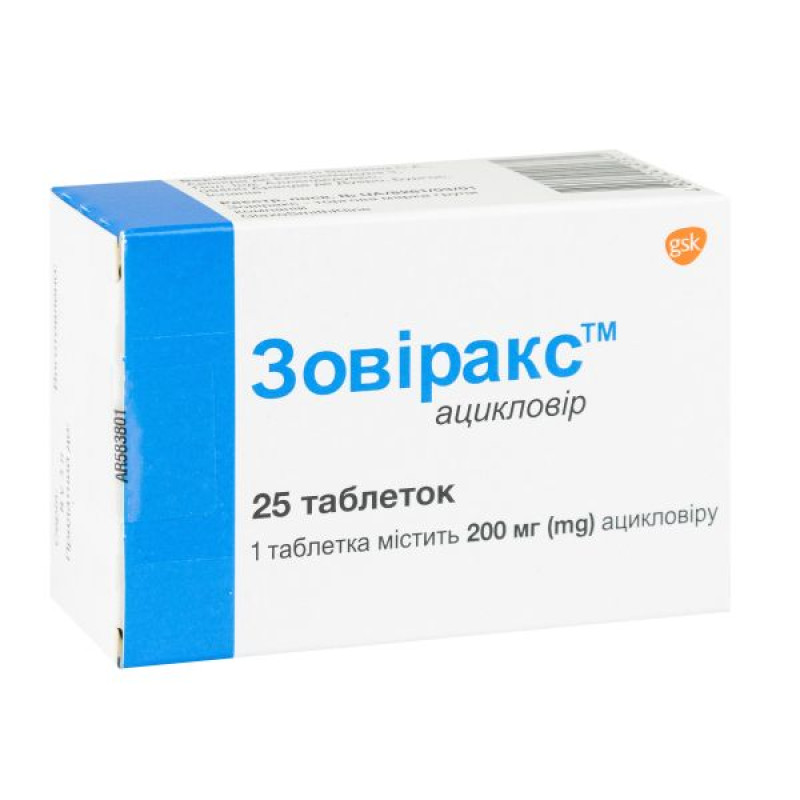
Instructions Zovirax tablets 200 mg blister No. 25
Composition
active ingredient: acyclovir,
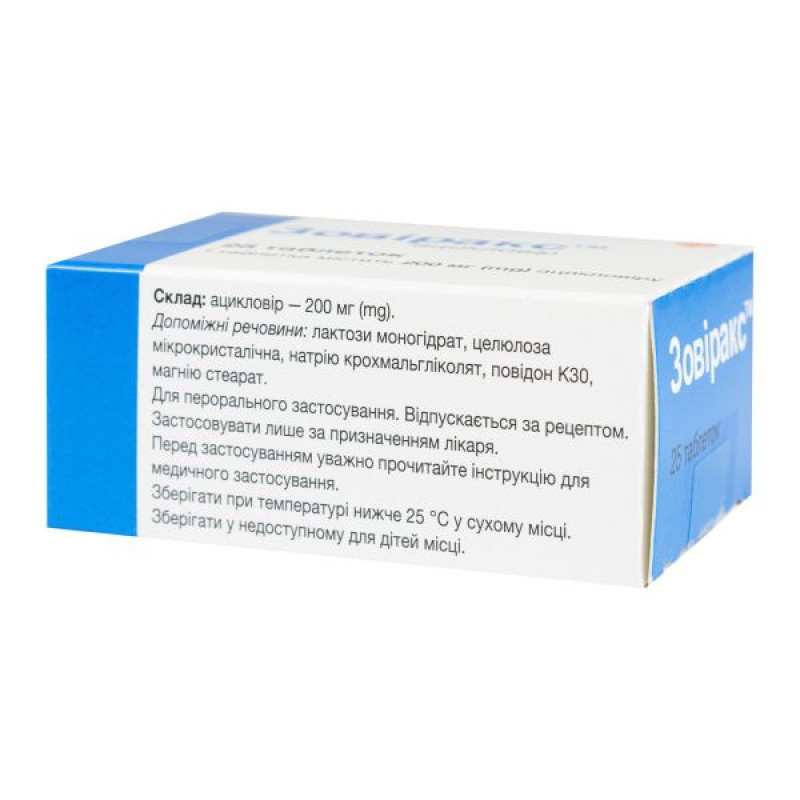
1 tablet contains acyclovir 200 mg;
excipients: lactose monohydrate, microcrystalline cellulose, sodium starch glycolate, povidone K 30, magnesium stearate.
Dosage form
Pills.
Main physicochemical properties: white, round, biconvex tablets with the inscription GXCL3 on one side.
Pharmacotherapeutic group
Antiviral agents for systemic use.
ATX code J05A B01.
Pharmacological properties
Pharmacodynamics.
Acyclovir is a synthetic purine nucleoside analogue with in vivo and in vitro inhibitory activity against human herpesviruses, including herpes simplex virus types I and II, varicella-zoster virus, Epstein-Barr virus, and cytomegalovirus. In cell culture, acyclovir exhibits the greatest activity against herpes simplex virus type I and then, in decreasing order of activity, against herpes simplex virus type II, varicella-zoster virus, Epstein-Barr virus, and cytomegalovirus.
The inhibitory activity of acyclovir against the above viruses is highly selective. The enzyme thymidine kinase in a normal uninfected cell does not use acyclovir as a substrate, so the toxic effect on host cells is minimal. However, thymidine kinase, encoded by herpes simplex viruses, varicella viruses, herpes zoster viruses and Epstein-Barr viruses, converts acyclovir to acyclovir monophosphate - a nucleoside analogue, which is then converted sequentially to diphosphate and triphosphate by cellular enzymes. Following incorporation into viral DNA, acyclovir triphosphate interacts with viral DNA polymerase, resulting in the termination of viral DNA chain synthesis.
With prolonged or repeated courses of treatment of severely immunocompromised patients, a decrease in the sensitivity of individual strains of the virus is possible, which do not always respond to treatment with acyclovir. Most clinical cases of insensitivity are associated with a deficiency of viral thymidine kinase, but there are reports of damage to viral thymidine kinase and DNA. In vitro interaction of individual herpes simplex viruses with acyclovir can also lead to the formation of less sensitive strains. The relationship between the sensitivity of individual herpes simplex viruses in vitro and the clinical results of treatment with acyclovir is not fully understood.
Pharmacokinetics.
Acyclovir is only partially absorbed from the gut. The mean peak steady-state plasma concentration (Cssmax) after a 200 mg dose administered 4 hours apart is 3.1 μmol (0.7 μg/ml) and the plasma level (Cssmin) is 1.8 μmol (0.4 μg/ml). The corresponding Cssmax levels after 400 mg and 800 mg doses administered 4 hours apart are 5.3 μmol (1.2 μg/ml) and 8 μmol (1.8 μg/ml) and the equivalent Cssmin levels are 2.7 μmol (0.6 μg/ml) and 4 μmol (0.9 μg/ml).
In adults, the terminal half-life of intravenous acyclovir is approximately 2.9 hours. The majority of the drug is excreted unchanged by the kidneys. Renal clearance of acyclovir is significantly higher than creatinine clearance, indicating that renal elimination of the drug is by both glomerular filtration and tubular secretion.
9-Carboxymethoxymethylguanine is the only major metabolite of acyclovir that can be detected in the urine and accounts for approximately 10-15% of the administered dose. When acyclovir is administered one hour after 1 g of probenecid, the terminal half-life and area under the concentration-time curve increase by 18% and 40%, respectively.
In patients with chronic renal failure, the mean terminal half-life is 19.5 hours. The mean half-life of acyclovir during hemodialysis is 5.7 hours. The plasma level of acyclovir during dialysis is reduced by approximately 60%.
The concentration of the drug in the cerebrospinal fluid is approximately 50% of the corresponding concentration in plasma. The level of binding to plasma proteins is relatively low (from 9 to 33%) and does not change when interacting with other drugs.
When acyclovir and zidovudine were used simultaneously for the treatment of HIV-infected patients, no changes in the pharmacokinetics of these drugs were detected.
Indication
Treatment of viral infections of the skin and mucous membranes caused by the herpes simplex virus, including primary and recurrent genital herpes.
Suppression (prevention of recurrence) of infections caused by the herpes simplex virus in patients with normal immunity.
Prevention of infections caused by the herpes simplex virus in immunocompromised patients.
Treatment of infections caused by the Varicella zoster virus (chickenpox and shingles).
Contraindication
Hypersensitivity to acyclovir, valacyclovir or other components of the drug.
Interaction with other medicinal products and other types of interactions
Acyclovir is excreted mainly unchanged by the kidneys by tubular secretion, so any drugs that have a similar mechanism of excretion can increase the concentration of acyclovir in plasma. Probenecid and cimetidine prolong the half-life of acyclovir and increase the area under the concentration/time curve. With simultaneous use of acyclovir with an immunosuppressant used in the treatment of patients after organ transplantation - mycophenolate mofetil - the level of acyclovir and the inactive metabolite mycophenolate mofetil in the blood plasma also increases, but given the wide therapeutic index of acyclovir, dose adjustment is not required.
An experimental study in five men indicated that concomitant acyclovir therapy increased the AUC of total theophylline by approximately 50%. It is recommended that plasma concentrations be measured during concomitant acyclovir therapy.
Application features
Patients with renal insufficiency and elderly patients
Acyclovir is eliminated primarily by renal clearance, so the dose should be reduced in patients with renal insufficiency (see Dosage and Administration). Elderly patients are also more likely to have impaired renal function, so a dose reduction may also be necessary in this patient group. Both groups (patients with renal insufficiency and elderly patients) are at risk for neurological adverse reactions and should therefore be closely monitored for these adverse reactions. These reactions have been reported to be generally reversible upon discontinuation of treatment (see Adverse Reactions). Prolonged or repeated courses of acyclovir treatment in severely immunocompromised individuals may result in the isolation of virus strains with reduced susceptibility that may not respond to prolonged acyclovir treatment.
Special attention should be paid to maintaining adequate hydration in patients receiving high doses of acyclovir.
The risk of kidney damage increases with concomitant use with other nephrotoxic drugs.
Available clinical trial data are insufficient to conclude that acyclovir treatment reduces the incidence of complications associated with varicella in immunocompetent patients.
Use during pregnancy or breastfeeding
There is no information on the effect of acyclovir on female fertility. In a study of 20 male patients with normal sperm counts, oral administration of up to 1 g daily for six months did not show any clinically significant effects on sperm count, motility, or morphology.
The post-marketing surveillance registry has documented the results of the use of various pharmaceutical forms of Zovirax in pregnant women. No increase in the number of birth defects was found in children whose mothers used Zovirax during pregnancy, compared with the general population. However, Zovirax tablets should be used only when the potential benefit to the pregnant woman outweighs the potential risk to the fetus.
When 200 mg of acyclovir is administered orally 5 times a day, acyclovir is detected in breast milk at concentrations that are 0.6-4.1 times the plasma acyclovir level. Potentially, a child fed this milk can absorb acyclovir at a dose of up to 0.3 mg/kg body weight per day. Therefore, acyclovir should be prescribed to breastfeeding women with caution, taking into account the risk/benefit ratio.
The ability to influence the reaction speed when driving or working with other mechanisms
When deciding whether to drive or operate machinery, the patient's clinical status and the side-effect profile of the drug should be taken into account. Clinical studies of the effect of acyclovir on the speed of reaction when driving or operating machinery have not been conducted. In addition, the pharmacology of acyclovir does not give reason to expect any negative effects.
Method of administration and doses
The tablet should be taken whole with water. When using high doses of acyclovir, adequate hydration should be maintained.
Adults
Treatment of infections caused by the herpes simplex virus
For the treatment of infections caused by the herpes simplex virus, Zovirax tablets should be taken at a dose of 200 mg 5 times a day at approximately 4-hour intervals, except at night.
Treatment should last 5 days, but in case of severe primary infection it may be extended.
For patients with severe immunodeficiency (e.g. after bone marrow transplantation) or for patients with reduced intestinal absorption, the dose can be doubled to 400 mg or an appropriate dose for intravenous administration can be used.
Treatment should be started as early as possible after the onset of infection. In the case of recurrent herpes, it is best to start treatment in the prodromal period or after the first signs of skin lesions appear.
Prevention of recurrence (suppressive therapy) of infections caused by the herpes simplex virus
For convenience, most patients can take 400 mg of Zovirax 2 times a day, approximately 12 hours apart.
Treatment will be effective even after reducing the dose of Zovirax tablets to 200 mg, taken 3 times a day with an 8-hour interval or even 2 times a day with an 12-hour interval.
Some patients experience radical improvement after taking a total daily dose of Zovirax 800 mg.
To monitor possible changes in the natural course of the disease, Zovirax therapy should be interrupted periodically at intervals of 6-12 months.
Prevention of infections caused by the herpes simplex virus
For the prevention of infections caused by the herpes simplex virus, patients with immunodeficiency should take Zovirax tablets at a dose of 200 mg 4 times a day with an interval of approximately 6 hours. For patients with significant immunodeficiency (for example, after bone marrow transplantation) or for patients with reduced intestinal absorption, the dose can be doubled to 400 mg or an appropriate dose for intravenous administration can be used.
The duration of prophylaxis depends on the duration of the risk period.
Treatment of chickenpox and herpes zoster
For the treatment of infections caused by the varicella zoster virus and herpes zoster, Zovirax tablets should be taken at a dose of 800 mg 5 times a day at approximately 4-hour intervals, excluding the night period. Treatment should last 7 days.
For patients with severe immunodeficiency (e.g., after bone marrow transplantation) or patients with reduced intestinal absorption, intravenous administration is preferable.
Treatment should be started as early as possible after the onset of the disease; the result will be better if treatment is started immediately after the appearance of the rash.
Children
For the treatment of infections caused by the herpes simplex virus and the prevention of infections caused by the herpes simplex virus in immunocompromised children from 2 years of age, adult doses can be used. For the treatment of chickenpox in children from 6 years of age, 800 mg of Zovirax is prescribed 4 times a day, children from 2 to 6 years of age can receive 400 mg of Zovirax 4 times a day. The duration of treatment is 5 days.
More precisely, a single dose of the drug can be calculated based on the child's body weight as 20 mg/kg of body weight (not to exceed 800 mg) of Zovirax 4 times a day.
There are no specific data on the use of Zovirax for the prophylaxis (prevention of recurrence) of infections caused by the herpes simplex virus or for the treatment of infections caused by the herpes zoster virus in children with normal immunity.
Zovirax, lyophilisate for solution for infusion, is used to treat infections caused by herpes viruses in newborns and children under 3 months of age.
Elderly patients
The possibility of impaired renal function in elderly patients should be borne in mind, and the dose of the drug should be adjusted accordingly (see Renal Failure). Adequate hydration should be maintained in elderly patients receiving high doses of Zovirax.
Kidney failure
Zovirax should be administered with caution to patients with renal insufficiency. Adequate hydration should be maintained.
In the prevention and treatment of infections caused by the herpes simplex virus, in patients with renal insufficiency, the recommended oral doses do not lead to accumulation of acyclovir, the level of which would exceed the safe level established for intravenous administration. However, for patients with severe renal insufficiency (creatinine clearance less than 10 ml / min), it is recommended to establish a dose of 200 mg 2 times a day with an interval of approximately 12 hours.
In the treatment of infections caused by the Varicella zoster virus (chickenpox and herpes zoster), for patients with significantly reduced immunity, it is recommended that in severe renal failure (creatinine clearance less than 10 ml/min) a dose of 800 mg be established 2 times a day with an interval of approximately 12 hours, and for patients with moderate renal failure (creatinine clearance within 10-25 ml/min) - 800 mg 3 times a day with an interval of approximately 8 hours.
Children
Zovirax tablets are used in children aged 2 years and older.
Overdose
Symptoms.
Acyclovir is only partially absorbed from the gastrointestinal tract. There have been cases of accidental ingestion of up to 20 g of acyclovir by patients without toxic effects. Accidental repeated overdose of oral acyclovir over several days has resulted in gastroenterological (such as nausea and vomiting) and neurological symptoms (headache and confusion).
Overdose of intravenous acyclovir increases serum creatinine and blood urea nitrogen levels, and renal failure occurs. Neurological manifestations of overdose may include confusion, hallucinations, agitation, convulsions, and coma.
Treatment
The patient should be carefully observed for signs of intoxication. Since acyclovir levels in the blood are well eliminated by hemodialysis, the latter should be used in case of overdose.
Side effects
Blood and lymphatic system
Very rare: anemia, thrombocytopenia, leukopenia.
Immune system
Rare: anaphylaxis.
Mental and nervous system disorders
Common: headache, dizziness.
Very rare: agitation, confusion, tremor, ataxia, dysarthria, hallucinations, psychotic symptoms, convulsions, drowsiness, encephalopathy, coma.
The above neurological reactions are generally reversible and usually occur in patients with renal insufficiency or other risk factors (see section "Special warnings and precautions for use").
Respiratory system and chest organs
Rare: shortness of breath.
Gastroenterological system
Common: nausea, vomiting, diarrhea, abdominal pain.
Hepatobiliary system
Rare: reversible increases in bilirubin and liver enzymes.
Very rare: jaundice, hepatitis.
Skin and subcutaneous tissue
Common: itching, rash (including photosensitivity).
Uncommon: urticaria, accelerated diffuse hair loss. Since hair loss can be associated with a large number of diseases and medications, no clear association with acyclovir has been identified.
Rare: angioedema.
Kidneys and urinary system
Rare: increased blood urea and creatinine levels.
Very rare: acute renal failure, kidney pain.
Kidney pain may be associated with renal failure and crystalluria.
General disorders
Common: fatigue, fever.
Expiration date
5 years.
Storage conditions
Keep out of reach of children. Store below 25°C in a dry place.
Packaging
5 tablets in a blister of polyvinyl chloride, polyvinylidene chloride, paper and aluminum with child-resistant closure; 5 blisters in a cardboard box.
Vacation category
According to the recipe.
Producer
Glaxo Wellcome SA (Spain).
Address
Glaxo Wellcome SA, Avda. de Extremadura, 3, Pol. Ind. Allendeduero, 09400 Aranda de Duero, Burgos, Spain/ Glaxo Wellcome SA, Avda. de Extremadura, 3, Pol. Ind. Allendeduero, 09400 Aranda de Duero, Burgos, Spain.